Beyond the Coding Assistant — A New Series
This free series examines AI-assisted software engineering at enterprise scale. While individual coding speed has skyrocketed, many teams have not seen delivery improve—some have even slowed down. The author argues that current AI coding assistants optimize a single role, but software is shipped by teams with many non-coding roles. The next frontier is lifecycle orchestration, not better code generation. The series is structured in four parts, publishing three times a week with no paywall. It is aimed at engineering leaders, architects, and developers interested in AI engineering.
This is the first article of Beyond the Coding Assistant, a multi-part series on AI-assisted software engineering at enterprise scale. The full series is available free of any paywall at https://articles.zimetic.com. Coming next: Article 1 — Your AI Coding Assistant Is Not Enough.
本文是《超越编码助手》系列的第一篇,该系列深入探讨企业级 AI 辅助软件工程。全系列可在 https://articles.zimetic.com 免费阅读,无付费墙。下一篇预告:《你的 AI 编码助手还不够》。
The last few years of AI-assisted development have been remarkable. Coding assistants have crossed real quality bars. Engineers can now produce working code, in unfamiliar languages, against unfamiliar systems, at speeds that would have looked like science fiction in 2022. There are real productivity gains, real new affordances, and a real shift in what an individual developer can do in an afternoon.
And yet — when the conversation turns to the team and the organization — the picture is more complicated. The dramatic gains many leaders were promised haven't shown up on every team. Some teams ship more. Some teams ship the same. Some teams have actually gotten slower, with the AI helping at the keystroke while the wider delivery metrics regress.
That gap, between what's possible at the keystroke and what's actually showing up in delivery, is what this series is about. The question I want to ask, and try to answer over the next several articles, is simple: what has changed, and what changes could take us so much farther than where current AI coding assistants have brought us?
过去几年,AI 辅助开发取得了惊人进展。编码助手已跨越真实的质量门槛。工程师现在能够针对不熟悉的系统和语言生成可工作的代码,速度之快在 2022 年看来如同科幻。个体开发者确实获得了生产力提升、新的能力和实实在在的改变。
然而,当话题转向团队和组织时,情况就复杂了。许多领导者被承诺的巨大收益并未在每个团队显现。有些团队交付更多,有些团队交付不变,还有些团队实际上变得更慢——AI 在敲键层面提供帮助,但更广泛的交付指标却在倒退。
敲键层面可实现的效果与实际交付之间的差距,正是本系列要探讨的。我希望在接下来几篇文章中提出并尝试回答的问题是:什么已经改变,以及什么改变能带我们超越当前 AI 编码助手所达到的高度?
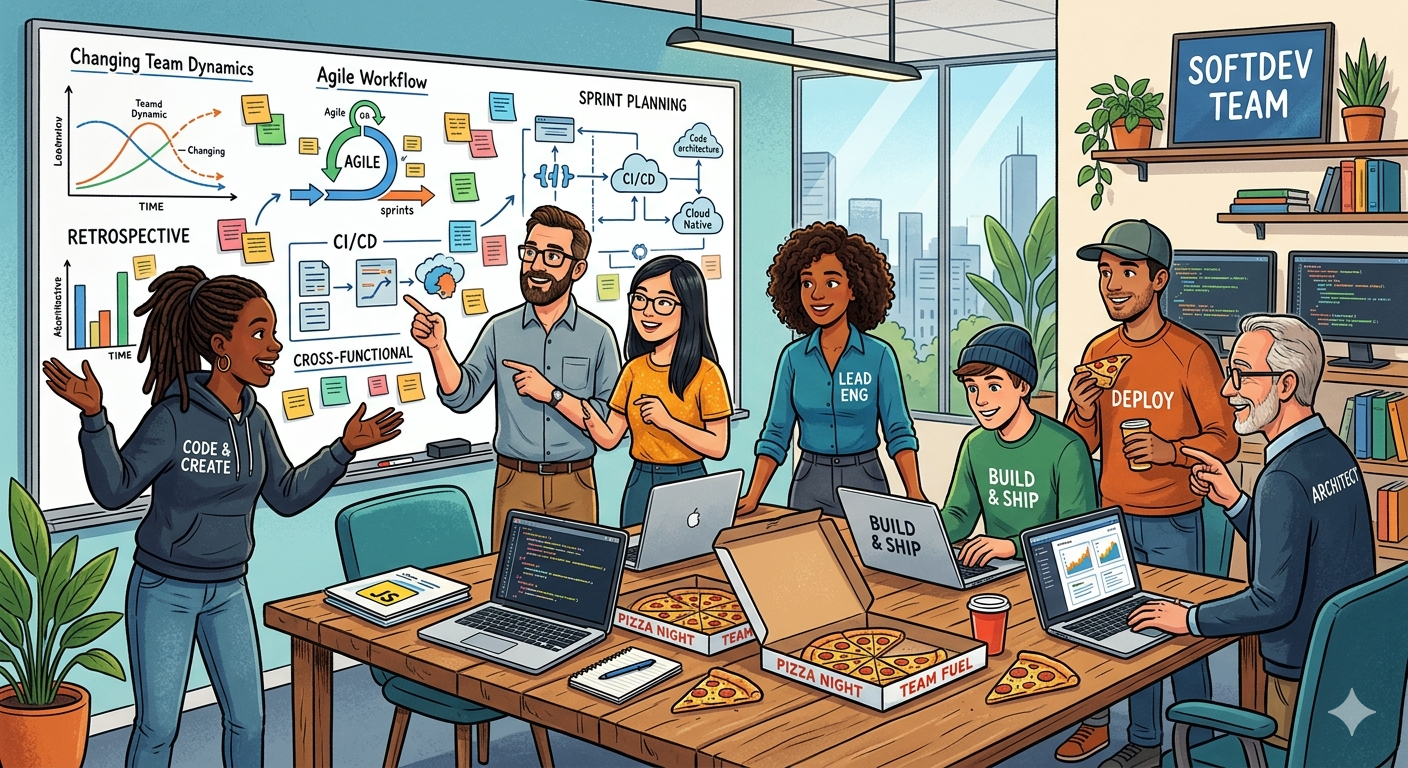
It would be easy to frame this series as a critique of current tools. That would also be wrong. The current generation of coding assistants is genuinely excellent at what it does. The problem isn't that the tools are bad. The problem is that the tools are designed for a single role on a much larger team, doing a small part of a very large multi-step process.
将本系列定调为对当前工具的批评很容易,但这并不正确。当前一代编码助手在其本职工作上确实表现出色。问题不在于工具本身不好,而在于它们是为庞大团队中的单一角色设计的,只处理了大型多步骤流程中的一小部分。
Software is shipped by teams — developers and product managers, designers, QA engineers, technical writers, program managers, security reviewers, compliance reviewers, devops, and more! Most of those people either don't write any code, or don't spend most of their time writing code. If the goal is team throughput rather than individual keystroke speed, optimizing one role's tooling is only going to get you so far. Instead, this series is looking at how we build tools and restructure the team and its workflows for the dynamics that are here today and will be here in the near future.
软件是由团队交付的——开发者、产品经理、设计师、QA 工程师、技术文档工程师、项目经理、安全审查员、合规审查员、DevOps 等等!这些人中大多数要么根本不写代码,要么不把大部分时间花在编码上。如果目标是团队吞吐量而非个体敲键速度,那么只优化单一角色的工具收效甚微。相反,本系列探讨如何构建工具并重组团队及其工作流,以适应今天和不久的将来的动态。
There's also a structural part of the story that's only now becoming visible. Token economics are shifting. The "burn-through-it" approach that worked when tokens were essentially free is getting expensive. The teams that have built disciplined development practices around AI tools are pulling away from the teams that haven't. None of this is anyone's fault, exactly. It's the natural moment in a maturing technology when the next set of questions starts to bite.
还有一个结构性问题正逐渐显现:Token 经济学正在改变。在 Token 几乎免费时行得通的“挥霍式”方法正变得昂贵。围绕 AI 工具建立了规范化开发实践的团队,正在拉开与那些没有做到的团队的差距。这并非任何人的错,确切地说,这是技术成熟过程中的自然时刻,下一轮问题开始变得尖锐。
Where the series goes
I'll work through this in four parts.
Part I — The Shifting Landscape. Why now. The crafting of code is the visible tip of the iceberg, and I'd like to address it and the rest of the iceberg — much of which isn't touched by current AI tools. Recent studies have shown that many teams are actually getting slower with AI, so we will talk about that and why it's happening. And of course the economic changes that are forcing the question of how to make this work economically. And finally, the quality-speed-cost trilemma that frames everything after.
Part II — Reframing the Problem. If the team is getting slower with our current SDLC and processes, are they the right processes for the team going forward? One of the key aspects of the Agile Manifesto was that we continue to improve our processes. So, we owe it to ourselves to evaluate whether the processes we built for a much longer coding step are still the right processes today. Let's also bring into view better ways to use our coding agents as we start to consider having them take on more and more of the SDLC. One of these changes is the true implementation of multi-pass workflows. We will also discuss why different kinds of work need different workflow shapes, and the benefits of specialized agents instead of generic workers. And then we will discuss how organizations may want to manage compute and AI resources in pools that engineers can utilize in a much more economical and controlled manner.
Part III — Design Principles. The coming economic changes are going to make cost a first-class constraint. They are also going to require us to manage the project's context in different ways than we have had to in the past, so that we can get optimal performance and cost effectiveness out of our agents. Managing our shared resources gets more complicated as we start to have pools of agents updating things in parallel. And of course, we need to make sure we are doing all of this in ways where the engineers are not being overburdened, and the entire team gets to come along in a meaningful way.
Part IV — The Road Ahead. I will share some of what I'm building and why I think it will move us forward. But let me reassure you: this series is not a sales pitch for that tool. It is more my way of sharing my thoughts on the state of the industry as we make this monumental transition, and what I think is happening. Feel free to skip Part IV if you are not interested in my tool, but please don't skip the discussion about how our industry is changing.
系列将分四部分展开。
第一部分——变化的地貌。为什么是现在。编码只是冰山一角,我想探讨冰山的水上和水下部分,其中大部分当前 AI 工具尚未触及。近期研究显示,许多团队使用 AI 后反而变慢了,我们将讨论这一现象及其原因。当然还有经济变化迫使我们必须重视成本效益。最后是质量-速度-成本的三难困境,它贯穿后续所有内容。
第二部分——重构问题。如果我们当前的软件开发生命周期(SDLC)和流程让团队变慢,那么它们是否还适合未来的团队?敏捷宣言的关键原则之一是持续改进流程。因此,我们有责任评估当初为长编码步骤设计的流程是否依然合适。我们还将探索如何更有效地使用编码代理,让它们承担更多 SDLC 任务,包括真正实现多轮次工作流。此外,讨论不同类型工作需要不同工作流形态,以及专用代理相比通用工作者的优势。最后,探讨组织如何以更经济且可控的方式管理计算和 AI 资源池,供工程师使用。
第三部分——设计原则。未来的经济变化将使成本成为一等约束。我们还需要以不同于以往的方式管理项目上下文,以便从代理中获得最佳性能和成本效益。随着代理池并行更新事物,共享资源的管理变得更加复杂。当然,我们必须确保这一切不会让工程师负担过重,整个团队都能有意义地共同前进。
第四部分——未来之路。我将分享我正在构建的工具及我认为它能推动进步的原因。但请放心:本系列并非该工具的推销。这更多是我在行业经历这场重大转型时分享的思考和观察。如果对我的工具不感兴趣,可以跳过第四部分,但请不要错过关于行业如何变革的讨论。
Each piece stands alone. Read in order, they build a cumulative argument: the next frontier of AI-assisted development is lifecycle orchestration, not better code generation — and it has to serve the whole team, not just the engineer.
每篇文章均可独立阅读。按顺序阅读,它们将构建一个累积的论点:AI 辅助开发的下一个前沿是生命周期编排,而非更好的代码生成——并且它必须服务于整个团队,而不仅仅是工程师。
A note on tone, and an invitation
These are my thoughts, based on what I'm seeing and hearing across the industry. They're claims, not conclusions. I have opinions and I'm going to defend them, but the whole point of publishing in public is to sharpen the ideas against readers who disagree. Your feedback is welcome, and desired.
I'm also building a tool that applies these ideas. I'll describe it in Part IV, and I'll keep references to it brief in the meantime. The series is about the ideas first; the tool is one way to test them. My goal is to get you thinking about these ideas, these changes and get a dialog going so we can all learn and grow in a meaningful way.
关于语气及邀请
这些是我基于在行业中的所见所闻而形成的思考。它们是主张,而非定论。我有自己的观点并会为之辩护,但公开发布的全部意义在于通过与持不同意见的读者碰撞来打磨这些想法。你的反馈是受欢迎的,也是我所期待的。
同时,我正在构建一个应用这些想法的工具。我将在第四部分中介绍它,在此之前会尽量少提。本系列以思想为先;工具只是检验思想的一种方式。我的目的是让你思考这些想法、这些变化,并开启对话,以便我们都能有意义地学习和成长。
How to follow along
I will be publishing three articles a week (Monday, Wednesday, and Friday), with the goal of having the entire series published in four weeks from start to finish. Feel free to drop by on a regular basis, or to sign up for notifications when articles are published. A hosted landing page at https://beyond-the-coding-assistant.ghost.io/ lists all of the articles in this series, including the expected publication dates of the upcoming pieces. That's the home for the free, paywall-free reading copy of the series. Bookmark it if you want to follow along; subscribe if your platform of choice supports it.
如何关注
我将每周发布三篇文章(周一、周三和周五),目标是在四周内完成整个系列的发布。欢迎定期来访,或注册接收文章发布通知。你可以在 https://beyond-the-coding-assistant.ghost.io/ 找到本系列所有文章列表及预期发布日期。这是本系列的免费阅读大本营,无付费墙。如果想跟进,请收藏该页面;如果所用平台支持,也欢迎订阅。
Coming next: Your AI Coding Assistant Is Not Enough. The iceberg of non-coding work, why current tools concentrate almost all their value on a fraction of the engineering job, and why "make the developer faster" is a local optimum that's already running out of room.
If you've read this far, thank you. Please join us for the ride.
下一篇预告:《你的 AI 编码助手还不够》。非编码工作的冰山,为何当前工具几乎将所有价值集中在工程工作的一小部分,以及为何“让开发者更快”只是一个局部最优解,且已接近极限。
读到这里,感谢你。请与我们同行。