How Anthropic runs large-scale code migrations with Claude Code
Anthropic engineers used Claude Code (Fable 5 and Opus 4.8) to migrate Bun from Zig to Rust in two weeks, producing one million lines of code with 100% test pass rate; another engineer ported a Python codebase to 165,000 lines of TypeScript over a weekend. The article details a six-step migration process: create rulebook and dependency map, stress-test rules, translate everything (parallel), compile, run, and match behavior. The core insight is to fix the loop that produces code, not the code itself. It discusses when migrations are justified, why AI changes the economics (parallelism, clear context, built-in referee, self-generating queue), and best practices (use smaller models for implementation, largest for review). Concrete token and cost data are provided: Bun migration consumed ~5.9B uncached input tokens and 690M output tokens, costing ~$165k at API pricing.
How Anthropic runs large-scale code migrations with Claude Code
By @ClaudeDevs · 2026-07-21T19:47:07.000Z
Code migrations, projects that port a production codebase to a new language, were multi-year endeavors until recently.
In the last month, individual developers at Anthropic migrated 10 code packages consisting of tens to hundreds of thousands of lines of code using Claude Fable 5, Claude Opus 4.8, and dynamic workflows.
Anthropic 如何用 Claude Code 运行大规模代码迁移
作者:@ClaudeDevs · 2026-07-21T19:47:07.000Z
代码迁移——将生产代码库移植到新语言的项目——直到最近还是耗时数年的工程。
过去的一个月里,Anthropic 的个人开发者使用 Claude Fable 5、Claude Opus 4.8 和动态工作流,迁移了 10 个代码包,每个包含数万到数十万行代码。
Jarred Sumner (@jarredsumner), co-founder of Bun and Member of Technical Staff at Anthropic, used Claude Code to migrate Bun from Zig to Rust. A million lines of code were produced in less than two weeks, with 100% of Bun's existing test suite passing in CI before merge. Nineteen regressions surfaced after merge and have all been fixed. The Rust port was shipped inside Claude Code in June.
Jarred Sumner(@jarredsumner),Bun 的联合创始人兼 Anthropic 技术员工,使用 Claude Code 将 Bun 从 Zig 迁移到 Rust。不到两周内产生了 100 万行代码,合并前 CI 中 Bun 现有测试套件全部通过。合并后出现了 19 个回归,现已全部修复。Rust 移植版已于六月在 Claude Code 内部发布。
Mike Krieger (@mikeyk), co-lead of Anthropic Labs, migrated a Python codebase to 165,000 lines of TypeScript over a weekend. This included hundreds of agents, eight phase gates, three adversarial review rounds, and a final parity check that diffed every command's output against the Python original.
Anthropic Labs 联合负责人 Mike Krieger(@mikeyk)在一个周末内将 Python 代码库迁移到 16.5 万行 TypeScript。这涉及数百个智能体、八个阶段关卡、三轮对抗性审查,以及最终的一致性检查,逐条对比每个命令的输出与 Python 原始版本。
Claude Code's new capabilities change the math for these long-deferred projects. Below is the six-step process we now use, drawn from what these migrations taught us.
The core insight is that you don't fix the code. You fix the process (loop) that produced the code.
Claude Code 的新能力改变了这些长期拖延项目的计算逻辑。下面是我们现在使用的六步流程,从这些迁移中学到的经验。
核心洞见是:你不需要修复代码。你需要修复产生代码的流程(循环)。
Why and when to migrate languages
Teams launch migrations because of landscape changes between their initial build and current project. Either a known trade-off has become limiting, a better approach has emerged, or the original ecosystem is shrinking.
For example, Jarred originally chose Zig because it offered C-level performance with radical simplicity, ideal for a solo founder "writing Bun in 1 year in a cramped Oakland apartment pre-LLM." This simplicity came with known tradeoffs, which he writes about here.
Bun's CLI is getting over 10 million monthly downloads and is used extensively within Claude Code.
As recently as last quarter, those tradeoffs wouldn't have been enough to justify freezing the roadmap and committing resources to a multi-quarter project. You could maintain two parallel code bases for quarters or years, and if the end result was 90% parity, you had a bigger headache than when you started.
Now, the worst case scenario is you delete the branch and try again.
There still needs to be a justifiable business case. While million line migrations no longer cost $3 to $4 million in engineering resources over the course of a four year project, they still cost tens to hundreds of thousands of dollars or more to execute. The Bun migration, for example, consumed 5.9 billion uncached input tokens and 690 million output tokens — around $165,000 at API pricing. The main portion of Mike's port was 27 million tokens.
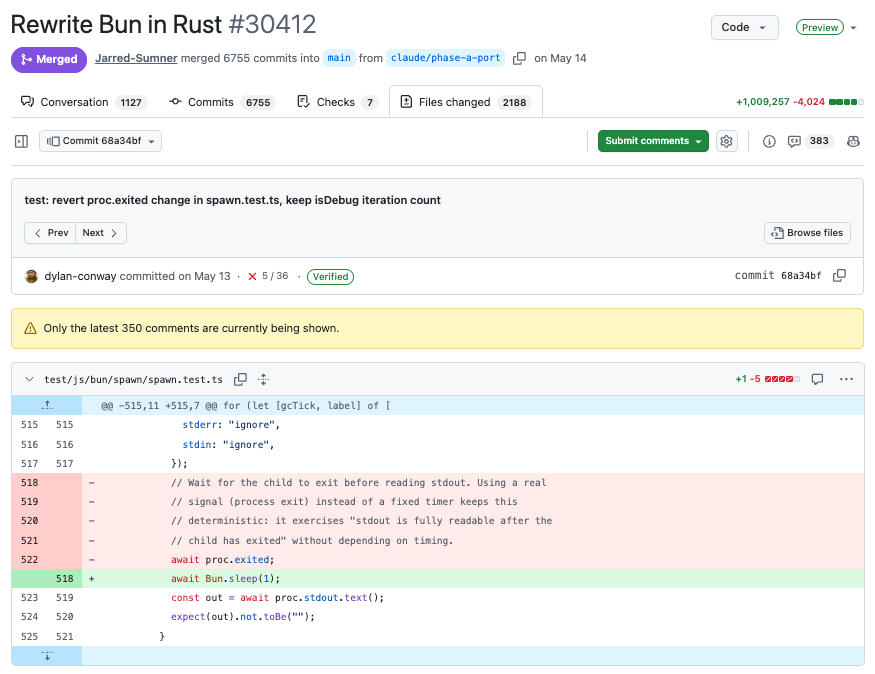
However, the migration case no longer needs to be existential. A year of memory-bug patches in the changelog, or one chronic bottleneck, can now justify it.
The compile step was the impetus for Mike's project. The internal tool his team works on ships to users as a single binary. Producing that binary with the Python toolchain took roughly eight minutes per platform, totaling a 30-minute wait across the build matrix on every release. After the port, the same compile now takes about two seconds, the binary starts 6x faster, and the team was able to retire a separate deployment pipeline.
为什么以及何时迁移语言
团队发起迁移是因为初始构建与当前项目之间的环境变化。要么是已知的折衷方案变得受限,要么是出现了更好的方法,要么是原始生态系统正在萎缩。
例如,Jarred 最初选择 Zig 是因为它提供了 C 级别的性能且极其简洁,非常适合一位独立创始人“在 LLM 时代之前,在奥克兰狭窄的公寓里一年内写出 Bun”。这种简洁性伴随着已知的权衡,他在这里写过。
Bun 的 CLI 每月下载量超过 1000 万次,并在 Claude Code 内部广泛使用。
就在上一季度,这些权衡还不足以证明冻结路线图并将资源投入一个跨季度项目的合理性。你可以维护两个并行代码库长达几个季度或几年,如果最终结果只有 90% 的一致性,那么你会比开始时更头疼。
现在,最坏的情况就是删除分支再试一次。
仍然需要有合理的商业理由。虽然百万行迁移不再需要在四年的项目周期内耗费 300 到 400 万美元的工程资源,但执行成本仍然需要数万到数十万美元甚至更多。例如,Bun 迁移消耗了 59 亿未缓存输入 token 和 6.9 亿输出 token——按 API 定价约 16.5 万美元。Mike 移植的主体部分消耗了 2700 万 token。
然而,迁移的理由不再需要是生死攸关的。变更日志中一年的内存错误补丁,或一个长期存在的瓶颈,现在就可以成为理由。
编译步骤是 Mike 项目的动力。他的团队负责的内部工具以单个二进制文件的形式交付给用户。使用 Python 工具链生成该二进制文件每个平台大约需要八分钟,每次发布在整个构建矩阵上总计需要等待 30 分钟。移植后,相同的编译现在只需大约两秒,二进制文件启动速度快了 6 倍,团队还因此淘汰了一个单独的部署流水线。
Why AI changes the code migration math
Fable and Opus 4.8 are particularly good at delegating, directing, and verifying parallel workstreams with subagents while finding multiple paths towards stated goals.
Large code migrations are a particularly effective use case for these advanced models because:
- The work is parallel. Work can be executed across thousands of independent units such as files and crates, so agents can work at the same time rather than have one waiting on the other.
- Context is clear and comprehensive. The old code serves as a great spec for the model.
- There is a built-in referee. Many large codebases will include a test suite that agents can use to verify their work.
- The queue writes itself. When a compiler or test run fails, that becomes the next item for an agent to fix.
- They require consistency and edge case handling: reviewers cite the rule behind every finding, so a violation becomes a queue item instead of a quiet divergence.
AI 为何改变代码迁移的计算
Fable 和 Opus 4.8 特别擅长通过子智能体委托、指导和验证并行工作流,同时寻找达成目标的多种路径。
大型代码迁移是这些高级模型特别有效的使用场景,因为:
- 工作可并行。工作可以在数千个独立单元(如文件和 crate)上执行,因此智能体可以同时工作,而不是一个等待另一个。
- 上下文清晰且全面。旧代码为模型提供了极好的规范。
- 有内置裁判。许多大型代码库包含测试套件,智能体可用其验证工作。
- 队列自动生成。当编译器或测试运行失败时,这就会成为智能体下一个要修复的项目。
- 它们需要一致性和边缘情况处理:审查者引用每个发现背后的规则,因此违反规则会成为队列项,而不是静默偏离。
Six steps for large code migrations
For additional details, you can read Jarred's blog.
Prerequisites
A prerequisite before starting on your migration project is to have a strong judge in place, otherwise you won't have an exit condition or measure of success.
To build this judge:
- Categorize existing tests. Use Claude to identify which tests are expressible as external calls and which depend on internals that won't port.
- Rewrite for portability. Convert the external-facing tests into assertions that can run against both the original and the port. Use adversarial agents to verify the rewritten tests don't weaken the assertions.
- Validate the judge. Run it against the original code to confirm it passes. Then run it against deliberately broken code to confirm it fails — a judge that doesn't catch breakage isn't a judge. This mostly follows Jarred's methodology, with reviews and gates at each stage. Mike followed a similar overall structure using similar loop workflows, but he ran the entire migration end to end, revised the rules and the workflow based on the results, and ran it again — discarding the output each time until the third run.

大型代码迁移的六步法
更多细节可阅读 Jarred 的博客。
先决条件
在开始迁移项目之前,必须具备一个强大的裁判,否则你将没有退出条件或成功衡量标准。
构建裁判的方法:
- 对现有测试进行分类。使用 Claude 识别哪些测试可以表示为外部调用,哪些依赖无法移植的内部实现。
- 为可移植性重写。将面向外部的测试转换为既能在原始代码库上运行也能在移植代码库上运行的断言。使用对抗性智能体验证重写后的测试没有削弱断言。
- 验证裁判。对原始代码运行裁判以确保其通过。然后对故意破坏的代码运行裁判,确认其失败——无法发现破坏的裁判不是好裁判。 这主要遵循 Jarred 的方法,每个阶段都有审查和关卡。Mike 采用了类似的整体结构和相似的循环工作流,但他完整地运行了整个迁移端到端,根据结果修订规则和工作流,然后再次运行——每次丢弃输出,直到第三次运行。
Step 1 — Create the rulebook, dependency map, and gap inventory
The order matters: the rulebook must come before the gap inventory. The gap inventory is defined by what the rulebook's defaults won't cover, and the two are tested together in a joint audit.
Rulebook
The exact shape of the rulebook depends on key architectural decisions you must make at the start. Chief among them, if the new code will follow the same structure, or if it will be completely redesigned.
If it's the former (Jarred), the rulebook will primarily be lookup tables that translates types and idioms between languages while pointing to the gap inventory for the harder-to-translate components. If it's the latter (Mike), it will be a design document.
Jarred created his rulebook by chatting with Claude, forming a policy for each area of ambiguity. He also used eight subagents specifically designed to review for 8 different categories of common failure modes based on his own intuition.
Dependency map
You need to understand file dependencies to effectively break up workstreams for a parallel migration so you know which files to migrate first and which files to contain in the same batch. Claude Code can deploy agents to create and run a deterministic script to produce this map.
Gap inventory and skeptic reviewers
The new language has different requirements from the old language that must be met. For Zig to Rust the difference was manual memory management (C and C++ work the same way). For example:
// Zig

fn readConfig(allocator: std.mem.Allocator) ![]u8 {
    const buf = try allocator.alloc(u8, 1024);
    // ...fill buf...
    return buf; // caller must free this — but only the comment says so
}

// A caller that forgets 'defer allocator.free(buf)' still compiles — the leak only surfaces at runtime.
fn read_config() -> Vec<u8> {
    let buf = vec![0u8; 1024];
    // ...fill buf...
    buf // ownership moves to the caller; memory is freed automatically
}

// Use it after it's moved? Free it twice? Neither compiles.
// Forget to free it? There's no free call to forget — drop is automatic.
For Python to TypeScript the gap was interfaces and contracts. Python doesn't require a contract declaring what shape of object it will accept or what it returns, but TypeScript does.
Both Jarred and Mike created gap inventory files capturing this implicit knowledge. Jarred inventoried these gaps up front, which is what we do here, while Mike chose to translate first and then create the gap inventory by auditing afterwards. You may need to do both.
Check out this sample Claude Code prompt to create a gap inventory file.
第一步——创建规则书、依赖映射和差距清单
顺序很重要:规则书必须先于差距清单。差距清单由规则书默认规则无法覆盖的内容定义,两者会在联合审计中共同测试。
规则书
规则书的具体形态取决于你在开始时必须做出的关键架构决策。其中最主要的是:新代码将遵循相同的结构,还是完全重新设计。
如果是前者(Jarred),规则书将主要是查找表,在语言之间翻译类型和惯用法,同时针对难以翻译的组件指向差距清单。如果是后者(Mike),规则书将是一份设计文档。
Jarred 通过与 Claude 对话创建了规则书,为每个模糊区域制定了策略。他还使用了八个子智能体,专门根据他自己的直觉审查八类常见失败模式。
依赖映射
你需要了解文件依赖关系,以便有效地分解并行迁移的工作流,从而知道哪些文件应该先迁移,哪些文件应该放在同一批次中。Claude Code 可以部署智能体来创建并运行确定性脚本以生成此映射。
差距清单与怀疑型审查者
新语言与旧语言有不同的要求,必须满足这些差异。从 Zig 到 Rust,差异在于手动内存管理(C 和 C++ 也是如此)。例如:
// Zig

fn readConfig(allocator: std.mem.Allocator) ![]u8 {
    const buf = try allocator.alloc(u8, 1024);
    // ...fill buf...
    return buf; // 调用者必须释放此内存——但只有注释这么说
}

// 忘记写 'defer allocator.free(buf)' 的调用者仍然能编译通过——泄漏只在运行时显现。
fn read_config() -> Vec<u8> {
    let buf = vec![0u8; 1024];
    // ...fill buf...
    buf // 所有权移交给调用者;内存自动释放
}

// 在移动后使用它?释放两次?两者都无法编译。
// 忘记释放?没有 free 调用可以忘记——drop 是自动的。
对于 Python 到 TypeScript,差距在于接口和契约。Python 不需要声明它接受或返回什么形状的对象,但 TypeScript 需要。
Jarred 和 Mike 都创建了差距清单文件来捕获这些隐式知识。Jarred 预先清点了这些差距(我们这里采用的方法),而 Mike 选择先翻译,然后通过事后审计创建差距清单。你可能需要两者都做。
查看这个创建差距清单文件的示例 Claude Code 提示词。
Step 2 — Stress-test the rules

In this step, Jarred used one agent to translate three files using the rulebook, one agent to translate three files "like a senior Rust engineer," and one agent to use the diff to create new translation rules. At this stage he caught two critical issues that would have created numerous issues if fanned out across all 1,448 files.
This type of stress test only works for structure-preserving migrations, where two translations of the same file are comparable line by line. If your rulebook is a redesign — like Mike's — the equivalent test is attacking the design document directly with adversarial reviewers, then validating it with a disposable end-to-end run.
Regardless, throw out any translated files. The goal is to refine the rules, not make incremental progress.
第二步——压力测试规则
在这一步中,Jarred 使用一个智能体根据规则书翻译三个文件,另一个智能体“像资深 Rust 工程师一样”翻译三个文件,第三个智能体利用差异来创建新的翻译规则。在这个阶段,他发现了两个关键问题,如果这些问题扩散到全部 1,448 个文件中,将会造成大量麻烦。
这种压力测试只适用于结构保持型迁移,即同一文件的两个翻译版本可以逐行比较。如果你的规则书是重新设计(如 Mike 的情况),那么等效的测试是直接让对抗性审查者攻击设计文档,然后通过一次性的端到端运行来验证。
无论如何,丢弃所有翻译好的文件。目标是完善规则,而不是取得渐进进展。
Step 3 — Translate everything

For the remaining steps, you run the same multi-agent loop architecture: implement, review, and fix.
You can offload implementer work to smaller models and keep reviewers on larger ones. For example, Mike used Claude Sonnet when he fanned out 12 subagents for the main migration.
The work queue should be mechanical. A batch script decides what's done by checking whether the translated file exists on disk, then slices the pending files into batches for the implementer agents. Because the queue is rebuilt from disk every time, the migration is resumable by construction.
Anything the translator can't execute confidently gets flagged with "// TODO(port): <reason>" to be dealt with in step 4.
Two adversarial reviewers evaluate the work of the implementers using separate contexts and disagreement between reviewers goes to a third agent. When a reviewer keeps catching the same mistake across files, the fix isn't per-file. You add one sentence to the rulebook and regenerate the affected batch. The rulebook keeps growing through this step; the code never gets hand-patched against it.
One important design decision to note in this step is where the compiler sits. Mike ran the TypeScript compiler inside every loop, because it checks a unit in seconds. Jarred banned the compiler from the loop entirely and deferred it to the next step, because cargo takes minutes.
第三步——全面翻译
对于剩余的步骤,你运行相同的多智能体循环架构:实施、审查和修复。
你可以将实施者的工作交给较小的模型,让较大的模型负责审查。例如,Mike 在主要迁移中分派了 12 个子智能体时使用了 Claude Sonnet。
工作队列应该是机械的。一个批处理脚本通过检查翻译后的文件是否存在于磁盘上来决定哪些已完成,然后将待处理文件分割成批次交给实施者智能体。由于每次从磁盘重建队列,迁移本质上是可恢复的。
翻译器无法自信执行的任何内容都会被标记为“// TODO(port): <reason>”,留待第 4 步处理。
两个对抗性审查者使用不同的上下文评估实施者的工作,审查者之间的分歧会交给第三个智能体。当一个审查者在多个文件中不断发现相同的错误时,修复不是逐个文件进行的。你在规则书中添加一句话,然后重新生成受影响的批次。规则书在这一步中不断增长;代码永远不会针对它进行手动修补。
需要指出的一个重要设计决策是编译器的位置。Mike 在每个循环内运行 TypeScript 编译器,因为它只需几秒钟就能检查一个单元。Jarred 则完全禁止编译器进入循环,将其推迟到下一步,因为 cargo 需要几分钟。
Steps 4, 5, 6 — Compile, run, and match behavior
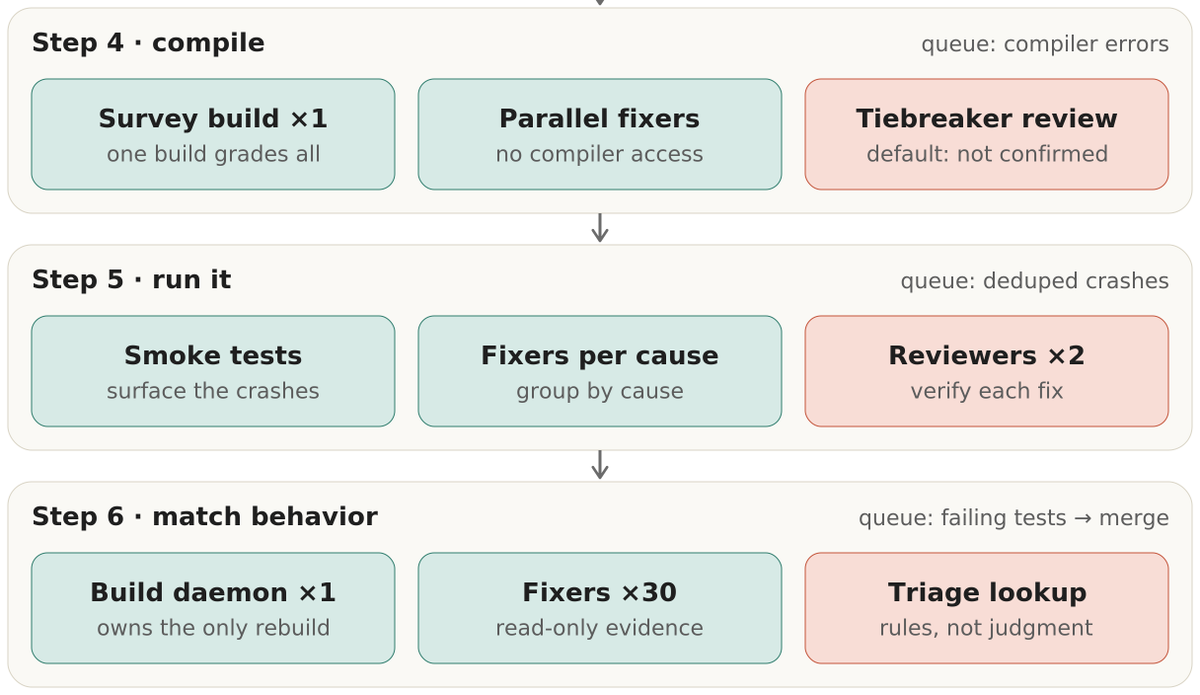
These three steps share the same loop architecture and need progressively less human judgment, so we cover them together.
Jarred executed this with an orchestrator script that invoked the compiler once across the whole workspace. "Fixer agents" then ran through the error list in parallel with adversarial review. The build runs again, rinse and repeat.
Reviewing the error list is helpful to catch systemic issues that may require adjustments. For example, Jarred ran into thousands of Rust module errors that surfaced after fixing cyclic imports that Zig's lazy compilation tolerated. He fixed the loop by encoding logic to classify which dependence to delete, move, or restructure the boundary.
Step 5 also has a mechanical source of truth similar to the compiler error list: crashes from the smoke test. Again, the loop fix was to group issues into categories, in this case grouping causes by root cause that are reviewed by adversarial subagents.
Step 6 and the end of our story is comparing the programs' behavior across the two codebases.
Our files have now been translated, compiled, and smoke tested.
Now it's time to shard them and run the test suite (from the prerequisite stage) against them. Tackle failures with "fixer agents" that review the failed tests against both codebases. Adversarial reviewers check their fixes.
The next stage in this loop is a build daemon, which is the only process allowed to rebuild the binary. Fixers write patches; the daemon batches them, rebuilds once, re-runs the affected tests, and feeds the results back. This serializes the most expensive operation instead of letting multiple agents trigger it independently.
Mike's approach matters here, because many developers won't have a built-out or ported test suite. Mike had Claude create a small script to run 7 real-world scenarios against both the new port and the original Python codebase, and diffed the results. Each failing scenario got its own fix agent, and the loop ran until all seven passed.
Then he went one step further. Claude designed its own end-to-end test suite and ran it autonomously overnight, fixing what broke and re-running four nights in a row. As a result, it caught the paper cuts no scenario list would have predicted.
The lesson is that a missing test suite doesn't block this step. If you can't inherit a referee, have Claude build one. Your original codebase is the ground truth either way.
第四、五、六步——编译、运行和行为匹配
这三个步骤共享相同的循环架构,并且逐渐减少对人工判断的依赖,因此我们一并介绍。
Jarred 使用一个编排脚本执行此步骤,该脚本在整个工作区调用一次编译器。然后“修复智能体”并行遍历错误列表,并接受对抗性审查。构建再次运行,重复此过程。
审查错误列表有助于发现可能需要调整的系统性问题。例如,Jarred 遇到了数千个 Rust 模块错误,这些错误在修复了 Zig 惰性编译容忍的循环导入后浮出水面。他通过编码逻辑来分类哪些依赖需要删除、移动或重构边界,从而修复了循环。
第 5 步也有一个类似于编译器错误列表的机械真值来源:冒烟测试中的崩溃。同样,循环修复是将问题按类别分组,这里按根因分组,由对抗性子智能体审查。
第 6 步也是我们故事的最后一步,是比较两个代码库中程序的行为。
现在我们的文件已经过翻译、编译和冒烟测试。
现在是时候将它们分片,并针对它们运行测试套件(来自先决条件阶段)了。使用“修复智能体”处理失败,这些智能体会对照两个代码库审查失败的测试。对抗性审查者检查他们的修复。
这个循环的下一阶段是一个构建守护进程,它是唯一允许重建二进制文件的进程。修复者编写补丁;守护进程将它们批量处理,重建一次,重新运行受影响的测试,并将结果反馈回来。这将最昂贵的操作序列化,而不是让多个智能体独立触发它。
Mike 的方法在此处很重要,因为许多开发者不会有完善或移植的测试套件。Mike 让 Claude 创建了一个小型脚本,针对新移植版本和原始 Python 代码库运行 7 个真实场景,并对结果进行差异比较。每个失败的场景都有自己的修复智能体,循环一直运行到所有七个场景通过。
然后他更进一步。Claude 设计了自己的端到端测试套件,并整晚自主运行,修复损坏的内容并连续四晚重新运行。结果,它捕获了任何场景列表都无法预见的小问题。
教训是:缺少测试套件不会阻塞这一步。如果你无法继承一个裁判,就让 Claude 构建一个。无论如何,你的原始代码库是事实来源。
Code migrations best practices
Every run taught us something the previous one didn't. But a few practices held up across every project:
- Don't follow this guide blindly. Each migration is different. Treat this as a starting point, and plan your specific migration with Claude before committing to it.
- Don't focus on individual failures. Individual failures are the loop's job. Your attention belongs on the patterns.
- Make review adversarial and verification mechanical. Let scripts — a compiler, a diff, a test suite — be the referee.
- Don't use the largest model for everything. Smaller models handle the high-volume implementation fan-out well; save your largest model for reviewers and for anything that writes rules other agents will follow.
- Front-load the human hours. The rulebook and the stress test are the most time-consuming. Everything after is mostly queues burning down.
代码迁移最佳实践
每一次运行都让我们学到了之前没有的经验。但有一些实践在所有项目中都行之有效:
- 不要盲目遵循本指南。每次迁移都是不同的。将其作为起点,并在开始之前与 Claude 一起规划你的具体迁移。
- 不要关注个别失败。个别失败是循环的工作。你的注意力应该放在模式上。
- 让审查是对抗性的,验证是机械的。让脚本——编译器、差异工具、测试套件——担任裁判。
- 不要在所有事情上都使用最大的模型。较小的模型能很好地处理高容量的实施任务;将最大的模型留给审查者以及任何编写其他智能体将遵循的规则的任务。
- 将人力时间前置。规则书和压力测试是最耗时的。之后的事情主要是消耗队列。
Review loop results, not code
Jarred's Bun migration is now in production, although every migration has tradeoffs. For example, about 4% of the Rust code sits inside "unsafe" blocks, mostly single-line pointer operations at C/C++ boundaries.
But the new codebase is measurably better. Every memory leak the team's tooling can detect has been fixed: one benchmark of 2,000 repeated builds dropped from 6,745 MB of memory to 609. The binary is 19% smaller on Linux and Windows. And cross-language optimization made it 2–5% faster across HTTP serving and real-world workloads like next build and tsc.
Pick the codebase you've been tolerating and ask Claude what the migration process looks like for it.
审查循环结果而非代码
Jarred 的 Bun 迁移现已投入生产,尽管每次迁移都有取舍。例如,大约 4% 的 Rust 代码位于“unsafe”块中,主要是 C/C++ 边界上的单行指针操作。
但新的代码库在可衡量方面更好。团队工具能检测到的每个内存泄漏都已修复:一个 2000 次重复构建的基准测试从 6,745 MB 内存降至 609 MB。二进制文件在 Linux 和 Windows 上缩小了 19%。跨语言优化使其在 HTTP 服务和真实工作负载(如 next build 和 tsc)上速度快了 2–5%。
挑选一个你一直忍受的代码库,问问 Claude 它的迁移过程会是什么样子。