Inside GPT-Live: full-duplex voice, one-round-trip startup
GPT-Live replaces turn-based voice architecture with streaming full-duplex inference: the turn-taking detector is removed from the audio path, the voice model listens and speaks simultaneously, and deeper reasoning or tool use is delegated asynchronously to GPT-5.5. Engineering details include a Go rewrite of the media front end that brings p95 frame delivery in line with the old p50; stateful handovers between model instances that turn context compaction into controlled failover without interrupting the media stream; and WARP, a set of backward-compatible WebRTC optimizations that cut session startup from six network round trips to one, plus Instant Connect to move SDP signaling off the critical path so a single UDP packet starts a session. Silent shadow testing showed CPU-side stream processing saturates before GPU inference under real traffic, shifting capacity planning from throughput to concurrent sessions. For engineers building realtime voice or agent interaction systems.
For voice AI, knowing when to speak is harder than it sounds. Human speakers can pass the conversational baton naturally in under a second, but earlier voice AI systems couldn't keep up. Their turn-based architecture relied on a small model called a turn detector, which faced a tricky task: judge too early and you interrupt the user; judge too late and responses feel sluggish. Only after the detector made its call could the much larger LLM get to work.
对语音 AI 来说,判断何时开口比听起来更难。人类说话者能在不到一秒的时间内自然地交接发言,但以往的语音 AI 系统跟不上这种节奏。它们的轮次制架构依赖称为轮次检测器的小型模型,而检测器面临一项棘手任务:判断得太早会打断用户,太晚则会让响应显得迟缓。只有检测器做出判断后,体量大得多的 LLM 才能开始工作。
Our third-generation voice system, GPT-Live, removes the turn detector from the audio path. Its voice model is full-duplex, meaning it can listen and speak at the same time. That eliminates the need for a separate detector and makes conversations more immediate and natural. When deeper reasoning or tool use is needed, GPT-Live can also call frontier models like GPT-5.5 without interrupting the conversational flow. Together, these capabilities give GPT-Live an unprecedented combination of conversational responsiveness and intelligence.
我们的第三代语音系统 GPT‑Live 从音频路径中移除了轮次检测器。它的语音模型采用全双工模式,也就是说可以同时听和说。这不再需要单独的检测器,让对话更即时、更自然。需要更深入的推理或使用工具时,GPT‑Live 还可以调用 GPT‑5.5 等前沿模型,而不会打断对话节奏。这些能力相结合,让 GPT‑Live 同时拥有前所未有的对话响应速度和智能水平。
Delivering this experience at scale required a new system architecture optimized for low latency. Unlike typical request-response inference, our system streams incoming audio into the voice model, streams the generated speech back to the user, and handles delegated tasks on a separate asynchronous path. Over the past six months, we redesigned model inference, context management, and media transport so that speech flows end to end without stutter.
The architecture also draws a clean boundary between the core voice path and application logic, making it easy to customize application behavior without affecting response speed. This foundation powers ChatGPT voice's expanding feature set, including the newly launched ability to control your computer and coordinate agents from the ChatGPT desktop app.
This article explains why our earlier turn-based system could not meet our needs, and how we designed a new system to stay responsive at every layer. We'll cover stateful inference, dynamic context management, asynchronous delegation, and protocol-level optimizations, and how they work together to make GPT-Live truly realtime.
要大规模提供这种体验,需要一套针对低延迟优化的新系统架构。与典型的请求—响应式推理不同,我们的系统会将传入音频流式送入语音模型,再将生成的语音流式传回用户,同时通过独立的异步路径处理委派任务。过去六个月中,我们重新设计了模型推理、上下文管理和媒体传输,让语音从端到端始终流畅传递。
该架构还在核心语音路径与应用逻辑之间划出了清晰边界。因此,无需影响响应速度即可轻松定制应用行为。这一基础为 ChatGPT 语音不断扩展的功能提供支持,包括新推出的功能:在 ChatGPT 桌面应用中控制电脑并协调智能体。
本文将说明以往的轮次制系统为何无法满足我们的需求,以及我们如何从各个层面设计新系统,使其保持快速响应。我们将介绍有状态推理、动态上下文管理、异步委派和协议级优化,以及它们如何协同工作,让 GPT‑Live 真正做到 实时。
Early voice architectures inherited the turn-based pattern of text LLMs, except each turn was a discrete chunk of audio instead of text. In cascaded systems, speech-to-text, the LLM, and text-to-speech ran serially, one after the other. That serial processing added latency and ignored cues like tone and speaking rate.
Speech-to-speech models improved on this by working with audio directly. Trained to understand and generate speech natively, they preserve details lost in transcription and respond faster. But the system still relied on a turn detector to decide when inference could begin. The model did more of the interactive work, yet interaction remained turn-based.
GPT-Live lets the voice model drive the conversation: audio flows continuously into and out of the model, while deeper reasoning and tool use happen asynchronously. The system's first priority is maintaining an uninterrupted media loop. Other work, like calling frontier models or persisting conversation state, happens off the realtime path.
早期语音架构沿用了文本 LLM 的轮次制模式,只是每轮内容不再是文本,而是独立的音频数据块。在级联系统中,语音转文本、LLM 和文本转语音依次串行运行。这种串行处理增加了延迟,也忽略了语气和语速等线索。
语音到语音模型通过直接处理音频改进了这种方式。通过训练模型原生理解和生成语音,它既能保留转写过程中丢失的细节,也能更快响应。但系统仍依赖轮次检测器来决定何时可以开始推理。模型承担了更多交互工作,但交互仍采用轮次制。
GPT‑Live 让语音模型主导对话:音频持续流入和流出模型,更深入的推理和工具使用则异步进行。系统的首要任务是维持不间断的媒体循环。调用前沿模型、持久化对话等其他工作则在实时路径之外进行。
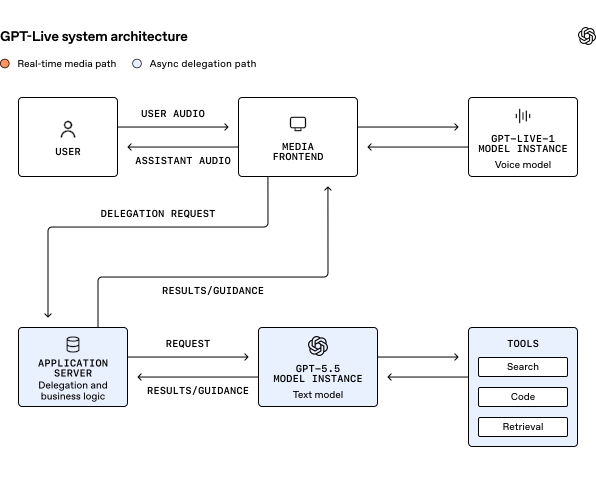
Keeping that media loop flowing smoothly isn't always simple. Any delay in transport, processing, or inference can become an audible pause or glitch. Turn-based systems could tolerate some jitter in when audio chunks arrived, but a realtime media system must deliver every frame on time.
Earlier work on ChatGPT voice and the Realtime API laid an important foundation. We had already rebuilt our voice infrastructure so audio and video can flow into and out of the system with lower, more stable latency. GPT-Live pushes this design further, streaming media all the way into the model through a new stateful inference system built for continuous conversation.
Still, streaming inference is only part of the solution. To run reliably in production, we also had to ensure audio could travel dependably from the client to the inference stack and to cope with the challenges of stateful systems.
让这个媒体循环保持畅通并不总是那么简单。传输、处理或推理中的任何延迟,都可能变成听得见的停顿或杂音。以往的轮次制系统可以容忍音频数据块到达时间有一定波动。但实时媒体系统必须按时传送每一帧音频。
此前在 ChatGPT 语音和 Realtime API 方面的工作为我们奠定了重要基础。我们已经重建了语音基础设施,让音频和视频能以更低、更稳定的延迟直接流入和流出系统。GPT‑Live 进一步推进了这一设计,通过专为连续对话打造的新型有状态推理系统,将媒体一路流式传输至模型。
不过,流式推理只是解决方案的一部分。要让它在生产环境中稳定运行,我们还必须确保音频能从客户端可靠传送至推理栈,并应对有状态系统带来的挑战。
One early decision was to cleanly separate the media stream from application and business logic. Audio travels between the client and the voice model over a dedicated fast path. Delegation, tool use, and other application work sit behind an asynchronous RPC boundary. A slow tool call or backend service may delay its own result, but it won't block the media stream.
That separation also creates a clean boundary for customization. Applications can change tools, policies, and backend behavior without affecting the media front end responsible for keeping audio flowing. The realtime path stays lean, predictable, and focused on the work that must happen in real time.
我们早期的一项决定,是将媒体流与应用及业务逻辑明确分离。音频通过专用快速路径在客户端和语音模型之间传输。委派、工具使用及其他应用工作都在异步 RPC 边界之后进行。缓慢的工具调用或后端服务可能延迟自身结果,却不会阻塞媒体流。
这种分离也为系统定制划出了清晰边界。应用可以更改工具、策略和后端行为,而不会影响负责保持音频流动的媒体前端。实时路径保持精简、可预测,并专注于必须实时完成的工作。
We rewrote the media front end and inference logic in Go, replacing the previous Python asyncio implementation. This noticeably smoothed frame delivery—the new system's p95 matched the old system's p50.
WebRTC provides the transport foundation. It was designed for low-latency media and continues working even with packet loss, clock drift, or changing client connections. If a packet arrives late, WebRTC can slightly stretch the audio to avoid a gap, then briefly speed up playback to catch back up to real time.
By minimizing buffering and blocking throughout the system, we can achieve the sub-second responsiveness people expect from conversation.
我们使用 Go 编写媒体前端和推理逻辑,取代了此前基于 Python asyncio 的实现。这显著提升了帧传送的流畅度,新系统的 p95 达到了旧系统 p50 的水平。
WebRTC 提供了传输基础。它专为低延迟媒体而设计,即使出现丢包、时钟漂移或客户端连接变化,也能继续运行。如果数据包延迟到达,WebRTC 可以轻微拉伸音频以避免出现空档,随后短暂加速播放,重新追上实时进度。
通过尽量减少整个系统中的缓冲和阻塞,我们可以实现人们在对话中所期待的亚秒级响应。
Stateful inference brings its own operational trade-offs. A voice session can remain active for a long time, but its context keeps growing, and model instances spin up and down based on demand.
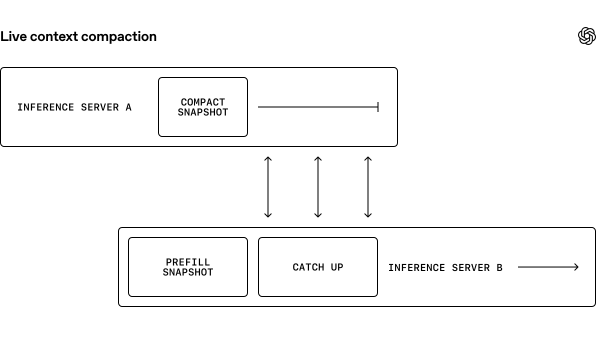
To address this, we built a seamless handoff mechanism across model instances. When a switch is needed, we warm up a replacement instance alongside the current one, prefill it with the current session context, run inference on both instances in parallel, and switch over once the new instance is fully ready.
有状态推理有其自身的运维权衡。语音会话可能长时间保持活动,但其上下文会持续增长,模型实例也会根据需求启动和关闭。
为解决这些问题,我们构建了跨模型实例的无缝交接机制。需要切换时,我们可以在现有模型实例旁预热替代实例,用当前会话上下文进行预填充,同时在两个实例上并行运行推理,并在新实例完全就绪后切换过去。
The same basic mechanism also supports dynamic context compaction. As a conversation continues, accumulated context can eventually exceed the model's context limit. Compaction shrinks the context to fit, but it takes time. And because compaction changes past context, it also invalidates the model's key-value (KV) cache—the stored attention keys and values for previously processed tokens. Rebuilding that state requires another prefill, adding extra latency.
So we treat compaction as another controlled switch. The original model instance keeps the conversation going while the system compacts the context and prepares a replacement instance with the new context. Once that instance is ready, we switch over without interrupting the media stream. This lets the system support long calls and compact when necessary.
Heavy work never enters the realtime path, so even during handoffs, the conversation stays smooth and uninterrupted.
同一套基本机制也支持动态上下文压缩。随着对话持续进行,累积的上下文最终可能超出模型的上下文限制。压缩可以缩减上下文,使其符合限制,但这项操作需要时间。此外,由于压缩会改变过去的上下文,它还会使模型的键值(KV)缓存失效;该缓存存储着此前已处理 token 的注意力键和值。重建这一状态需要再次预填充,从而引入额外延迟。
因此,我们将压缩视为另一种受控切换。原模型实例继续对话的同时,系统会压缩上下文,并使用新上下文准备替代模型实例。该实例就绪后,我们便可切换过去,媒体流不会中断。这样,系统便能支持长时间通话,并在必要时进行压缩。
繁重工作不会进入实时路径,因此即使在交接期间,对话也始终流畅无间断。
GPT-Live is powerful because it can call existing frontier models; in effect, it decouples 'speaking' from deeper 'thinking.' But making this dual-model architecture feel like one unified system required solving two related engineering problems.
First, results have to come back fast enough to be useful in an ongoing conversation. So we had to minimize latency across the entire delegation path, from routing and prompt processing to inference and tool calls. At the same time, other systems in the product still expect discrete messages, so we had to represent the continuous conversation in a form they can understand.
GPT-Live responds quickly and naturally while GPT-5.5 handles a search task in the background:
User — GPT-Live-1 — GPT-5.5 — Search + reason
Transcript: example conversation with GPT-Live-1 using GPT-5.5 Instant
GPT‑Live 能调用现有前沿模型,因此能力十分强大,实际上将“说话”与更深入的“思考”解耦开来。但要让这种双模型架构呈现为一个统一系统,需要解决两个相关的工程问题。
首先,结果必须足够快地返回,才能在正在进行的对话中发挥作用。因此,从路由、提示处理到推理和工具调用,我们必须最大限度降低整条委派路径的延迟。与此同时,产品中的其他系统仍需要离散消息,因此我们必须将持续对话表示为它们能够理解的形式。
GPT-Live 提供快速、自然的响应,同时由 GPT-5.5 在后台处理搜索任务
User — GPT-Live-1 — GPT-5.5 — Search + reason
转录文字稿:使用 GPT-5.5 Instant 的 GPT-Live-1 对话示例
Once a delegation is issued, we focus on minimizing the time the frontier model needs to produce something useful for the current conversation. While the frontier model is reasoning or using tools, the voice model can keep the conversation going briefly, but it can't mask arbitrarily long response latency. So we put the entire delegation loop—routing, prompt processing, inference, and tool calls—under a response-time budget.
The first optimization is to prepare the frontier model and all its required tools before a delegation is requested. When a voice session starts, the application server creates an inference session for the frontier model and prefills it with the initial conversation context, making sure the prompt is fully processed before the first delegation request is sent.
We then keep that inference session available for the entire voice conversation and use stable session affinity for consecutive requests. Combined with prompt caching, these techniques improve latency and make it easy to recover from worker failures.
Inference strength, output limits, tool architecture, and round trips between model and tools also affect how quickly the conversation gets a useful result, so we tuned these to speed up responses. By minimizing what the delegation path has to do, we let the voice model quickly incorporate what the frontier model returns.
发出委派任务后,我们会重点优化前沿模型产出对当前对话有用内容所需的时间。当前沿模型进行推理或使用工具时,语音模型可以短暂维持交流,但无法掩盖任意漫长的响应延迟。因此,我们将整个委派循环——路由、提示处理、推理和工具调用——都纳入响应时间预算。
第一项优化,是在请求委派之前准备好前沿模型及其所需的所有工具。语音会话开始时,应用服务器会为前沿模型创建推理会话,并使用初始对话上下文进行预填充,确保在第一个委派请求发出前已完整处理提示。
随后,我们会在整个语音对话期间保持该推理会话可用,并为连续请求采用稳定的会话亲和性。这些技术与提示缓存结合使用,既能改善延迟,也能轻松从工作节点故障中恢复。
推理强度、输出限制、工具架构以及模型与工具间的往返也会影响对话获得有用结果的时间,因此我们调整了这些因素来加快响应。通过尽量减少委派路径上的工作量,我们让语音模型能够迅速整合前沿模型返回的结果。
Even though the voice model works with a continuous audio stream, many surrounding systems still operate in user and assistant turns, including ChatGPT's conversation UI and parts of the analytics and safety infrastructure. So the application server sifts through overlapping and sometimes ambiguous conversations and splits them into discrete messages.
When audio arrives, the server uses partial transcripts and timing signals to infer who is speaking and builds a message queue. The latest message is still tentative: as more speech arrives, its text, timing, and speaker attribution can change. Once a speaker has been talking long enough for the attribution to be reliable, the server finalizes the message.
Simultaneous speech makes this more complicated. If the user is talking and the assistant briefly interjects with something like “mm-hmm” or “okay,” that doesn't need to become its own message. But substantive assistant insertions usually should. Similarly, even if the user starts speaking mid-response, we prioritize keeping the displayed assistant reply coherent.
尽管语音模型处理的是连续语音流,周边许多系统仍以用户和助手的轮次为单位运行,包括 ChatGPT 的对话界面,以及部分分析和安全基础设施。因此,应用服务器会梳理彼此重叠、偶尔含义不明的对话,将其拆分为离散消息。
音频到达时,服务器会利用部分转写和时间信号来推断当前由谁发言,并构建消息队列。最新消息仍是暂定的;随着更多语音到达,其文本、时间和说话者归属都可能改变。当某位说话者持续发言的时间足以确保归属可靠后,服务器便会确定相应消息。
多人同时说话会让情况更加复杂。用户说话时,助手简短回应一句(例如“嗯哼”或“好的”),不一定要单独成为一条消息。但助手插入的实质性内容通常应该单独成条。同样,即使用户中途开口,我们也会优先确保显示的助手回复连贯。
Any segmentation strategy has to balance timeliness against certainty. Finalizing too early produces fragmented history and unstable ordering; waiting too long delays transcripts and the features that depend on them. So the system keeps two linked views of the conversation: a speculative view that reflects the current state, and an authoritative version that captures what was actually said. The conversation view in the app can handle updates, so it uses the speculative view. But when writing logs to analytics pipelines, the final transcript is required.
That way, the rest of ChatGPT can have a stable picture of the conversation without forcing the realtime voice path to be constrained by turn-taking mechanics.
任何分段策略都必须在时效性与确定性之间取舍。过早确定会产生碎片化的历史记录和不稳定的顺序;等待太久则会延迟转写及依赖转写的功能。因此,系统会维护两个相互关联的对话视图:反映当前状态的推测视图,以及记录实际对话内容的权威版本。应用界面中的对话视图可以处理更新,因此采用推测视图。但向分析管道写入日志时,需要最终转写文本。
这样,ChatGPT 的其他部分便能稳定地了解对话内容,而不必让实时语音路径受轮次机制约束。
Fast response starts the moment a user hits the button. With GPT-Live, the system has to establish a media path and start sending audio into the model before the conversation can begin, putting every part of the startup flow on the critical path.
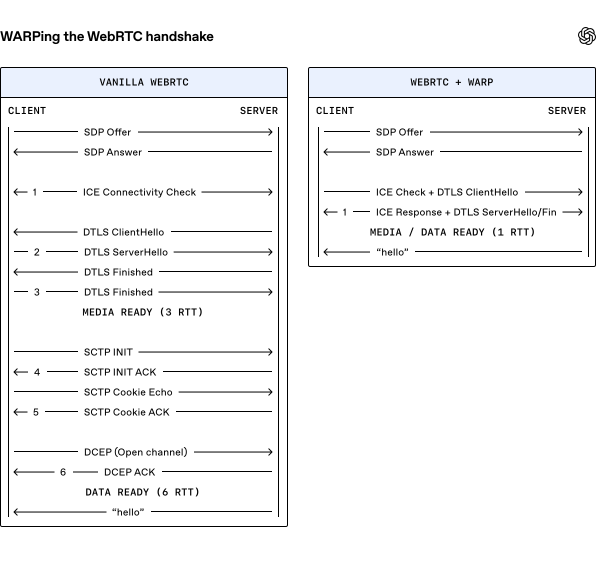
As noted above, WebRTC provides a strong realtime foundation, but starting a standard WebRTC session requires a surprising number of protocol handshakes and network round trips. WebRTC predates the “minimize round trips” ethos that shaped protocols like QUIC, so its underlying protocols sometimes end up doing the same work twice when combined. For example, each protocol has its own anti-DoS mechanism, even when that protection isn't needed in the full WebRTC stack.
用户点击按钮的那一刻,快速响应就已经开始。使用 GPT‑Live 时,系统必须先建立媒体路径并开始将音频送入模型,对话才能开始。这使启动流程的每个环节都位于关键路径上。
如上所述,WebRTC 提供了强大的实时基础,但启动标准 WebRTC 会话需要执行数量惊人的协议握手和网络往返。WebRTC 出现得较早,并未受到后来塑造 QUIC 等协议的“尽量减少往返”理念影响。因此,其底层协议结合使用时,有时会重复执行相同工作。例如,每个协议都有自己的抗 DoS 机制,即使在完整 WebRTC 栈中并不需要。
We analyzed the protocol stack and developed a streamlined round-trip protocol for WebRTC called WARP, reducing the startup process for media and data from six network round trips to one. WARP does this through a set of backward-compatible protocol improvements: piggybacking the DTLS handshake on ICE (SPED), using the faster DTLS 1.3 handshake, pre-negotiating the SCTP handshake (SNAP), and pre-negotiating data channels instead of using DCEP.
We designed WARP with WebRTC community collaborators as a set of open specifications, so the broader ecosystem can benefit too. The proposals are moving through the IETF's TSVWG working group; libwebrtc and Pion have both added WARP support, and other WebRTC implementations are following.
After optimizing the media handshake, one latency stood out: the signaling exchange used to share SDP parameters before WebRTC establishes a connection. To move this exchange off the critical path, we built a mechanism called Instant Connect. It negotiates these parameters in advance, without reserving server capacity or changing existing WebRTC implementations.
Instant Connect runs in parallel with the standard signaling flow. If the pre-negotiated parameters are valid, the server can create the session when it receives the first media packet. If the parameters are expired or invalid, signaling is already underway, so the client can fall back without adding latency.
Together, Instant Connect and WARP dramatically shorten the time from user intent to realtime media flowing. With the SDP exchange off the critical path and WARP's streamlined transport handshake, the client now needs to send just a single UDP packet to start a session. The server can respond immediately, letting the rest of the system get to work on what the user actually cares about: listening and responding.
优化媒体握手后,还有一项延迟格外突出:WebRTC 建立连接前,用于共享 SDP 参数的信令交换。为了将这项交换移出关键路径,我们开发了名为 Instant Connect 的机制。它会提前协商这些参数,无需预留服务器容量,也无需改动现有 WebRTC 实现。
Instant Connect 与标准信令流程并行运行。如果预协商参数有效,服务器可以在收到第一个媒体包时创建会话。如果参数已过期或无效,信令流程也已在进行,因此客户端可以回退,且不会增加额外延迟。
Instant Connect 与 WARP 相结合,大幅缩短了从用户产生意图到实时媒体开始流动的时间。SDP 交换移出关键路径、WARP 精简传输握手后,客户端现在只需发送一个 UDP 包即可启动会话。服务器可以立即响应,让系统的其余部分开始完成用户真正关心的工作:倾听并回应。
A system can look fast on paper and still stumble under real voice traffic. Before letting GPT-Live talk to users, we ran a silent test, routing a small percentage of production ChatGPT voice sessions to both the existing Advanced Voice Mode experience and the new system, then gradually increased the percentage. Advanced Voice Mode continued to serve users normally, while the shadow path ran inference in read-only mode. This let the system face real clients, networks, session durations, and geographic distributions without changing what users heard.
一个系统在纸面上可能很快,但面对真实语音流量时仍可能卡顿。在让 GPT‑Live 与用户对话之前,我们进行了一次静默测试,将一小部分生产环境中的 ChatGPT 语音会话同时路由至现有的高级语音模式体验和新系统,并逐步提高这一比例。高级语音模式继续照常为用户提供服务,而影子路径则以只读模式运行推理。这样既能让系统面对真实的客户端、网络、会话时长和地域分布,又不会改变用户听到的内容。
One of the first lessons was that GPU throughput alone can't measure capacity. Voice sessions stay connected and keep sending frames, so the CPU-side stream handlers, queues, and network paths have to scale along with inference capacity. Under real load, a supporting component saturated earlier than load testing predicted, causing inference requests to back up and latency to compound. We reframed the capacity question from “how many requests can a GPU handle?” to “how many concurrent sessions can the system sustain while ensuring every frame is processed on time?”
我们最先得到的经验之一是,不能仅用 GPU 吞吐量来衡量容量。语音会话会保持连接并持续发送帧,因此 CPU 端的流处理程序、队列和网络路径必须与推理能力同步扩展。在真实负载下,一个辅助组件比负载测试预测的更早达到饱和,导致推理请求积压,延迟不断叠加。我们将容量问题从“一块 GPU 能处理多少请求?”改为“在确保每一帧都按时处理的前提下,系统能维持多少个并发会话?”
The test also made geography a top concern. Routing sessions to capacity resources in far-away regions can add latency at several points in startup and streaming. We began validating model releases against regional capacity and traffic-routing configurations, and broke down latency by traffic origin. Moving inference closer to users helped, but it also reinforced a broader lesson: end-to-end responsiveness depends on every service along the path, not just the model server.
这项测试也让地域成为首要考量。将会话路由到较远地区的容量资源,可能在启动和流式传输的多个环节增加延迟。我们开始结合区域容量和流量调度配置来验证模型发布,并按流量来源地域细分延迟。将推理移至更靠近用户的位置确实有所帮助,但也进一步印证了一个更广泛的经验:端到端响应速度取决于路径上的每项服务,而不只是模型服务器。
There were also failures that only appear over real session lifecycles. Long-running sessions exposed memory and persistence pressure. Reconnects stressed compaction and state-recovery mechanisms. Ordinary client disconnects exposed race conditions in the closing handshake. These problems rarely showed up in short load tests, because they depend on time, accumulated state, and behavior across service boundaries.
还有一些故障只会在真实的会话生命周期中出现。长时间运行的会话暴露出内存和持久化压力。重新连接会对压缩和状态恢复机制形成考验。普通的客户端断开连接暴露了关闭握手中的竞态问题。这些问题在短时负载测试中很少出现,因为它们取决于时间、累积状态以及跨服务边界的行为。
Finally, production testing pushed us to improve observability and release controls. We found that some metrics conflated different sources of latency, some dashboard rollups hid individual bad engines, and there were configuration drifts between the test system and the deployed system. So we added finer-grained telemetry, validation based on verified configurations, staged rollouts, and the ability to quickly isolate or disable a single path. The silent test became a dress rehearsal for launch: not just how much traffic the system could carry, but how quickly we could find, contain, and recover from failures.
最后,生产环境测试促使我们改进了可观测性和发布控制。我们发现,有些指标混淆了不同的延迟来源,有些仪表板的汇总数据掩盖了个别异常引擎,测试系统与已部署系统之间还存在配置偏差。为此,我们增加了更细粒度的遥测、基于已验证配置的校验、分阶段放量,以及快速隔离或停用单条路径的能力。这次静默测试成为发布前的一次预演:它不仅检验系统能承载多少流量,也检验我们能多快地发现、控制故障并从中恢复。
Scaling GPT-Live to ChatGPT's size required building an entirely new system around one core principle: keep voice flowing. Streaming inference continuously feeds audio into a full-duplex model. A dedicated media path ensures audio frames arrive reliably. Asynchronous delegation lets deeper thinking happen in parallel. Optimized transport keeps the experience fast from start to finish.
The architecture behind GPT-Live is already evolving into a broader realtime interaction platform. As ChatGPT voice expands from conversation to agent collaboration, this architecture supports it, and it will also be the foundation for the upcoming GPT-Live API. Over time, it will bring voice experiences to more devices, applications, and modalities, while preserving the immediacy that makes voice conversations feel as natural as talking in real time.
If you'd like to work on engineering problems like these, we'd love to have you join us.
要让 GPT‑Live 达到 ChatGPT 的规模,需要围绕一项基本原则构建全新系统:让语音持续流动。流式推理持续向全双工模型输送音频。专用媒体路径确保音频帧可靠送达。异步委派让更深入的思考能够并行进行。经过优化的传输机制让用户全程获得快速响应的体验。
GPT‑Live 背后的架构已开始发展为更广泛的实时交互平台。随着 ChatGPT 语音从对话扩展到智能体协同,该架构为其提供支持,也将成为即将推出的 GPT‑Live API 的基础。随着时间推移,它将使语音体验覆盖更多设备、应用和模态,同时保留让语音对话如同实时交流般自然的即时性。
如果你也想解决这类工程问题,欢迎加入我们。