LangChain’s Open-Source Software Factory
LangChain open-sources four internal software engineering agent tools: local coding agent dcode, cloud coding agent OpenSWE, automated code review OpenSWE Review, and repo knowledge documentation OpenWiki. It includes real usage data (OpenSWE triggered ~1,000 times from Slack last week) and benchmark results (OpenSWE Review scores 47%, #1 among open-source tools). Built on Deep Agents framework with LangSmith observability. Targeted at engineers building controllable, observable agent pipelines.
LangChain’s Open-Source Software Factory
By @BraceSproul · 2026-07-18T19:13:42.000Z
At LangChain, we interact with software engineering agents from the terminal, Slack, Linear, GitHub, and CI.
Different workflows need different agents. Local coding should feel interactive. Cloud coding should run in the background and open PRs. Code review should be careful and tied into GitHub. Repo documentation should stay close to the code and give agents useful context.
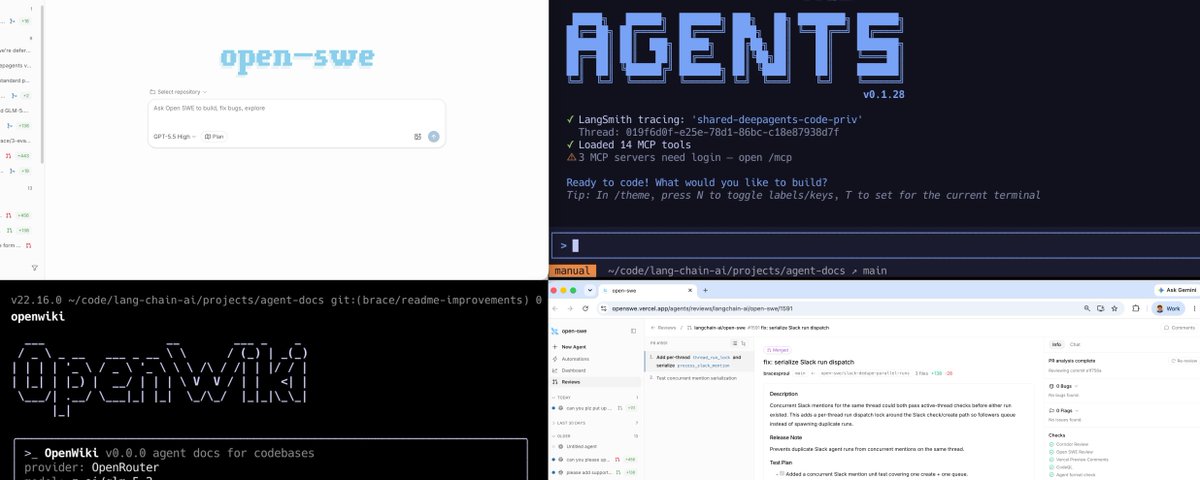
We’ve built that system as a set of open-source tools:
- dcode for local coding
- OpenSWE for cloud coding agents
- OpenSWE Review for automated code review
- OpenWiki for repo documentation and agent memory
Together, they form our software engineering agent factory. This is the shape we use internally: local agents, cloud agents, review agents, repo memory, open models, and LangSmith traces across the system.
LangChain 开源软件工厂
作者 @BraceSproul · 2026-07-18T19:13:42.000Z
在 LangChain,我们通过终端、Slack、Linear、GitHub 和 CI 与软件工程代理交互。
不同的工作流需要不同的代理。本地编码应具有交互性。云编码应在后台运行并创建 PR。代码审查要细致并关联 GitHub。仓库文档应贴近代码并为代理提供有用的上下文。
我们将这套系统构建为一组开源工具:
- dcode 用于本地编码
- OpenSWE 用于云编码代理
- OpenSWE Review 用于自动化代码审查
- OpenWiki 用于仓库文档和代理记忆
它们共同构成了我们的软件工程代理工厂。这是我们内部使用的方式:本地代理、云代理、审查代理、仓库记忆、开放模型以及跨系统的 LangSmith 追踪。
Why open source matters
Software engineering agents read code, edit code, review PRs, and participate in engineering workflows. Teams need to understand and control how those agents behave.
That is hard if the agent is a closed system. You are limited to the provider’s supported models, review behavior, integrations, and observability.
We want agents that teams can inspect, modify, and adapt to their own workflows, including their own review standards, repo conventions, model choices, and internal tools. That is why these projects are open source.
为什么开源很重要
软件工程代理读取代码、编辑代码、审查 PR 并参与工程工作流。团队需要理解并控制这些代理的行为。
如果代理是封闭系统,这很困难。您会受限于提供商支持的模型、审查行为、集成和可观测性。
我们希望团队能够检查、修改代理并将其适配到自己的工作流中,包括自己的审查标准、仓库约定、模型选择和内部工具。这就是这些项目开源的原因。
dcode
dcode is the local coding agent we use from the terminal.
The CLI and agent runtime run locally on your machine, while the model can still be hosted. That lets developers work directly against a local repo while using large coding models that may not run on a laptop.
We use dcode for interactive coding work: exploring a repo, making edits, and running implementation tasks from the terminal.
dcode
dcode 是我们从终端使用的本地编码代理。
CLI 和代理运行时在您的机器上本地运行,而模型仍可托管。这让开发者可以直接在本地仓库上工作,同时使用可能在笔记本电脑上无法运行的大型编码模型。
我们使用 dcode 进行交互式编码工作:探索仓库、进行编辑以及从终端运行实施任务。

OpenSWE
OpenSWE is the cloud coding agent we use when work should happen in the background.
A lot of engineering work starts outside the terminal. A bug comes up in Slack. A feature request lives in Linear. A repo maintenance task needs to run on a schedule.
OpenSWE can be triggered from Slack, Linear, GitHub, or the web UI. It runs in the cloud, works on the code, and can open a pull request when it is done.
Internally, this has become one of our most-used agent workflows. In just the last week, we triggered OpenSWE almost 1,000 times from Slack alone, not including Linear or UI usage.
Because OpenSWE runs in a sandbox in the cloud, we can run many coding agents in parallel without tying up anyone’s local environment.
OpenSWE also includes a UI for inspecting agent work, chatting with the cloud coding agent, configuring models and prompts, viewing analytics, and setting up scheduled automations.
OpenSWE
OpenSWE 是我们在工作需要在后台进行时使用的云编码代理。
很多工程工作从终端之外开始:Slack 中出现了 bug,Linear 中有一个功能请求,仓库维护任务需要按计划运行。
OpenSWE 可以从 Slack、Linear、GitHub 或 Web UI 触发。它在云端运行,处理代码,完成后可以创建一个 Pull Request。
在内部,这已成为我们最常用的代理工作流之一。仅上周,我们就从 Slack 触发了近 1000 次 OpenSWE,还不包括 Linear 或 UI 的使用。
由于 OpenSWE 在云端的沙箱中运行,我们可以并行运行许多编码代理,而不会占用任何人的本地环境。
OpenSWE 还包含一个 UI,用于检查代理工作、与云编码代理聊天、配置模型和提示、查看分析以及设置计划自动化。

OpenSWE Review
OpenSWE Review connects to GitHub and automatically reviews pull requests. It identifies bugs and regressions before code merges.
It also performs extremely well on external benchmarks. On the Offline Code Review Benchmark, OpenSWE Review scores 47% when running GPT-5.5 with medium reasoning. That places it #6 overall and #1 among open-source code review agents.
Code review is highly organization-specific. Teams differ in what issues they care about, how they phrase comments, and when they want an agent to block, suggest, or stay quiet.
OpenSWE Review gives us a strong default that we can adapt by changing prompts, workflows, model choices, and repo-specific behavior.
OpenSWE Review
OpenSWE Review 连接到 GitHub 并自动审查 Pull Request。它在代码合并前识别 bug 和回归。
它在外部基准测试中表现也非常出色。在离线代码审查基准测试中,OpenSWE Review 在使用 GPT-5.5 中等推理能力时获得 47% 的分数,总排名第 6,在开源代码审查代理中排名第 1。
代码审查高度组织特定。不同团队关注的问题不同,评论措辞不同,以及他们希望代理在何时阻止、建议或保持沉默也不同。
OpenSWE Review 为我们提供了一个强大的默认配置,我们可以通过更改提示、工作流、模型选择和仓库特定行为来调整它。

OpenWiki
OpenWiki generates and maintains codebase documentation using Google’s Open Knowledge Format.
The docs live with the code and are kept up to date automatically via a GitHub action. That gives both humans and agents a maintained knowledge layer for the repo, without needing to worry about maintaining the docs (OpenWiki does that for you!).
If an agent has to rediscover the architecture of a repo every time it runs, it wastes tokens and misses important conventions. OpenWiki gives coding and review agents a better starting point, while supporting an auto-update flow so you never need to think about maintaining your agent docs again.
OpenWiki
OpenWiki 使用 Google 的 Open Knowledge Format 生成并维护代码库文档。
文档与代码共存,并通过 GitHub Action 自动保持更新。这为人类和代理提供了一个维护良好的仓库知识层,无需担心维护文档(OpenWiki 会为您代劳!)。
如果代理每次运行时都必须重新发现仓库架构,就会浪费 token 并错过重要约定。OpenWiki 为编码和审查代理提供了更好的起点,同时支持自动更新流程,让您无需再考虑维护代理文档。

The stack
Deep Agents
dcode, OpenSWE, OpenSWE Review, and OpenWiki are all built on Deep Agents.
The workflows are different, but they share the same underlying agent foundation. That gives us a consistent way to build, customize, and improve agents across local coding, cloud coding, review, and documentation. Sharing code, resources and engineering know-how is made even easier when they’re all built in the same framework.
技术栈
Deep Agents
dcode、OpenSWE、OpenSWE Review 和 OpenWiki 都构建在 Deep Agents 之上。
工作流不同,但它们共享相同的底层代理基础。这为我们提供了一种一致的方式来构建、定制和改进跨本地编码、云编码、审查和文档的代理。当所有工具都在同一个框架中构建时,共享代码、资源和工程知识变得更加容易。
Open models
We’ve optimized the stack for open models.
SWE agents get expensive quickly when they run across an organization. Local coding, cloud coding, code review, documentation, scheduled maintenance, and repeated repo analysis all use tokens.
Open models give us more control over cost (the key reason), latency, and deployment choices. They also let teams route different tasks to different models, experiment with open coding models, or even fine-tune models for their own repos and workflows.
开放模型
我们已经针对开放模型优化了技术栈。
当 SWE 代理在整个组织中运行时,成本会迅速增加。本地编码、云编码、代码审查、文档、计划维护和重复的仓库分析都会消耗 token。
开放模型让我们在成本(关键原因)、延迟和部署选择方面拥有更多控制权。它们还允许团队将不同任务路由到不同模型,尝试开放的编码模型,甚至针对自己的仓库和工作流微调模型。
LangSmith
We trace these agents with LangSmith.
When an agent opens a PR, leaves a review comment, or fails on a task, traces show the files it inspected, the context it loaded, the tool calls it made, and where it got stuck.
Those traces help us debug individual runs and improve the system over time. We use them to identify failure modes, improve prompts, compare models, and feed higher-quality examples into continual improvement workflows with LangSmith Engine.
Engine for coding agents is a new workflow we’ve been experimenting with, where we have Engine run over coding agent traces, identify shortfalls, and propose optimizations. Since every coding agent run from every employee at LangChain is traced, Engine is able to do identify and preform these optimizations from birds eye view, instead of individually on specific engineers traces.
LangSmith
我们使用 LangSmith 追踪这些代理。
当代理打开 PR、留下审查评论或任务失败时,追踪会显示它检查过的文件、加载的上下文、进行的工具调用以及卡住的位置。
这些追踪帮助我们调试单个运行并随着时间的推移改进系统。我们利用它们来识别故障模式、改进提示、比较模型,并将更高质量的示例输入到 LangSmith Engine 的持续改进工作流中。
Engine for Coding Agents 是我们一直在试验的新工作流:Engine 在编码代理追踪上运行,识别不足并提出优化建议。由于 LangChain 每个员工的每次编码代理运行都被追踪,Engine 能够从全局视角识别并执行这些优化,而不是针对单个工程师的追踪。
Build your own software engineering agent factory
This stack reflects how we use software engineering agents at LangChain, but the pieces are open source so other teams can adapt them, and retain full control over your own software factory.
You can start small:
- Use dcode for local coding.
- Add OpenSWE to run coding agents from Slack, Linear, GitHub, or the web UI.
- Turn on OpenSWE Review for automated PR review.
- Use OpenWiki to maintain repo knowledge for humans and agents.
- Connect traces to LangSmith if you want observability and improvement loops across the system.
The goal is not to move every engineering workflow into one agent interface. It is to put the right agents in the places where engineering work already happens, with enough control to make them fit your repos, models, and team conventions.
构建你自己的软件工程代理工厂
该技术栈反映了我们在 LangChain 使用软件工程代理的方式,但这些组件是开源的,因此其他团队可以改编它们,并完全控制自己的软件工厂。
你可以从小处着手:
- 使用 dcode 进行本地编码。
- 添加 OpenSWE,从 Slack、Linear、GitHub 或 Web UI 运行编码代理。
- 启用 OpenSWE Review 进行自动 PR 审查。
- 使用 OpenWiki 维护供人类和代理使用的仓库知识。
- 如果需要可观测性和跨系统的改进循环,将追踪连接到 LangSmith。
目标不是将每个工程工作流都移到一个代理界面中,而是将正确的代理放在工程工作已经发生的地方,并提供足够的控制权,使其适应你的仓库、模型和团队约定。