Claude Opus 5 发布:接近 Fable 5 性能,成本减半
Anthropic 发布 Claude Opus 5,性能接近最强模型 Fable 5 但价格减半。在编码(Frontier-Bench v0.1 超越所有模型,性能是 Opus 4.8 的两倍以上)和知识工作(ARC-AGI 3 得分是次优模型的 3 倍)上达到新 SOTA,但网络安全任务仍落后于 Mythos 5。模型支持 effortless 设置以平衡成本与智能,客户反馈在软件开发、金融、法律等领域表现显著提升。安全对齐更好,但故意未训练网络攻击能力,且安全拦截比 Fable 5 减少约 85%。定价与 Opus 4.8 相同,提供 Fast 模式。
Claude Opus 5 is available today. It’s a thoughtful and proactive model that comes close to the frontier intelligence of Claude Fable 5 at half the price.
On coding and knowledge work evaluations like Frontier-Bench and GDPval-AA, Opus 5 is the new state-of-the-art, though it remains behind Mythos 5 on cybersecurity tasks.
Opus 5 is designed to be used every day: it works more efficiently than other models. It’s the new default model on Claude Max, and the strongest model on Claude Pro.
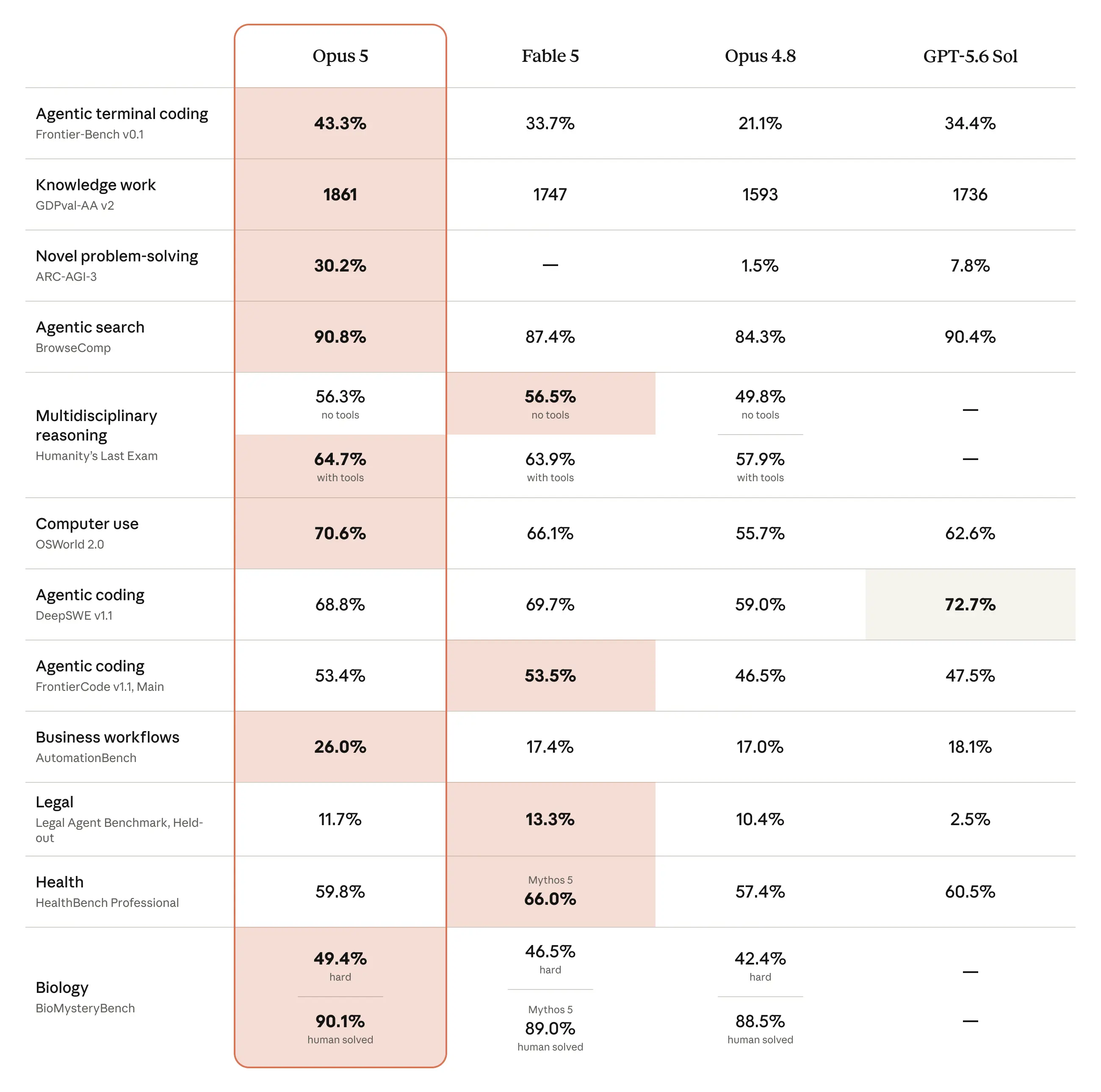
Claude Opus 5 今日正式发布。它是一款深思熟虑且积极主动的模型,以一半的价格逼近 Claude Fable 5 的前沿智能。
在 Frontier-Bench 和 GDPval-AA 等编码与知识工作评测中,Opus 5 达到了新的最佳水平,但在网络安全任务上仍不及 Mythos 5。
Opus 5 专为日常使用而设计:它比其他模型工作更高效。它将成为 Claude Max 的新默认模型,也是 Claude Pro 上最强的模型。
Claude Opus 5 provides greatly improved performance for the same cost as its predecessor, Opus 4.8. The charts in this section show how performance changes according to the model’s effort setting, which customers can use to optimize for intelligence or conserve tokens for faster and cheaper results.
Claude Opus 5 在成本与前代 Opus 4.8 相同的前提下,性能大幅提升。本节图表展示了性能如何随模型的 effort 设置而变化,客户可利用这一设置在智能与 token 消耗之间进行优化,以获得更快速、更经济的结果。
Opus 5 excels on valuable software engineering tasks. For example, on Frontier-Bench v0.1, Opus 5 surpasses all other models, and more than doubles Opus 4.8’s performance at a lower cost per task. On CursorBench 3.2, at max effort, the model performs within 0.5% of Fable 5’s peak score, but at half the cost per task; it also achieves greater performance at a given cost than all other models on high, xhigh, and max effort.
Opus 5 在关键的软件工程任务上表现出色。例如,在 Frontier-Bench v0.1 上,Opus 5 超越了所有其他模型,且每任务成本更低,性能是 Opus 4.8 的两倍以上。在 CursorBench 3.2 上,使用最大 effort 时,该模型的表现与 Fable 5 的最高分相差不到 0.5%,但每任务成本减半;在 high、xhigh 和 max effort 设置下,给定成本下的性能也优于所有其他模型。
We see similar results on knowledge work and problem-solving tasks. For example:
On ARC-AGI 3, an evaluation where the model has to solve novel problems, Opus 5’s score is three times as high as the next-best model.
On Zapier AutomationBench, which measures whether models can complete business tasks from start to finish, Opus 5’s pass rate is around 1.5× the next-best model for the same cost per task. Even at its lowest effort setting, Opus 5 passes more tasks than any other model.
On OSWorld 2.0, a computer use benchmark, Opus 5 outperforms every other model at any given cost, surpassing Fable 5’s best result at just over a third of the cost.
It’s also our best and most cost-efficient model on several related evaluations:
我们在知识工作和问题解决任务上也看到了类似的结果。例如:
在 ARC-AGI 3(一项要求模型解决全新问题的评测)上,Opus 5 的得分是次优模型的三倍。
在 Zapier AutomationBench(评估模型能否从头到尾完成业务任务)上,Opus 5 的通过率约为次优模型的 1.5 倍,且成本相同。即使在其最低 effort 设置下,Opus 5 通过的任务数也超过任何其他模型。
在 OSWorld 2.0(一项计算机使用基准测试)上,Opus 5 在任意给定成本下都优于所有其他模型,以略高于三分之一的成本超越了 Fable 5 的最佳结果。
在多项相关评估中,它也是我们最好、最具成本效益的模型:
Opus 5 is a meaningful improvement over Opus 4.8 for scientific research. It shows better performance than Opus 4.8 on every one of our life sciences evaluations, which cover topics including structural biology, organic chemistry, and bioinformatics. Its improvements are most notable on organic chemistry tasks, like inferring molecular structures from spectroscopy data (it scores 10.2 percentage points higher than Opus 4.8 on our internal benchmark), and on protein-related tasks like predicting how variations in a protein’s sequence affect how it functions (here, it scores 7.7 percentage points higher).
在科学研究方面,Opus 5 相对于 Opus 4.8 有显著改进。在我们涵盖结构生物学、有机化学和生物信息学等主题的所有生命科学评估中,Opus 5 的表现均优于 Opus 4.8。改进最明显的是有机化学任务,例如从光谱数据推断分子结构(在我们的内部基准上,它的得分比 Opus 4.8 高 10.2 个百分点),以及与蛋白质相关的任务,例如预测蛋白质序列变异如何影响其功能(在此方面,它的得分高 7.7 个百分点)。
Finally, Opus 5 is capable of producing much stronger visual outputs:
Working with Claude Opus 5
Claude Opus 5 is much stronger at verifying its work and iterating carefully until it succeeds. In evaluations and early-access testing, we and our users found many examples of Opus 5’s agency and thoroughness:
On one Frontier-Bench task, Opus 5 was given a drawing of a machine part and asked to write code to rebuild it as a 3D FreeCAD model. However, in this task, the model was intentionally given no way to directly view the drawing. Opus 5 responded by writing its own computer vision pipeline to pull the geometry from the raw pixels, then reconstructed the full machine part. It succeeded in doing so repeatedly; no competing model with the same setup could solve it after five attempts.
Given a real bug in a popular open-source package manager, Opus 5 found the root cause and fixed an edge case that the community’s patch had missed. A competing model fixed only the surface symptom (not the underlying cause), then reported the bug resolved.
An engineer at a trading firm used Opus 5 to build a market data feed for a new exchange in a single session. Previous models could not complete this task at all, even given extensive plans from the engineer. Finding no live feed to validate against, Opus 5 even built its own test harness to check that its code parsed the exchange’s data correctly.
最后,Opus 5 能够产生更强的视觉输出:
与 Claude Opus 5 协同工作
Claude Opus 5 在验证自身工作并反复迭代直至成功方面要强大得多。在评测和早期访问测试中,我们和用户发现了许多体现 Opus 5 主动性和彻底性的例子:
在一个 Frontier-Bench 任务中,Opus 5 被要求根据一张机械零件图纸编写代码,将其重建为 3D FreeCAD 模型。但在此任务中,模型被故意剥夺了直接查看图纸的途径。Opus 5 的回应是编写自己的计算机视觉管道,从原始像素中提取几何形状,然后重建了整个机械零件。它多次成功完成;其他竞争模型在相同设置下尝试五次都无法解决。
面对一个流行开源包管理器中的真实 bug,Opus 5 找到了根本原因,并修复了社区补丁遗漏的一个边缘情况。而竞争模型仅修复了表面症状(而非根本原因),然后报告 bug 已解决。
一家交易公司的工程师利用 Opus 5 在一个会话中为新交易所构建了市场数据推送。之前的模型即使有了工程师的详尽计划也无法完成此任务。由于没有实时推送可供验证,Opus 5 甚至构建了自己的测试工具来检查其代码是否正确解析了交易所的数据。
Below are further reports from our early-access customers on their experience of working with Opus 5:

On FrontierCode 1.1, Claude Opus 5 approaches Fable-level performance at half the cost. Within Devin, it also shows particular strength on difficult debugging and root-cause analysis tasks.

Claude Opus 5 delivers near Fable 5 intelligence at Opus speed and cost. On CursorBench it’s just under Fable 5 and has many of the same behaviors. We are excited to see how developers use it in Cursor.

Claude Opus 5 topped Zapier’s AutomationBench leaderboard without spending more tokens than prior Claude models. It took a raw account-health workbook and ran a full churn-prevention sequence end to end: flagging at-risk accounts, alerting the right owner, and summarizing for retention ops. Previous models didn’t pass; Opus 5 hit 100%.

On our genomics analysis work, Claude Opus 5 behaves more like a careful scientist than any model we’ve run. It reaches for the right statistical tests to rule out confounders, cross-checks its own results by independent methods, and stays on track through long multi-step analyses.

Claude Opus 5 came out ahead of every model in its family on our internal evals. It isn’t just better on our hardest agentic coding tasks, up 22% over Opus 4.7, it’s steadier, with far less variance run to run. For the millions of builders on Lovable, that consistency is the whole game. Reliable results, build after build.

Claude Opus 5 is the biggest leap in the Opus family since 4.5. On the same full-stack app builds, the front end shows it first: the best animations, games, and 3D work we have seen from an Opus model.

We’re loving Claude Opus 5. For the kind of open-ended analytical work our agent handles, it’s a strict upgrade over Opus 4.8, and the gains are biggest exactly where it matters: the harder, vaguer tasks. Responses are clearer and more concise, and we see improved efficiency at higher effort levels too.

Claude Opus 5 is a striking improvement over Opus 4.8 for the financial research workflows our analysts run every day. It stands out on numerical reasoning, table work, and sharper critical thinking where precision matters.

Claude Opus 5 delivers the industry intelligence and accuracy that is essential for the analysis of specialized enterprise content. Box found that Opus 5 outperforms Opus 4.8 by 8% and delivers notable performance gains in the data analysis (11% improvement) and due diligence (17% improvement) workflows that technology, healthcare, and public sector organizations rely on daily.

Claude Opus 5 is a clear generational step up from Opus 4.8. Over one weekend I gave it a chief-of-staff role over my dev environments: it built its own monitor, drove each box, and pulled me in only for the judgment calls.

Claude Opus 5 made large scale changes across our Fundamental Research Assistant codebase, adapting to feedback throughout an agentic workflow and explaining its reasoning more clearly than any model we’ve used. It handled work we would normally have broken into much smaller pieces.

On some of our hardest financial-modeling tasks, Claude Opus 5 is a clear step up from Opus 4.8 in both accuracy and efficiency. Its performance floor is materially higher, especially on deep finance domain logic. Across effort levels it averaged 9 percentage points higher accuracy with a third fewer turns and tool calls and 60% less time.

Claude Opus 5 checks its own work the way a real frontend developer would. On our benchmark it opened its pages in a browser at desktop and phone widths, caught a product hidden below the mobile fold and an off-screen checkout button, and fixed both before handing the work back.

Claude Opus 5 is a clear step up in performance on legal agent work compared to prior Opus models, and we saw the biggest gains in practice areas like corporate governance and arbitration. We were also impressed with Opus 5’s ability to maintain quality at lower reasoning levels, achieving similar performance while generating 26% fewer tokens on average compared to Opus 4.8 at max reasoning.

Claude Opus 5’s biggest gains for us are on longer-horizon work: building a full deck, then revising it. Artifact quality is what decides which model we ship, and this is the clearest step up we’ve seen — better visual understanding, cleaner formatting, fewer slide issues.

Claude Opus 5’s judgment is what stands out. Handing off a PR, it doesn’t rush to publish: it verifies the branches, checks the template, and thinks through test implications so the handoff is clean. The older models tended to jump ahead and get caught on our checks.

During a rearchitecting session, Claude Opus 5 pushed back on a design I proposed, and it didn’t fold when I insisted. Instead, it explained exactly what was valuable in my idea, narrowed its objection to a single design question, and proposed a compromise that kept the good part while fixing the flaw. That’s the kind of judgment that lets us trust it with less oversight.

On first-turn redlines, Claude Opus 5 scored the highest of any model we tested, nearly double Opus 4.8. Commenting is better too: on NDAs it gets to the redline in less time and with fewer passes, with accuracy maintained or better.

Claude Opus 5 writes clean, tight diffs with no dead code, and it’s the stronger hazard spotter on subtle, codebase-specific issues. We’re adopting it for production workloads.

We will definitely migrate a number of use cases in Cosmos, our unified agent platform. We’re looking forward to increasingly using Claude Opus 5 for code review, and I am confident in saying we would rather people be using Opus 5 than Opus 4.8.

What stands out about Claude Opus 5 is judgment. It thinks harder before it writes a single line, catches its own logical faults during planning rather than after the fact, and reasons about why an answer is right, not just whether it works. It’s the clearest jump in problem-solving we’ve seen from one Claude model to the next, and we’re looking forward to seeing it adopted in JetBrains IDEs.

Claude Opus 5 is the strongest Opus model we’ve tested on our trading benchmark, and it gets there using roughly a seventh of the reasoning tokens and under half the latency of Opus 4.8. Better answers at a fraction of the compute.

Claude Opus 5 lets monitoring agents manage parts of their own memory in production, making them more autonomous and reliable over longer horizons. The agent treats its context as a living document: after flagging a potential anomaly in one of our services, it re-checked its own assumption against production, found the signal was benign, wrote the correction into its memory, and retired its monitoring queries on its own.

Claude Opus 5 is a strong agentic coding model built for long-running, multi-step work. It deeply understands your codebase, holds the thread across complex tasks, and pins down requirements for feature development and bug-fixing more effectively than Opus 4.8. Developers can now build with Opus 5 in Kiro, accessing its advanced capabilities to tackle ambitious projects.
以下是我们早期访问客户对 Opus 5 使用体验的进一步反馈:
在 FrontierCode 1.1 上,Claude Opus 5 以一半的成本达到了接近 Fable 水平的性能。在 Devin 内部,它在困难的调试和根因分析任务上也表现出特别强的实力。
Claude Opus 5 以 Opus 的速度和成本提供了接近 Fable 5 的智能。在 CursorBench 上,它略低于 Fable 5,但具有许多相同的行为。我们很期待看到开发者如何在 Cursor 中使用它。
Claude Opus 5 在 Zapier 的 AutomationBench 排行榜上名列榜首,且没有比之前的 Claude 模型消耗更多 token。它拿到一个原始的账户健康工作簿,从头到尾运行了完整的流失预防流程:标记风险账户、提醒相应负责人、并为留存运营团队做总结。之前的模型未能通过,而 Opus 5 达到了 100%。
在我们的基因组分析工作中,Claude Opus 5 比我们运行过的任何模型都更像一位谨慎的科学家。它采用正确的统计检验来排除混杂因素,通过独立方法交叉验证自身结果,并在长时间的多步骤分析中保持专注。
Claude Opus 5 在我们的内部评估中超越了同系列的所有其他模型。它不仅在我们最难的智能体编码任务上表现更好(比 Opus 4.7 高出 22%),而且更加稳定,每次运行之间的方差小得多。对于 Lovable 上数百万的构建者来说,这种一致性就是一切。每次构建都能得到可靠的结果。
Claude Opus 5 是 Opus 家族自 4.5 以来最大的飞跃。在相同的全栈应用构建上,前端首先体现了这一点:这是我们从 Opus 模型中见过的最佳动画、游戏和 3D 作品。
我们喜欢 Claude Opus 5。对于我们的智能体处理的开放式分析工作,它是对 Opus 4.8 的严格升级,而且提升最大的恰好是最关键的地方:更困难、更模糊的任务。回答更清晰、更简洁,我们还在更高的 effort 水平下看到了效率的提升。
Claude Opus 5 对于我们分析师每天运行的金融研究工作流程来说,是相对于 Opus 4.8 的一次显著改进。它在数值推理、表格处理以及在需要精确性的领域进行更敏锐的批判性思考方面表现出色。
Claude Opus 5 提供了专业企业内容分析所需的行业智能和准确性。Box 发现 Opus 5 比 Opus 4.8 性能提升 8%,并在数据分析(提升 11%)和尽职调查(提升 17%)工作流程中带来了显著收益,这些工作流程是技术、医疗和公共部门组织每天所依赖的。
Claude Opus 5 是相对于 Opus 4.8 的一次明显的代际飞跃。一个周末,我让它扮演我开发环境中的参谋长角色:它构建了自己的监控器,驱动每台机器,只有在需要做出判断时才来找我。
Claude Opus 5 在我们的 Fundamental Research Assistant 代码库中进行了大规模更改,在整个智能体工作流程中根据反馈进行调整,并且比我们使用过的任何模型都更清晰地解释其推理过程。它处理了我们通常会分解成更小片段的工作。
在我们一些最困难的金融建模任务上,Claude Opus 5 在准确性和效率方面都比 Opus 4.8 有了明显的提升。它的性能下限显著提高,尤其是在深度金融领域逻辑方面。在各种 effort 水平下,它的准确率平均高出 9 个百分点,而轮次和工具调用减少了三分之一,时间减少了 60%。
Claude Opus 5 像真正的前端开发者一样检查自己的工作。在我们的基准测试中,它在桌面和手机宽度的浏览器中打开页面,发现了折叠线以下被隐藏的产品和屏幕外的结账按钮,并在交回工作前修复了这两个问题。
Claude Opus 5 在法律智能体工作上的性能相比之前的 Opus 模型有了明显提升,我们在公司治理和仲裁等实践领域看到了最大的收益。同时,Opus 5 在较低推理水平下保持质量的能力也给我们留下了深刻印象:与 Opus 4.8 在最大推理时相比,它实现了相似性能,同时平均生成的 token 减少了 26%。
对我们来说,Claude Opus 5 最大的收益在于更长周期的工作:构建完整的演示文稿,然后进行修订。工件质量决定了我们选择哪个模型进行交付,而这是我们见过的最明显的进步——更好的视觉理解、更清晰的格式、更少的幻灯片问题。
Claude Opus 5 的判断力最为突出。在移交 PR 时,它不会急于发布:它会验证分支、检查模板,并思考测试影响,从而确保交接干净利落。较旧的模型往往急于推进,从而在执行我们的检查时被卡住。
在一次重构会话中,Claude Opus 5 反驳了我提出的一个设计方案,并且在我坚持时也没有退缩。相反,它准确地解释了我的想法中哪些是有价值的,将反对意见缩小到单个设计问题,并提出了一个保留优点同时修复缺陷的折中方案。这种判断力让我们在减少监督的情况下也能信任它。
在第一次合同修订中,Claude Opus 5 在我们测试的所有模型中得分最高,几乎是 Opus 4.8 的两倍。注释功能也更好了:在 NDA 上,它以更短的时间和更少的轮次达到修改界限,且准确率保持不变或更好。
Claude Opus 5 编写干净、紧凑的 diff,没有死代码,并且在微妙的、特定于代码库的问题上是更强大的隐患发现者。我们正在将其用于生产工作负载。
我们肯定会将我们的统一智能体平台 Cosmos 中的许多用例迁移过来。我们期待越来越多地使用 Claude Opus 5 进行代码审查,并且我确信,我们更希望人们使用 Opus 5 而不是 Opus 4.8。
Claude Opus 5 的突出之处在于判断力。它在写一行代码之前会更深入地思考,在规划阶段而非事后发现自身的逻辑错误,并且会推理答案为何正确,而不仅仅是是否有效。这是我们见过的从一代 Claude 模型到下一代在问题解决方面最明显的飞跃,我们期待它在 JetBrains IDE 中得到采用。
Claude Opus 5 是我们测试过的交易基准测试中最强的 Opus 模型,而且它使用的推理 token 大约只有 Opus 4.8 的七分之一,延迟不到一半。用更少的算力获得更好的答案。
Claude Opus 5 让监控智能体在生产环境中管理自身部分内存,使其在更长的时间范围内更加自主和可靠。该智能体将其上下文视为一个活文档:在标记了某个服务中的潜在异常后,它重新检查了自己的假设与实际生产情况,发现该信号是良性的,将修正写入内存,并自行停止了监控查询。
Claude Opus 5 是一款强大的智能体编码模型,专为长期、多步骤工作而构建。它深入理解你的代码库,在复杂任务中保持主线,并且比 Opus 4.8 更有效地确定功能开发和 bug 修复的需求。开发者现在可以在 Kiro 中使用 Opus 5 进行构建,利用其高级能力来处理雄心勃勃的项目。
During pre-deployment testing, our automated behavioral audit found Opus 5 to be our most aligned model to date (as shown in the graph below). It adheres to Claude’s Constitution better than Opus 4.8, Sonnet 5, or Fable 5; exhibits the lowest rates of deceptive behavior; and is the least susceptible to being tricked into misuse. It’s also our safest model yet in terms of avoiding reckless actions that could have hard-to-reverse side effects.
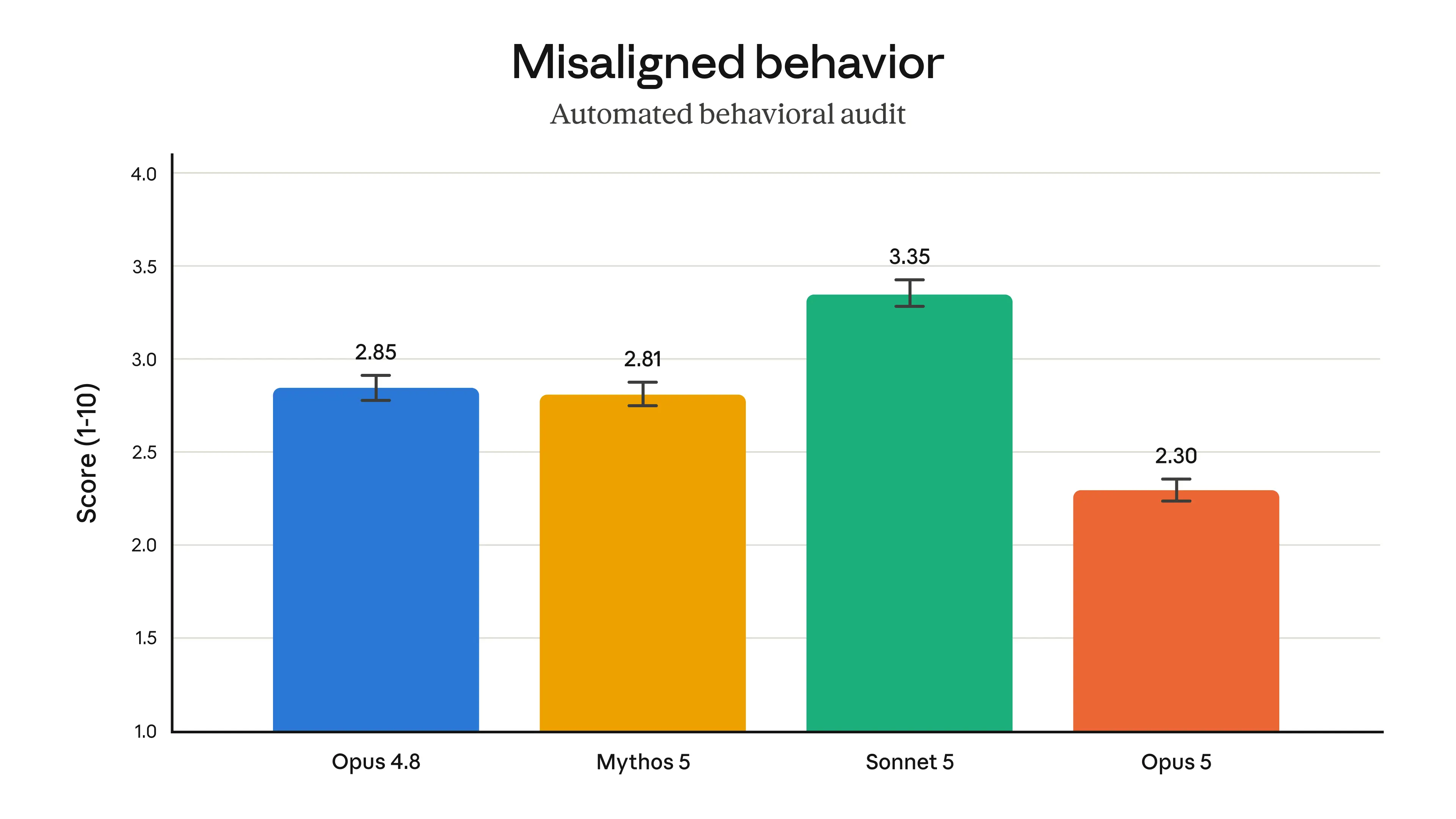
On our automated behavioral audit, Opus 5 scores 2.3 on overall misaligned behavior, the lowest of our recent models.
在部署前的测试中,我们的自动行为审计发现 Opus 5 是迄今为止对齐度最高的模型(如下图所示)。它比 Opus 4.8、Sonnet 5 或 Fable 5 更严格地遵循 Claude 的宪法;表现出最低的欺骗性行为率;并且最不易被诱导滥用。在避免可能产生难以逆转的副作用的鲁莽行为方面,它也是我们迄今为止最安全的模型。
在我们的自动行为审计中,Opus 5 的整体失调行为评分为 2.3,是我们近期模型中最低的。
Opus 5 does not advance the frontier in risky, dual-use capabilities. In rigorous evaluations conducted alongside private-sector and government partners, we found it remains behind Mythos 5 in both biology research and offensive cybersecurity. More information about these evaluations can be found in our System Card.
As with its predecessor, Opus 4.8, we’ve intentionally avoided training Opus 5 on cyber tasks. The model has nevertheless improved substantially on these tasks as a result of becoming more generally capable, and it comes close to Mythos 5 at finding cybersecurity vulnerabilities. However, it remains substantially behind Mythos 5 on the exploitation of those vulnerabilities—that is, in turning vulnerabilities into material cyber threats.
This is illustrated by Opus 5’s performance on OSS-Fuzz, an evaluation we’ve developed to assess how well models can find and then exploit vulnerabilities without extensive human guidance. Although Mythos 5 and Opus 5 identify vulnerabilities with similar success, Opus 5’s score on the development of exploits is far behind that of Mythos 5.
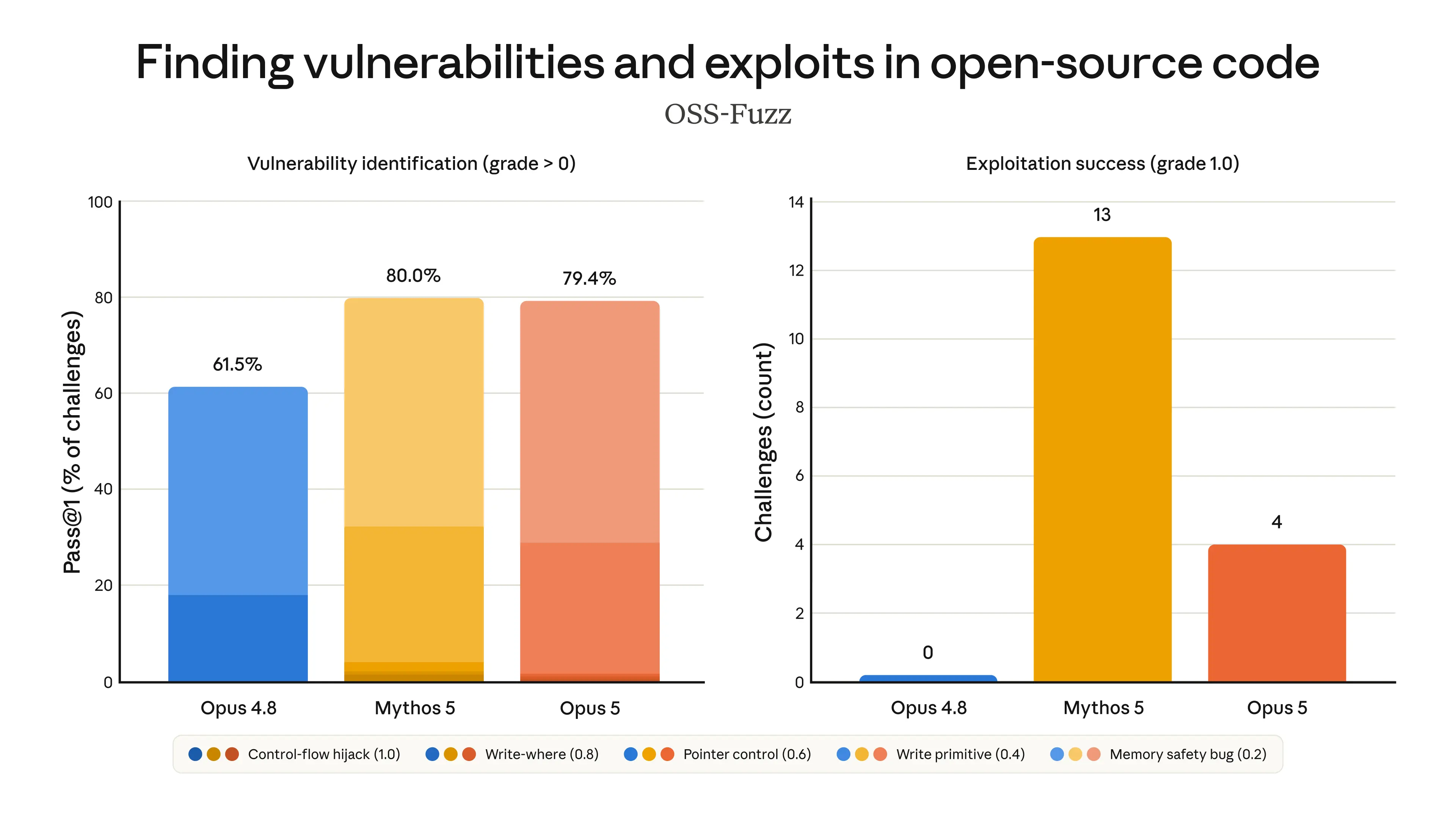
On OSS-Fuzz, one of our cybersecurity evaluations, Opus 5 is close to Mythos 5 at identifying software vulnerabilities (left), but is considerably less successful at developing exploits for them (right).
Opus 5 在危险的双重用途能力上没有推动前沿。在与私营部门和政府合作伙伴共同进行的严格评估中,我们发现它在生物学研究和攻击性网络安全方面均落后于 Mythos 5。更多关于这些评估的信息可在我们的系统卡中找到。
与它的前代 Opus 4.8 一样,我们有意避免在网络安全任务上训练 Opus 5。然而,由于整体能力提升,该模型在这些任务上仍然有了显著改进,并且在发现网络安全漏洞方面接近 Mythos 5。但在利用这些漏洞——即将漏洞转化为实质性网络威胁方面——它仍远落后于 Mythos 5。
这通过 Opus 5 在 OSS-Fuzz 上的表现可以说明。OSS-Fuzz 是我们开发的一项评估,用于衡量模型在无需大量人工指导的情况下发现并利用漏洞的能力。尽管 Mythos 5 和 Opus 5 在识别漏洞方面成功率相似,但 Opus 5 在漏洞利用开发方面的得分远低于 Mythos 5。
在 OSS-Fuzz(我们的网络安全评估之一)中,Opus 5 在识别软件漏洞(左图)方面接近 Mythos 5,但在开发利用(右图)方面则远逊于 Mythos 5。
Claude Opus 5’s safeguards are designed to allow beneficial uses of the model in both cybersecurity and biology. They are similar to those we applied to Opus 4.8, with the exception of some stronger guardrails on a narrow range of cyber tasks.
Cybersecurity. Opus 5’s cyber classifiers are proportionally less restrictive than those on Fable 5. They allow Opus 5 to find vulnerabilities in source code, but block “binary-based” vulnerability scanning (a method more likely to be associated with malicious actors), penetration testing, and exploit generation.
Based on our testing, we expect the classifiers to intervene around 85% less often than they do for Fable 5. In Claude.ai, Claude Code, and Claude Cowork, any flagged requests will fall back to Opus 4.8 by default. Fallbacks to Opus 4.8 can also be enabled on the API.
Our Cyber Verification Program (CVP) facilitates cybersecurity work that would otherwise be impeded by the model’s safeguards. Enterprises and researchers who are already part of the CVP have immediate access to a version of Opus 5 with fewer security restrictions.
Biology. Since Opus 5 has a similar suite of safeguards to Opus 4.8, it is now our most capable generally available model for scientific research. Nevertheless, the model still shows important limitations on long-running, autonomous research tasks, which is where we expect AI models to pose the most substantial biology-related risks. (Mythos 5 remains the stronger model for this type of biological work.) As part of this launch, biology-related requests that are blocked on Fable 5 will now route to Opus 5 rather than Opus 4.8.
Claude Opus 5 的安全防护措施旨在允许模型在网络安全和生物学领域的有益用途。它们与我们应用于 Opus 4.8 的防护措施类似,仅在少数网络安全任务上加强了防护栏。
网络安全。Opus 5 的网络安全分类器在比例上比 Fable 5 的限制性更弱。它们允许 Opus 5 发现源代码中的漏洞,但阻止“基于二进制”的漏洞扫描(一种更可能被恶意行为者使用的方法)、渗透测试和漏洞利用生成。
根据我们的测试,预计这些分类器的干预频率将比 Fable 5 低约 85%。在 Claude.ai、Claude Code 和 Claude Cowork 中,任何被标记的请求将默认回退到 Opus 4.8。API 上也可以启用回退到 Opus 4.8。
我们的网络安全验证计划(CVP)促进了因模型防护措施而受阻的网络安全工作。已加入 CVP 的企业和研究人员可以立即访问安全限制更少的 Opus 5 版本。
生物学。由于 Opus 5 拥有与 Opus 4.8 类似的防护措施,它现在是我们用于科学研究的最强大的通用模型。不过,该模型在长时间运行的自主研究任务上仍表现出重要限制,而这正是我们认为 AI 模型可能带来最重大生物学相关风险的领域。(Mythos 5 在这方面仍然是更强的模型。)作为此次发布的一部分,之前在 Fable 5 上被阻止的生物学相关请求现在将路由到 Opus 5 而非 Opus 4.8。
Claude Opus 5 is available today on all platforms, priced at $5 per million input tokens and $25 per million output tokens (the same as Opus 4.8). Developers can get started with claude-opus-5 on the Claude API.
It’s also offered in Fast mode, where it runs around 2.5 times the default speed. As with Opus 4.8, Fast mode is available at twice Opus 5’s base price on the Claude Platform and through usage credits in Claude Code.
Alongside Opus 5, we’re releasing two updates in beta:
Mid-conversation tool changes on the Claude Platform. Within a conversation, developers can now change which tools Claude can use without invalidating the prompt cache.
Automatic fallbacks on the API. Users can now choose to have requests that are flagged by our safety classifiers on Opus 5 (or Fable 5) automatically route to another model. With automatic fallbacks on, API requests always route to the best available model by default rather than being blocked.
Consistent with prior Opus models, Opus 5 does not have data retention requirements for general access.
For more guidance on how to get the best out of Opus 5, see our prompting guide.
Claude Opus 5 今日在所有平台上可用,定价为每百万输入 token 5 美元,每百万输出 token 25 美元(与 Opus 4.8 相同)。开发者可以通过 Claude API 使用 claude-opus-5 开始。
它还提供快速模式,运行速度约为默认速度的 2.5 倍。与 Opus 4.8 一样,快速模式在 Claude 平台上的价格为 Opus 5 基础价格的两倍,并可通过 Claude Code 中的使用额度获取。
与 Opus 5 一同,我们还发布了两个测试版更新:
Claude 平台上的对话中工具更改。在对话中,开发者现在可以更改 Claude 可使用的工具,而不会使提示缓存失效。
API 上的自动回退。用户现在可以选择让被 Opus 5(或 Fable 5)安全分类器标记的请求自动路由到其他模型。启用自动回退后,API 请求将默认路由到可用最佳模型,而不是被阻止。
与之前的 Opus 模型一致,Opus 5 没有针对通用访问的数据保留要求。
关于如何充分利用 Opus 5 的更多指导,请参阅我们的提示指南。
Frontier-Bench v0.1, Effort plot: These results are from an internal run of Frontier-Bench v0.1, on the mini-SWE-agent harness and a GKE backend, mean reward over 5 attempts per task. Opus 4.8 served as fallback on safety-classifier refusals for Opus 5 and Fable 5.
Frontier-Bench v0.1,Effort 图:这些结果来自 Frontier-Bench v0.1 的内部运行,使用 mini-SWE-agent 框架和 GKE 后端,每个任务取 5 次尝试的平均奖励。Opus 4.8 作为 Opus 5 和 Fable 5 的安全分类器拒绝回退。