Kimi K3 发布:2.8T参数开源模型,聚焦长周期编程与知识密集型工作
月之暗面发布了 Kimi K3,一个 2.8T 参数的开源模型,采用 Kimi Delta Attention (KDA) 和 Attention Residuals (AttnRes) 架构,激活 896 个专家中的 16 个,扩展效率较 K2 提升约 2.5 倍。Kimi K3 支持原生视觉和 100 万 token 上下文窗口,在编程、知识工作、推理等基准上与 Claude Fable 5 和 GPT 5.6 Sol 竞争,虽整体仍稍逊,但在多个内部评测中表现突出。文章详细展示了其在 GPU 内核优化、编译器开发(MiniTriton)、3D 游戏开发、芯片设计(48 小时自主设计芯片)、科研复现(2 小时完成通常 1-2 周的工作)等场景的案例。Kimi K3 即日起可通过 Kimi.com、Kimi Work、Kimi Code 和 API 使用,完整模型权重将于 7 月 27 日开源。适合 AI 系统工程师、模型开发者、以及需要长周期代理工作能力的研究人员。
Today, we are introducing Kimi K3 — our most capable model. Kimi K3 is a 2.8T-parameter model built on our Kimi Delta Attention and Attention Residuals, with native vision capabilities and a 1-million-token context window. It is the world's first open 3T-class model, designed for frontier intelligence across long-horizon coding, knowledge work, and reasoning.
While its overall performance still trails the most powerful proprietary models, Claude Fable 5 and GPT 5.6 Sol, Kimi K3 demonstrated frontier-level performance across our evaluation suite, consistently outperforming other tested models.
Kimi K3 is available today on Kimi.com, Kimi Work, Kimi Code, and the Kimi API. At launch, Kimi K3 will use max thinking effort by default, with low- and high-effort modes to be introduced in subsequent updates. We are currently working closely with inference partners and open-source maintainers to align technical details and ensure a reliable rollout across the ecosystem. The full model weights will be released by July 27, 2026. Further details on the architecture, training, and evaluations will be released alongside the Kimi K3 technical report.
今天,我们正式发布 Kimi K3——这是我们目前能力最强的模型。Kimi K3 是一个拥有 2.8 万亿参数的模型,基于我们自研的 Kimi Delta Attention 和 Attention Residuals 架构,具备原生视觉能力和 100 万 token 的上下文窗口。它是全球首个开源的 3T 级模型,专为长周期编程、知识工作和推理等前沿智能任务而设计。
虽然整体性能仍略逊于目前最强大的闭源模型 Claude Fable 5 和 GPT 5.6 Sol,但 Kimi K3 在我们的评估套件中展现了前沿水平的表现,持续优于其他参与测试的模型。
Kimi K3 现已登陆 Kimi.com、Kimi Work、Kimi Code 和 Kimi API 平台。发布之初,Kimi K3 默认使用最大思考力度(max thinking effort),低力度和高力度模式将在后续更新中推出。我们正与推理合作伙伴及开源社区维护者紧密协作,对齐技术细节,确保生态系统内的可靠落地。完整模型权重将于 2026 年 7 月 27 日前释放。关于架构、训练和评估的更多细节,将与 Kimi K3 技术报告一同发布。
An Open 3T-Class Model
Kimi K3 is the first open model to reach 2.8 trillion parameters. It marks the latest step in Kimi's sustained push at the scaling frontier: for nine of the past twelve months, Kimi models have set the upper bound of open-model sizes.
Kimi K3 is built on Kimi Delta Attention (KDA) and Attention Residuals (AttnRes), two architectural updates designed to improve how information flows across sequence length and model depth. We have also scaled up Mixture of Experts (MoE) sparsity, effectively activating 16 out of 896 experts when paired with a Stable LatentMoE framework. Together with refined training and data recipes, these structural changes yield an approximate 2.5× improvement in overall scaling efficiency compared to Kimi K2, allowing the model to convert compute into intelligence more effectively.
αwKDAαwStable LatentMoEαwGated MLAαwStable LatentMoEwα3×1×Block n−1Block n−2Block n−3EmbeddingRouterLinear12123NNormLinearShared ExpertRouted ExpertLinearConvL2LinearConvL2LinearConvσσLinearσKimi Delta AttentionNormLinearOutput
开放 3T 级模型
Kimi K3 是首个达到 2.8 万亿参数的开源模型。这标志着 Kimi 在规模前沿持续突破的最新一步:过去 12 个月中,有 9 个月 Kimi 模型都占据着开源模型规模的上限。
Kimi K3 基于 Kimi Delta Attention(KDA)和 Attention Residuals(AttnRes)两项架构创新,旨在改善信息在序列长度和模型深度上的流动。我们还扩展了混合专家(MoE)的稀疏性,结合 Stable LatentMoE 框架,有效激活 896 个专家中的 16 个。配合优化的训练和数据策略,这些结构变化使得整体扩展效率相比 Kimi K2 提升约 2.5 倍,让模型能更高效地将算力转化为智能。
αwKDAαwStable LatentMoEαwGated MLAαwStable LatentMoEwα3×1×Block n−1Block n−2Block n−3EmbeddingRouterLinear12123NNormLinearShared ExpertRouted ExpertLinearConvL2LinearConvL2LinearConvσσLinearσKimi Delta AttentionNormLinearOutput
Coding
Kimi K3 has strong long-horizon coding performance. Operating with minimal human oversight, it can sustain long engineering sessions, navigate massive repositories, and orchestrate terminal tools.
Kimi K3 also excels in tasks blending software engineering with visual reasoning — it leverages screenshots and visuals to optimize game dev, frontend, and CAD.
The case studies below show how Kimi K3's coding capability translates into open-ended software creation and scientific research.
编程能力
Kimi K3 在长周期编程任务上表现出色。在最小的人类监督下,它能维持长时间的工程会话,浏览大型代码仓库,并协调终端工具。
Kimi K3 还擅长融合软件工程与视觉推理的任务——它利用截图和视觉信息来优化游戏开发、前端设计和 CAD 工作。
以下案例展示了 Kimi K3 的编程能力如何转化为开放式软件创造和科学研究。
Kernel Optimization
We tested the models' capability to optimize GPU kernels. Each model works independently in an identical sandbox, with up to 24 hours to profile, rewrite, and benchmark four tasks spanning AttnRes, KDA, and a 512-head-dimension MLA kernel across NVIDIA H200 and GPGPU from an alternative vendor. Kimi K3 performed competitively with Fable 5 (with fallback) and substantially outperformed Opus 4.8, GPT 5.6 Sol, and GPT 5.5.
Claude Fable 5 was evaluated by a third party, and its results may include fallback behavior. Across most models, some trajectories include small, acceptable precision shortcuts that remain within our numerical tolerance. GPGPU denotes general-purpose GPUs used for computation beyond graphics rendering.
In the late stages of Kimi K3 development, an early version of Kimi K3 handled the majority of the team's kernel optimization works.
GPU 内核优化
我们测试了各模型优化 GPU 内核的能力。每个模型在相同的沙盒环境中独立运行,拥有最多 24 小时来分析、重写和基准测试四个任务,涵盖 AttnRes、KDA 以及一个 512 头维度的 MLA 内核,在 NVIDIA H200 和另一供应商的 GPGPU 上执行。Kimi K3 与 Fable 5(含后备模式)竞争激烈,并显著优于 Opus 4.8、GPT 5.6 Sol 和 GPT 5.5。
Claude Fable 5 由第三方评估,其结果可能包含后备行为。对于大多数模型,部分轨迹包含微小但可接受的精度近似,仍在我们的数值容差范围内。GPGPU 指用于超越图形渲染的通用 GPU。
在 Kimi K3 开发的后期阶段,早期版本的 Kimi K3 承担了团队大部分内核优化工作。
GPU Compiler Development
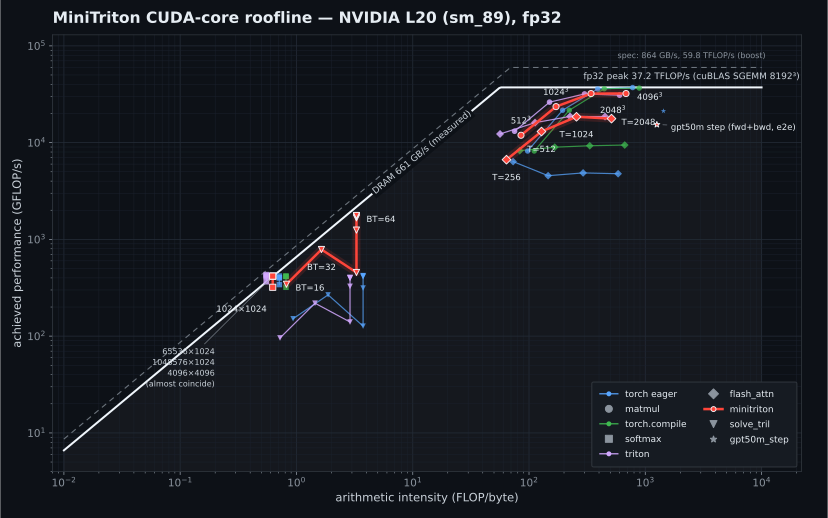
We further tested whether Kimi K3 could build a GPU programming system from scratch. Kimi K3 developed MiniTriton, a compact Triton-like compiler with its own tile-level IR layer over MLIR, optimization passes, and a PTX code-generation pipeline. Across supported roofline benchmarks, MiniTriton delivers performance on par with or better than Triton and torch.compile — beating Triton on certain workloads. Beyond microbenchmarks, MiniTriton sustains end-to-end nanoGPT training with stable convergence, the loss curve closely tracking the reference with only minor divergence — validating the full pipeline on a realistic workload. These results demonstrate that Kimi K3 can build a coherent end-to-end compiler — from DSL frontend and IR passes to PTX codegen and runtime — rather than isolated kernels; its from-scratch Tensor Core path already rivals Triton's extensively optimized stack.
GPU 编译器开发
我们进一步测试了 Kimi K3 能否从零开始构建 GPU 编程系统。Kimi K3 开发了 MiniTriton,一个紧凑的类 Triton 编译器,拥有基于 MLIR 的自有 tile 级 IR 层、优化 passes 和 PTX 代码生成流水线。在受支持的 roofline 基准测试中,MiniTriton 的性能与 Triton 和 torch.compile 相当或更优——在某些负载上甚至超越了 Triton。超越微基准测试,MiniTriton 能够支持端到端的 nanoGPT 训练,实现稳定收敛,损失曲线与参考紧密追踪,仅有微小偏差——在真实负载上验证了完整流水线。这些结果表明,Kimi K3 能够构建连贯的端到端编译器——从 DSL 前端、IR passes 到 PTX 代码生成和运行时,而非孤立的 kernel;其从零实现的 Tensor Core 路径已能与 Triton 高度优化的堆栈相媲美。
Game Dev and Digital Creation
Kimi K3 combines strong 3D reasoning, coding, and vision capabilities to turn concepts, images, and videos into fully playable interactive experiences. Kimi K3 achieves true "vision in the loop" by seamlessly iterating between code and live screenshots—instantly seeing and refining outputs.
Case 1: 3D Open World
Kimi K3 built a fully procedural browser-based 3D exploration game using Three.js WebGPU and GPU compute. It procedurally generated the environment, while using a 3D asset generation tool to create the rider and horse models, producing an expansive open world with forests, a log-cabin village, snowy mountains, and dynamic weather. External assets used: animated cowboy and horse models and terrain data.
游戏开发与数字创作
Kimi K3 结合了强大的 3D 推理、编码和视觉能力,将概念、图片和视频转化为可玩的全交互式体验。Kimi K3 通过在代码和实时截图之间无缝迭代,实现了真正的“视觉闭环”——即时查看并优化输出。
案例 1:3D 开放世界
Kimi K3 使用 Three.js WebGPU 和 GPU 计算构建了一个完全程序化的浏览器端 3D 探索游戏。它程序化地生成了环境,同时使用 3D 资产生成工具创建骑手和马匹模型,打造了一个广阔的开放世界,包含森林、木屋村庄、雪山和动态天气。使用的外部资产:动画牛仔和马匹模型以及地形数据。
Chip Design
As an early proof of concept, Kimi K3 designed a chip to serve a nano model built on its own architecture. In a single 48-hour autonomous run, K3 built, optimized, and verified the chip using open-source EDA tools on the Nangate 45nm library. Within 4 mm², the chip closes timing at 100 MHz and sustains over 8,700 tokens/s decode throughput in simulation, packing 1.46M standard cells, 0.277 MB of SRAM, and an INT4 MAC array with fused dequantization. A chip built by a model, for a model, reflects K3's long-horizon agentic capabilities.
芯片设计
作为早期概念验证,Kimi K3 设计了一款芯片,用于运行基于自身架构构建的 nano 模型。在单次 48 小时的自主运行中,K3 使用开源 EDA 工具在 Nangate 45nm 库上构建、优化并验证了该芯片。在 4 平方毫米内,芯片以 100 MHz 频率收敛时序,仿真中维持超过 8,700 tokens/s 的解码吞吐量,集成了 146 万个标准单元、0.277 MB SRAM 和一个带有融合反量化的 INT4 MAC 阵列。一个由模型为模型设计的芯片,体现了 K3 长周期自主 agent 的能力。
Coding for Research
Kimi K3 bridges scientific literature and executable code, autonomously implementing, validating, and analyzing complex computational research workflows.
In one case, Kimi K3 completed in about two hours what would typically require one to two weeks of work by an experienced researcher. To reproduce the I–Love–Q universal relations in computational astrophysics, it reviewed and cross-validated 20+ papers, implemented the full numerical pipeline, evaluated 300+ equations of state, identified inconsistencies in published formulas, generated 3,000+ lines of Python code, and produced an interactive HTML dashboard for exploring the results.
科学研究编码
Kimi K3 桥接了科学文献与可执行代码,自主实现、验证并分析复杂的计算研究流程。
在一个案例中,Kimi K3 在大约两小时内完成了通常需要经验丰富的研究人员一到两周的工作。为了复现计算天体物理学中的 I–Love–Q 普适关系,它审阅并交叉验证了 20 多篇论文,实现了完整的数值流水线,评估了 300 多个状态方程,识别出已发表公式中的不一致之处,生成了 3000 多行 Python 代码,并制作了一个交互式 HTML 仪表盘来探索结果。
Knowledge Work
Kimi K3 advances end-to-end knowledge work. Beyond public benchmarks, Kimi K3 (max) demonstrates consistent gains across our internal evaluations, which are derived from recurring patterns and challenges observed in real-world user-agent workflows. These consistent advantages across distinct production-oriented workflows reflect a broad improvement in Kimi K3's agentic knowledge work capabilities.
知识工作
Kimi K3 推动了端到端知识工作的发展。超越公开基准,Kimi K3(最大思考模式)在我们的内部评估中展现了持续的优势,这些评估源于真实用户 agent 工作流中反复出现的模式和挑战。在不同生产导向的工作流中,这些持续的优势反映了 Kimi K3 agent 知识工作能力的全面提升。
Research with Interactive Visualization
Below are a few examples of what Kimi K3 in Kimi Work can produce across financial consulting and scientific research:
Case 1: Interactive 42 years of AI ASIC industry research website
An interactive research report you can drill into: 42 years of the ASIC industry, created through 120+ rounds of recursive self-improvement. Kimi K3 transforms evidence into bespoke charts, animated diagrams, and interactive visual narratives. It pulled data via 2.8k+ web searches/fetches and 1.1k+ terminal data pulls, across 11k+ pages spanning 87 quarterly reports and 99 original PDFs.
Case 2: Fusion Industry Research
A consulting-style industry report with interactive visualizations—including timelines, Funnel Chart, Range Bar Chart, Gantt Charts, and publication-quality slides.
Case 3: GWTC-5 Gravitational-wave Analysis
An analysis of 391 gravitational-wave events using 20+ concurrent subagents, producing 7 scientific visualizations, 2 tables, and a literature synthesis from 10+ papers.
Kimi K3 is also particularly effective at producing infographic-style presentations, such as the fully editable heatmap and annual report shown below:
交互式可视化研究
以下是一些 Kimi K3 在 Kimi Work 中产出的示例,涵盖金融咨询和科学研究:
案例 1:交互式 42 年 AI ASIC 行业研究网站
一个可深入探索的交互式研究报告:42 年的 ASIC 行业历史,通过 120 多轮递归自我改进生成。Kimi K3 将证据转化为定制图表、动画图示和交互式视觉叙事。它通过 2800 多次网络搜索/获取和 1100 多次终端数据拉取,跨越 87 份季度报告和 99 份原始 PDF 的 11000 多页,提取了数据。
案例 2:聚变产业研究
一份咨询风格的行业报告,包含交互式可视化——时间线、漏斗图、范围条图、甘特图以及出版质量的幻灯片。
案例 3:GWTC-5 引力波分析
使用 20 多个并发子 agent 分析 391 个引力波事件,生成 7 个科学可视化、2 个表格以及来自 10 多篇论文的文献综述。
Kimi K3 在制作信息图风格的演示文稿方面尤其出色,例如下面显示的可完全编辑的热力图和年度报告:
Widgets and Dashboard
In Kimi Work, we introduce two new features - Widgets and Dashboard - which make interactions with Kimi K3 more visual and persistent. Widgets let you generate interactive components directly within a chat, with connections to local data or external plugins for continuous updates. Dashboard brings the widgets you care about most into one persistent, personalized view organized around a topic, project, or goal.
Widgets 与 Dashboard
在 Kimi Work 中,我们引入了两个新功能——Widgets 和 Dashboard——使与 Kimi K3 的交互更加可视化和持久化。Widgets 允许你在聊天中直接生成交互式组件,并可连接本地数据或外部插件实现持续更新。Dashboard 将你最关心的 widgets 整合到一个围绕主题、项目或目标组织的持久化个性化视图中。
Video Editing
Kimi K3 excels at motion design, animation, and video editing because its native multimodal architecture understands text, images, and video within the same model.
In one example, K3 created a 3Blue1Brown-style motion-graphics explainer of its own architecture, translating technical ideas into animated diagrams and transitions.
In another, Kimi K3 edited its own teaser video from 56 source clips, handling clip selection, motion-matched cuts, frame-accurate beat synchronization, audio processing, and multiple rounds of revision. A high-density short video like this would typically take an experienced editor one to two working days, or a beginner three to five.
视频编辑
Kimi K3 在动态设计、动画和视频编辑方面表现出色,因为其原生多模态架构能够在同一模型中理解文本、图像和视频。
在一个例子中,K3 制作了一个 3Blue1Brown 风格的自身架构解释动画,将技术概念转化为动画图示和转场。
另一个例子中,Kimi K3 从 56 个源剪辑中编辑了自己的预告视频,完成了剪辑选择、动作匹配剪接、帧精确的节奏同步、音频处理和多轮修改。这样一个高密度短视频通常需要经验丰富的编辑一到两个工作日,或初学者三到五天。
Architecture and Infrastructure
Kimi K3 is built on Kimi Delta Attention (KDA) and Attention Residuals (AttnRes). KDA provides an efficient foundation for scaling attention, while AttnRes selectively retrieves representations across depth rather than accumulating them uniformly. Together, they form the architectural backbone of a model designed to scale well beyond the trillion-parameter regime.
架构与基础设施
Kimi K3 基于 Kimi Delta Attention(KDA)和 Attention Residuals(AttnRes)构建。KDA 为扩展注意力机制提供了高效基础,而 AttnRes 则跨深度选择性检索表示,而非均匀累积。两者共同构成了模型架构的骨干,旨在超越万亿参数规模进行扩展。
Kimi K3 uses Stable LatentMoE, effectively activating 16 of 896 experts. At this level of sparsity, routing and optimization become first-order challenges. Quantile Balancing derives expert allocation directly from router-score quantiles, eliminating heuristic updates and a sensitive balancing hyperparameter, while Per-Head Muon extends Muon by optimizing attention heads independently for more adaptive learning at scale. Sigmoid Tanh Unit (SiTU) and Gated MLA improve activation control and attention selectivity respectively. Together, these advances enable stable and efficient training at the 2.8-trillion-parameter scale.
Kimi K3 采用 Stable LatentMoE,有效激活 896 个专家中的 16 个。在这种稀疏度下,路由和优化成为首要挑战。Quantile Balancing 直接从路由器得分的分位数推导专家分配,消除了启发式更新和敏感的平衡超参数;同时,Per-Head Muon 通过独立优化注意力头扩展了 Muon,以实现更大规模的自适应学习。Sigmoid Tanh Unit(SiTU)和 Gated MLA 分别改进了激活控制和注意力选择性。这些进步共同实现了 2.8 万亿参数规模的稳定高效训练。
Kimi K3 applies quantization-aware training from the SFT stage onward, using MXFP4 weights with MXFP8 activations for broad hardware compatibility. To prevent expert imbalance from degrading throughput at large expert-parallel scales, we introduce a fully balanced expert-parallel training method with static shapes and no host synchronization on the critical path. Since inference efficiency likewise benefits from larger high-bandwidth communication domains, we recommend deploying Kimi K3 on supernode configurations with 64 or more accelerators. Finally, as KDA poses new challenges for conventional prefix caching, we have contributed a corresponding implementation to the vLLM community, to be released alongside the model. KDA with prefill cache allows us to serve Kimi K3 at a highly competitive token price despite its scale and long context.
More technical details will be available in our coming report.
Kimi K3 从 SFT 阶段开始就应用量化感知训练,使用 MXFP4 权重和 MXFP8 激活,以获得广泛的硬件兼容性。为防止专家不平衡在大的专家并行规模下降低吞吐量,我们引入了一种完全平衡的专家并行训练方法,采用静态形状且关键路径上无需主机同步。由于推理效率同样受益于更大的高带宽通信域,我们建议在具有 64 个或更多加速器的超节点配置上部署 Kimi K3。最后,由于 KDA 对传统前缀缓存提出了新挑战,我们已向 vLLM 社区贡献了相应实现,将与模型一同发布。KDA 结合预填充缓存使我们能够以极具竞争力的 token 价格提供 Kimi K3 服务,尽管其规模大、上下文长。
更多技术细节将在我们即将发布的报告中提供。
Availability
Kimi K3 Agents: Download or update to the latest Kimi app from your mobile app store, available on iOS, Android, and HarmonyOS, or visit kimi.com.
Work with Kimi K3: Download the latest Kimi Work desktop app, version 3.1.0 or later, available for Windows and Apple silicon Macs.
Code with Kimi K3: Run Kimi Code in your terminal and select Kimi K3 using the /model command.
Build with the Kimi API: Visit the Kimi API Platform and select kimi-k3. Pricing is $0.30/MTok for cache-hit input, $3.00/MTok for cache-miss input, and $15.00/MTok for output. Powered by Mooncake's disaggregated inference architecture, the official Kimi API achieves a cache hit rate above 90% in coding workloads.
Bring Kimi to your organization: Kimi Enterprise provides enterprise-grade data privacy and member management, with complete separation between personal and organization accounts. Visit the pricing page and select "Get Kimi Enterprise" to subscribe for your team.
可用性
Kimi K3 Agent:从移动应用商店下载或更新最新版 Kimi 应用,支持 iOS、Android 和 HarmonyOS,或访问 kimi.com。
使用 Kimi K3 工作:下载最新版 Kimi Work 桌面应用,版本 3.1.0 或更高,适用于 Windows 和 Apple silicon Mac。
使用 Kimi K3 编程:在终端中运行 Kimi Code,使用 /model 命令选择 Kimi K3。
通过 Kimi API 构建:访问 Kimi API 平台,选择 kimi-k3。定价为:缓存命中输入 $0.30/MTok,缓存未命中输入 $3.00/MTok,输出 $15.00/MTok。基于 Mooncake 的分离式推理架构,官方 Kimi API 在编程工作负载中的缓存命中率超过 90%。
将 Kimi 引入你的组织:Kimi Enterprise 提供企业级数据隐私和成员管理,个人账户与组织账户完全分离。访问定价页面,选择“获取 Kimi Enterprise”为你的团队订阅。
Full Benchmark Table
| Benchmark | Kimi K3 (max) | Claude Fable 5 (max, with fallback) | GPT 5.6 Sol (max) | Claude Opus 4.8 (max) | GPT 5.5 (xhigh) | GLM-5.2 (max) |
|---|---|---|---|---|---|---|
| Coding | ||||||
| DeepSWE | 67.5 | 70.0 | 73.0 | 59.0 | 67.0 | 46.2 |
| Program Bench | 77.8 | 76.8 | 77.6 | 71.9 | 70.8 | 63.7 |
| Terminal Bench 2.1 | 88.3 | 84.6 | 88.8 | 84.6 | 83.4 | 82.7 |
| FrontierSWE | 81.2 | 86.6 | 71.3 | 66.7 | 64.9 | 67.3 |
| SWE Marathon | 42.0 | 35.0 | 39.0 | 40.0 | 14.0 | 13.0 |
| PostTrain Bench | 36.6 | 41.4 | 34.6 | 34.1 | 28.4 | 34.3 |
| MLS Bench | 48.3 | 49.9 | 46.2 | 42.8 | 35.5 | 40.4 |
| Kimi Code Bench 2.0 (Internal) | 72.9 | 76.9 | 64.8 | 71.7 | 69.0 | 64.2 |
| Agentic | ||||||
| GDPval-AA v2 (Elo-score) | 1668.0 | 1760.0 | 1748.0 | 1600.0 | 1494.0 | 1514.0 |
| BrowseComp | 91.2 | 88.0 | 90.4 | 84.3 | 84.4 | — |
| DeepSearchQA (f1-score) | 95.0 | 94.2 | — | 93.1 | — | — |
| Toolathlon-Verified | 73.2 | 77.9 | 74.9 | 76.2 | 73.5 | 59.9 |
| MCP Atlas | 84.2 | 84.7 | 83.6 | 83.6 | 82.8 | 82.6 |
| Automation Bench | 30.8 | 29.1 | 29.7 | 27.2 | 22.7 | 12.9 |
| Job Bench | 52.9 | 57.4 | 46.5 | 48.4 | 38.3 | 43.4 |
| AA-Briefcase (Elo-score) | 1548.0 | 1583.0 | 1495.0 | 1354.0 | 1158.0 | 1260.0 |
| APEX-Agents | 37.6 | 43.3 | 39.9 | 39.4 | 38.5 | 35.6 |
| Office QA Pro | 63.3 | 69.9* | 63.2* | 63.9* | 60.9* | 41.4 |
| SpreadsheetBench 2 | 34.8 | 34.7* | 32.4* | 31.6* | 29.1* | 28.1 |
| DECK-Bench (Internal) | 73.5 | 73.0 | 74.7 | 66.9 | 68.2 | 68.6 |
| Reasoning & Knowledge | ||||||
| GPQA-Diamond | 93.5 | 92.6 | 94.1 | 91.0 | 93.5 | 91.2 |
| HLE-Full | 43.5 | 53.3 | 44.5 | 49.8* | 41.4* | — |
| HLE-Full w/ tools | 56.0 | 63.0 | 58.0 | 57.9* | 52.2* | — |
| Vision | ||||||
| MMMU-Pro | 81.6 | 81.2 | 83.0 | 78.9 | 81.2 | — |
| MMMU-Pro w/ python | 83.4 | 86.5 | 84.6 | 82.7 | 83.2 | — |
| CharXiv (RQ) | 84.8 | 88.9 | 84.6 | 80.5 | 84.1 | — |
| CharXiv (RQ) w/ python | 91.3 | 93.5 | 89.1 | 89.9 | 89.0 | — |
| MathVision | 94.3 | 94.8 | 95.8 | 86.7 | 92.2 | — |
| MathVision w/ python | 97.8 | 98.6 | 97.8 | 97.1 | 96.8 | — |
| BabyVision w/ python | 85.7 | 90.5 | 88.9 | 81.2 | 83.6 | — |
| ZeroBench_main (pass@5) | 23.0 | 23.0 | 17.0 | 17.0 | 22.0 | — |
| ZeroBench_main w/ python (pass@5) | 41.0 | 46.0 | 35.0 | 34.0 | 41.0 | — |
| WorldVQA ForceAnswer | 51.0 | 56.7 | 41.8 | 39.1 | 38.5 | — |
| OmniDocBench | 91.1 | 89.8 | 85.8 | 87.9 | 89.4 | — |
| PerceptionBench | 58.5 | 57.2 | 59.7 | 47.2 | 55.8 | — |
All Kimi K3 results reported below are obtained with the reasoning effort set to 'max', setting temperature = 1.0 and top-p = 1.0. Depending on the benchmark, each model is evaluated under one of three agentic harnesses — KimiCode, Claude Code, or Codex — as specified in the notes below.
完整基准测试表
| 基准测试 | Kimi K3(最大) | Claude Fable 5(最大,含后备) | GPT 5.6 Sol(最大) | Claude Opus 4.8(最大) | GPT 5.5(xhigh) | GLM-5.2(最大) |
|---|---|---|---|---|---|---|
| 编程 | ||||||
| DeepSWE | 67.5 | 70.0 | 73.0 | 59.0 | 67.0 | 46.2 |
| Program Bench | 77.8 | 76.8 | 77.6 | 71.9 | 70.8 | 63.7 |
| Terminal Bench 2.1 | 88.3 | 84.6 | 88.8 | 84.6 | 83.4 | 82.7 |
| FrontierSWE | 81.2 | 86.6 | 71.3 | 66.7 | 64.9 | 67.3 |
| SWE Marathon | 42.0 | 35.0 | 39.0 | 40.0 | 14.0 | 13.0 |
| PostTrain Bench | 36.6 | 41.4 | 34.6 | 34.1 | 28.4 | 34.3 |
| MLS Bench | 48.3 | 49.9 | 46.2 | 42.8 | 35.5 | 40.4 |
| Kimi Code Bench 2.0(内部) | 72.9 | 76.9 | 64.8 | 71.7 | 69.0 | 64.2 |
| Agent | ||||||
| GDPval-AA v2(Elo 分数) | 1668.0 | 1760.0 | 1748.0 | 1600.0 | 1494.0 | 1514.0 |
| BrowseComp | 91.2 | 88.0 | 90.4 | 84.3 | 84.4 | — |
| DeepSearchQA(f1 分数) | 95.0 | 94.2 | — | 93.1 | — | — |
| Toolathlon-Verified | 73.2 | 77.9 | 74.9 | 76.2 | 73.5 | 59.9 |
| MCP Atlas | 84.2 | 84.7 | 83.6 | 83.6 | 82.8 | 82.6 |
| Automation Bench | 30.8 | 29.1 | 29.7 | 27.2 | 22.7 | 12.9 |
| Job Bench | 52.9 | 57.4 | 46.5 | 48.4 | 38.3 | 43.4 |
| AA-Briefcase(Elo 分数) | 1548.0 | 1583.0 | 1495.0 | 1354.0 | 1158.0 | 1260.0 |
| APEX-Agents | 37.6 | 43.3 | 39.9 | 39.4 | 38.5 | 35.6 |
| Office QA Pro | 63.3 | 69.9* | 63.2* | 63.9* | 60.9* | 41.4 |
| SpreadsheetBench 2 | 34.8 | 34.7* | 32.4* | 31.6* | 29.1* | 28.1 |
| DECK-Bench(内部) | 73.5 | 73.0 | 74.7 | 66.9 | 68.2 | 68.6 |
| 推理与知识 | ||||||
| GPQA-Diamond | 93.5 | 92.6 | 94.1 | 91.0 | 93.5 | 91.2 |
| HLE-Full | 43.5 | 53.3 | 44.5 | 49.8* | 41.4* | — |
| HLE-Full w/ tools | 56.0 | 63.0 | 58.0 | 57.9* | 52.2* | — |
| 视觉 | ||||||
| MMMU-Pro | 81.6 | 81.2 | 83.0 | 78.9 | 81.2 | — |
| MMMU-Pro w/ python | 83.4 | 86.5 | 84.6 | 82.7 | 83.2 | — |
| CharXiv (RQ) | 84.8 | 88.9 | 84.6 | 80.5 | 84.1 | — |
| CharXiv (RQ) w/ python | 91.3 | 93.5 | 89.1 | 89.9 | 89.0 | — |
| MathVision | 94.3 | 94.8 | 95.8 | 86.7 | 92.2 | — |
| MathVision w/ python | 97.8 | 98.6 | 97.8 | 97.1 | 96.8 | — |
| BabyVision w/ python | 85.7 | 90.5 | 88.9 | 81.2 | 83.6 | — |
| ZeroBench_main(pass@5) | 23.0 | 23.0 | 17.0 | 17.0 | 22.0 | — |
| ZeroBench_main w/ python(pass@5) | 41.0 | 46.0 | 35.0 | 34.0 | 41.0 | — |
| WorldVQA ForceAnswer | 51.0 | 56.7 | 41.8 | 39.1 | 38.5 | — |
| OmniDocBench | 91.1 | 89.8 | 85.8 | 87.9 | 89.4 | — |
| PerceptionBench | 58.5 | 57.2 | 59.7 | 47.2 | 55.8 | — |
以下报告的 Kimi K3 所有结果均在推理强度设为“最大”,温度设置为 1.0,top-p 设置为 1.0 的情况下获得。根据基准测试的不同,每个模型在三种 agent 框架之一(KimiCode、Claude Code 或 Codex)下进行评估,具体见下方注释。
Limitations
Sensitivity to thinking history. K3 was trained in the preserved thinking history mode. If the agent harness fails to pass back all the historical thinking content as required, or if an ongoing session with another model is switched over to K3, generation quality may become highly unstable. We recommend using a harness with verified compatibility, such as Kimi Code, and avoiding switching to K3 in the middle of a session.
Excessive proactiveness. K3's training places particular emphasis on long-horizon, challenging tasks. As a result, when it encounters minor issues or ambiguous user intent during task execution, it may make unexpected decisions on the user's behalf. If your application requires the agent to operate within well-defined boundaries and refrain from excessive improvisation, please impose more explicit behavioral constraints on K3 in the system prompt or in AGENTS.md.
Despite being a highly competitive model overall, K3 nonetheless exhibits a noticeable gap in user experience compared with Claude Fable 5 and GPT 5.6 Sol.
局限
对思考历史的敏感性。K3 是在保留思考历史模式下训练的。如果 agent 框架未能按要求传回所有历史思考内容,或者当前与其他模型的会话切换为 K3,生成质量可能会变得高度不稳定。建议使用经过兼容性验证的框架(如 Kimi Code),并避免在会话中途切换到 K3。
过度主动。K3 的训练特别强调长周期、高挑战性任务。因此,当在执行过程中遇到小问题或用户意图不明确时,它可能会代表用户做出意外决定。如果你的应用需要 agent 在严格定义的边界内运行,避免过度即兴发挥,请在系统提示或 AGENTS.md 中对 K3 施加更明确的行为约束。
尽管整体上是一个极具竞争力的模型,但 K3 在用户体验上与 Claude Fable 5 和 GPT 5.6 Sol 相比仍存在明显差距。