公共智慧被私人捕获:AI时代的数据税与群智回归
本文以AT&T在1956年被迫免费开放全部专利的历史为引,类比当前AI前沿实验室(OpenAI、Anthropic)未经补偿地大规模抓取互联网公共数据训练基础模型。作者指出,训练语料库本质上是全人类集体智慧的沉积物(类似冲积三角洲),而前沿模型将这一公共品压缩为私有价值,如同AT&T垄断时期由用户补贴研发却最终通过反垄断令释放了产业活力。文章细数当前法律困境——美国版权局非约束性报告、部分法院判决(如Bartz v. Anthropic)认为训练具有“变革性”,但市场稀释问题悬而未决。作者提出“语料库版税”(Corpus Royalty):按前沿实验室总收入固定比例注入公共基金,向每位美国公民等额发放,以此补偿无法逐条归因(Shapley值在超大语料下失效)的集体贡献。文章深入分析了互联网的不同层次(文本层、发现层、注意力层、贡献层、完整性层)如何相互依赖且易因AI生成内容泛滥而崩溃,并引用埃莉诺·奥斯特罗姆(Elinor Ostrom)的共有资源治理原则指出当前互联网完全缺乏共同治理条件。适合关注AI治理、技术伦理、知识产权、公共政策的一线工程师与研究者。
On January 24, 1956, the American Telephone and Telegraph Company was the largest private company in the world.
Its revenues amounted to almost 2% of the U.S. gross domestic product. It employed 746,000 people. It owned Bell Labs, the fabled research division that had already produced the transistor, the solar cell, information theory, and radio astronomy, while also actively laying the first transatlantic telephone cable. In the following decades, it would add UNIX, modern cellular telephony, the CCD image sensor, the first active communications satellite, and a long list of other scientific milestones. This singular stretch of intellectual output paved the way for Bell scientists to eventually collect five Turing Awards and ten Nobel Prizes.
By many metrics, life as a regulated monopoly was very good for AT&T.
Yet by the end of the day AT&T had signed away exclusive rights to every single one of its 7,820 unexpired patents, royalty-free, to any American firm that asked. AT&T would also license any future patents it filed at “reasonable rates.” A bleeding-edge, intellectual property treasure hoard was suddenly and irrevocably opened to the free market.
1956年1月24日,美国电话电报公司(AT&T)是全球最大的私营企业。
其收入接近美国GDP的2%,雇员达74.6万人。它旗下拥有贝尔实验室——这个传奇研究部门已孕育出晶体管、太阳能电池、信息论和射电天文学,同时还在积极铺设第一条跨大西洋电话电缆。在随后的几十年里,它又贡献了UNIX、现代蜂窝电话、CCD图像传感器、第一颗有源通信卫星以及一系列科学里程碑。这一系列非凡的智力产出,最终让贝尔科学家们收获了五项图灵奖和十项诺贝尔奖。
从许多指标来看,作为受监管的垄断企业,AT&T的日子相当滋润。
然而就在这一天结束时,AT&T签署协议,将其7,820项未过期专利的独家权利,以免费许可的方式拱手让给任何提出请求的美国公司。AT&T还将以“合理费率”授权其未来申请的任何专利。一个前沿的知识产权宝库,突然之间、不可逆转地向自由市场敞开了大门。
Antitrust officials initially sold the settlement as a triumph. The Justice Department called it a major victory, with one DOJ lawyer hailing it as “miraculous.” Despite AT&T already existing for decades as a regulated monopoly, with its returns constrained to a relatively conservative (by today’s standards) ~7% per annum, government regulators had pursued and established a landmark set of additional restrictions to curtail AT&T’s monopoly power.
Soon, however, public sentiment started to shift. Business Week called the decree “hardly more than a slap on the wrist.” A House congressional subcommittee would later deem it “a blot on the enforcement history of antitrust laws” for its perceived lenience on AT&T’s exclusive supply chains and vertical integration. Both the ratepayers, who subsidized AT&T’s vast research budget through its rate contracts, and many in the federal government believed this unprecedented economic concentration to still be far too dangerous for the Republic to continue unabated.
The now-infamous 1956 patent decree was just one half of a settlement negotiated over seven years between AT&T and the federal government. AT&T wanted to continue manufacturing telephone equipment through its subsidiary Western Electric, but regulators believed the vertical integration was foreclosing competition within the industry. The federal government itself was so conflicted about this issue that Secretary of Defense under President Eisenhower, Charles Wilson, pleaded with litigators that severing AT&T from Western Electric was “contrary to the vital interests of our nation.”
The second half of the settlement barred Bell from pursuing any business other than telecommunications.
A later analysis of the historical record revealed that 69% of Bell’s patents had little to do with telecom. Rather, they ranged from chemistry to semiconductors to metalworking, lighting, optics, and more.
The two halves of the settlement combined to ensure that this rich intellectual corpus, roughly 1.3% of all unexpired American patents at the time, became freely available essentially overnight and had a guarantee from Uncle Sam that the big, bad Bell Labs legal wolf would not come knocking.
反垄断官员最初将这项和解宣扬为胜利。司法部称其为重大胜利,一名司法部律师甚至赞其“奇迹般”。尽管AT&T作为受监管的垄断企业已存在数十年,其回报率被限制在相对保守(按当今标准)的年均约7%,政府监管机构仍追求并确立了一系列标志性的额外限制,以遏制AT&T的垄断权力。
然而,公众情绪很快发生了转变。《商业周刊》称该法令“不过是轻轻拍了一下手腕”。一个众议院小组委员会后来将其称为“反垄断执法史上的污点”,认为其对AT&T的独家供应链和垂直整合过于宽容。无论是通过费率合同补贴AT&T庞大研究预算的缴费用户,还是联邦政府内部的许多人,都认为这种前所未有的经济集中度对共和国来说仍然过于危险,不能任其发展。
如今臭名昭著的1956年专利法令,只是AT&T与联邦政府历时七年谈判达成的和解协议的一半。AT&T希望继续通过其子公司西部电气制造电话设备,但监管机构认为这种垂直整合扼杀了行业内的竞争。联邦政府自身对此问题也极度矛盾,以至于艾森豪威尔总统任内的国防部长查尔斯·威尔逊向诉讼律师恳求,切断AT&T与西部电气的联系“违背了我们国家的切身利益”。
和解协议的第二部分禁止贝尔从事电信以外的任何业务。
后来对历史记录的分析表明,贝尔69%的专利与电信关系不大。相反,它们涵盖从化学到半导体、金属加工、照明、光学等领域。
和解协议的两个部分结合起来,确保了这笔丰富的知识宝藏——约占当时美国所有未过期专利的1.3%——基本在一夜之间免费可用,并且有山姆大叔的保证,那个强大、可怕的贝尔实验室法律之狼不会找上门来。
Within just a few years, these released patents would generate almost $6B in follow-on patent value outside of the telecom industry. About $3.5B of that value came from patents filed by young, startup companies. One famous branch of that startup explosion ran through Shockley Semiconductor, then Fairchild Semiconductor, and eventually into the storied company known as Intel.
Intel’s co-founder, Gordon Moore (of Moore’s Law fame), would later describe this consent-decree-driven innovation cascade as:
“One of the most important developments for the commercial semiconductor industry. [It] allowed the merchant semiconductor industry to really get started in the United States. There is a direct connection between the liberal licensing policies of Bell Labs and people such as Gordon Teal leaving Bell Labs to start Texas Instruments and William Shockley doing the same thing to start Shockley Semiconductor in Palo Alto. This started the growth of Silicon Valley.”
A generation of brilliant, publicly subsidized scientists built one of the most impactful clusters of technical genius the world has ever seen. Bell generated patents, invented products, and became the undisputed epicenter of American frontier science for decades. But how?
短短几年内,这些释放的专利在电信行业之外产生了近60亿美元的后续专利价值。其中约35亿美元的价值来自年轻初创公司提交的专利。这场创业爆炸的一个著名分支贯穿了肖克利半导体,然后是仙童半导体,最终进入了传奇公司英特尔。
英特尔的联合创始人戈登·摩尔(以摩尔定律闻名)后来这样描述这场由同意法令驱动的创新浪潮:
“这是商业半导体行业最重要的发展之一。[它]让美国的商业半导体行业真正起步。贝尔实验室的自由许可政策与戈登·蒂尔离开贝尔实验室创办德州仪器,以及威廉·肖克利同样离开创办帕洛阿尔托的肖克利半导体之间,存在着直接的联系。这开启了硅谷的成长。”
一代才华横溢、由公共资助的科学家,建造了世界见过的最具影响力的技术天才集群之一。贝尔产出专利、发明产品,几十年来一直是美国前沿科学无可争议的中心。但这一切是如何实现的?
Imagine a carefully crafted rice paddy, terraced by exacting farmers who spent years precisely engineering a fertile environment. It looks like just a flooded field, but it turns out that rice is one of the few major crops that tolerates submerged roots. Since most weeds can’t tolerate submersion either, the water does the weeding. The deliberate flooding also cuts off the oxygen required for organic decomposition, so the soil retains more of its nutrients rather than burning them off like a dry, aerated field does. And the warm, waterlogged mud triples as an excellent habitat for nitrogen-fixing microbes. A well-tended paddy largely fertilizes itself, season after season, sometimes for centuries. This humble mud pond is actually one of the most productive growing systems humans ever designed.
AT&T’s unique economic position as a monopoly set the conditions for Bell Labs’ culture of deliberate experimentation, patient exploration, and delayed harvesting. Bell drew from an enormous and stable nationwide revenue base that didn’t have to be re-justified every budget cycle. American regulators set this revenue base through AT&T’s prices by using a fixed percentage return calculation on the capital it invested in the network. Here invested capital means switches, cables, buildings, and the like.
At a normal firm, research is a cost you minimize, but not at AT&T.
Every dollar spent on research at Bell Labs did two things at once. First and foremost, it was a no-risk, recoverable cost subsidized by U.S. telephone ratepayers under contract. Second, it was a wellspring of new, capital-intensive technology for AT&T to build and deploy. This capital expenditure expanded the very rate base on which its guaranteed return was calculated. The more money spent on these new technologies, the larger the absolute profit gained by the same regulated ~7% return.
This arrangement worked out very well for all parties for decades, but is not necessarily replicable. Nor is it obvious we should even try to recreate it because it came with real costs too. Inefficient over-investment, lack of price discipline, and most importantly an incentive to hoard inventions behind a monopoly wall all hurt ratepayers. But for much of the 20th century, these guaranteed profits did objectively create an expansive paddy field in which one technological innovation after another could flourish.
想象一块精心打造的稻田,由严苛的农夫耗时多年精确构建的肥沃环境。它看起来只是一片水田,但事实证明,水稻是少数能耐受水淹根部的主要作物之一。由于大多数杂草也无法耐受水淹,水便充当了除草剂。刻意淹水还切断了有机分解所需的氧气,因此土壤能保留更多养分,不像干燥、透气的田地那样会烧掉养分。温暖、积水的泥浆还是固氮微生物的绝佳栖息地。一块精心照料的稻田,很大程度上能自我施肥,季复一季,有时可持续数百年。这个不起眼的泥塘,实际上是人类设计过的最具生产力的种植系统之一。
AT&T作为垄断企业的独特经济地位,为贝尔实验室形成了刻意实验、耐心探索和延迟收获的文化奠定了基础。贝尔从一个庞大而稳定的全国性收入基础中汲取养分,无需在每个预算周期重新论证其合理性。美国监管机构通过AT&T的价格设定了这个收入基础,计算方法是对其投资于网络的资本采用固定百分比回报。这里的投资资本指交换机、电缆、建筑物等。
在正常公司,研发是你要最小化的成本,但在AT&T并非如此。
贝尔实验室每花一美元研究经费,能同时做两件事。首先也是最重要的,这是由美国电话缴费用户根据合同补贴的无风险、可回收成本。其次,它是AT&T构建和部署新的资本密集型技术的源泉。这种资本支出扩大了计算其保证回报的费率基础本身。花在这些新技术上的钱越多,通过同样的约7%受监管回报率获得的绝对利润就越大。
这种安排在几十年里对各方都效果很好,但并非必然可以复制。我们是否应该尝试重现它也不明显,因为它也带来了实际成本。低效的过度投资、缺乏价格纪律,以及最重要的——在垄断壁垒后囤积发明的动机——都损害了缴费用户的利益。但在20世纪的大部分时间里,这些有保证的利润确实创造了一片广阔的稻田,让一项又一项技术创新得以蓬勃发展。
Frontier science looks different today. It's rooted in model weights and GPUs. It is flooded with token spend and agentic loops. It blooms in data centers.
While AI-assisted research is still young as a field, usage statistics show something big is happening in and around the major AI labs. Serious people are using this new technology to solve real problems, sometimes entire classes of problems, that were previously unsolvable. Protein structures, research mathematics, material design, drug discovery, and complex systems analysis are just a few of the fields where AI models are tangibly improving researchers’ abilities to clear humanity’s scientific roadblocks. But from where does this rich soil come?
It’s not really a secret.
OpenAI says it “primarily rel[ies] on publicly available information to teach [its] models how to be helpful.” Anthropic attempted to build a “central library of ‘all the books in the world’” to train its models. Sam Altman himself elaborates that their frontier models are trained on “the collective experience, knowledge [and] learnings of humanity.”
Strip the euphemisms and you’re left with the stark reality that these unprecedented capabilities were assembled out of the self-expression of every person across the globe who ever wrote anything down.
And the product built from this reality is, by the frontier labs’ own revenue, projections, and usage numbers, the most valuable thing built in a generation.
Anthropic’s annualized revenue run-rate rocketed from $87M in January 2024 to $1B by year-end, roughly 10x’d through 2025, and just hit $47B in May 2026. This makes it the fastest-compounding enterprise software company in history. OpenAI isn’t that far behind. An estimated 80% of the American workforce now holds a job where some portion of the work is exposed to these models. All of this impact was made possible by multi-week training runs over a data corpus measured in the lifetimes of billions.
This is the private capture of public genius.
今天的前沿科学看起来不同了。它植根于模型权重和GPU。它充斥着令牌消耗和智能体循环。它在数据中心里绽放。
虽然AI辅助研究作为一个领域还很年轻,但使用统计数据表明,主要AI实验室内部和周围正发生着重大事件。严肃的人们正在使用这项新技术解决真实问题,有时是整类以前无法解决的问题。蛋白质结构、研究数学、材料设计、药物发现和复杂系统分析,只是AI模型正在切实提升研究人员清除人类科学障碍能力的几个领域。但这片肥沃的土壤从何而来?
这并非秘密。
OpenAI表示它“主要依赖公开可用的信息来教导[其]模型如何提供帮助”。Anthropic尝试建立一个“包含‘全世界所有书籍’的中心图书馆”来训练其模型。Sam Altman本人阐述说,他们的前沿模型是在“人类的集体经验、知识和学习成果”上训练的。
剥去委婉语,你面对的是赤裸裸的现实:这些前所未有的能力,是由全球每一个曾经写下过任何东西的人的自我表达拼凑而成的。
而基于这一现实构建的产品,根据前沿实验室自身的收入、预测和使用数据,是一代人之中最有价值的东西。
Anthropic的年化收入运行率从2024年1月的8700万美元飙升至年底的10亿美元,在2025年大约增长了10倍,并在2026年5月达到了470亿美元。这使其成为历史上复合增长最快的企业软件公司。OpenAI也相差不远。估计80%的美国劳动力现在从事的工作中,有一部分工作内容暴露于这些模型。所有这些影响,都源于在数据集上进行的、耗时数周的训练运行,而这个数据集的大小以数十亿人的生命周期来衡量。
这是对公共天才的私人捕获。
A frontier model is the compression of a massive amount of training data into numerical weights. The combined collection of books, forums, code repositories, manuals, papers, chat logs, transcripts, court cases, essays, comment sections, articles, tutorials, and every errant thought scrapeable by the frontier labs’ army of spiders crawling across the internet and beyond is staggering.
In a way, its incomprehensibility is almost like psychic armor. It’s too big to understand directly.
Consider a wild river delta. As water runs from highlands to the sea, it erodes the land it travels through and carries the debris downstream as sediment. Silt, sand, clay, and all manner of organic material, scoured from every inch of tributary and riverbank, from plowed fields to rugged hillsides, end up aggregated in the delta. So does the richness of every life the river supports along the way. A continental watershed, swirling, accumulating, and ultimately settling at its terminus. The vast volume of disparate material combines in the delta to form something lush, strange, and alive.
And what is the sum of all human knowledge if not this?
Every cluster of letters scraped from the pages of history (the literal tokens an AI model ingests) is a single grain of silt deposited by the ever-flowing river of man’s exploration. Pile enough grains and you understand the movement of the stars. Stare long enough at the mud and you see the structures of logic itself. The large language model’s transubstantiation of alluvial soil into answers is the grand harvest of the society that grew it.
But subtract the dirt and there is no delta.
Subtract the corpus and there is no harvest.
There is nothing.
The model did not learn to reason in a vacuum. It absorbed rationality by observing rationality over and over and over again. Its powers of generalization are downstream of every example, correction, and argument it subsumed. A human decision somewhere in the echoes of history, culture, and science set the stage for today’s chatbot response. This cultivated intelligence grows from the sediment of human sensemaking, but there is no sediment here that was not deposited by someone.
Many of those someones are dead. They wrote the ancient texts, tested the baseline science, and recorded the history of the world from antiquity for the benefit of all of us still here. But too, many of those someones are alive. They are writing the working code that the model spits out. They’re pushing that baseline science past its frontier. They’re organizing and investigating and acting upon and reacting to the infinite feed of current events. Any response germane to today is borrowed from somebody.
In fact, you’re one of those somebodies. Literally.
Your 2am shitpost. That eloquent reply to a stranger’s essay. The scathing restaurant review you left. Your captions, comments, inside jokes, and all of your public conversations. Every contribution you ever made to the infinitely branching stream of digital communication, big and small, has settled somewhere in the delta.
一个前沿模型是将海量训练数据压缩成数值权重。书籍、论坛、代码仓库、手册、论文、聊天记录、转录稿、法庭案例、散文、评论区、文章、教程,以及前沿实验室的爬虫大军在互联网及更广领域抓取的每一个散乱想法——这个集合体庞大得令人震惊。
某种程度上,它的不可理解性几乎像是一种精神盔甲。它太大,无法直接理解。
想象一个狂野的河流三角洲。当水从高地奔向海洋时,它侵蚀流经的土地,并将碎片作为沉积物向下游搬运。淤泥、沙子、黏土,以及各种各样的有机物质,从每一条支流和河岸,从犁过的田野到崎岖的山坡被冲刷而来,最终汇聚在三角洲。河流沿途滋养的每一个生命的丰富性也是如此。一个大陆分水岭,旋转、积累,最终在其终点沉降。海量不同物质在三角洲结合,形成丰茂、奇异且充满活力的新事物。
而人类知识的总和,如果不是这样,又是什么呢?
从历史书页中抓取的每一簇字母(AI模型摄入的字面意义上的令牌),都是人类探索这条永不停歇的河流沉积下的一粒淤泥。堆积足够多的颗粒,你就能理解星体的运动。凝视泥土足够久,你就能看到逻辑本身的结构。大语言模型将冲积土壤转化为答案的圣餐变体,是滋养它的社会的盛大收获。
但去掉泥土,就没有三角洲。
去掉语料库,就没有收获。
什么都没有。
模型不是在真空中学会推理的。它通过一遍又一遍地观察理性来吸收理性。它的泛化能力,源自它吸收的每一个例子、每一次修正和每一场论证。历史、文化和科学回声中的某个人类决策,为今天的聊天机器人回应奠定了基础。这种被培育的智能从人类意义建构的沉积物中生长出来,但这里的每一粒沉积物都是由某人放下的。
这些“某人”中的许多已经去世。他们撰写了古代文本,测试了基础科学,从远古时代起为了我们这些仍在世的人记录了世界历史。但同时,也有许多“某人”还活着。他们正在编写模型吐出的工作代码。他们正在将基础科学推向其前沿。他们正在组织、调查、行动和回应无穷无尽的时事新闻流。任何与今天相关的回应,都是从某人那里借来的。
事实上,你就是那些“某人”之一。字面上的。
你凌晨两点的垃圾帖。你对陌生人文章的精辟回复。你留下的尖刻餐厅评论。你的标题、评论、内部笑话,以及你所有的公开对话。你为无限分支的数字通信流做出的每一个贡献,无论大小,都已沉淀在三角洲的某处。
The Nile River delta fed Egypt for five thousand years. The Mekong and the Ganges regions still feed hundreds of millions today. It’s no coincidence that every cradle of civilization owes its formation in whole or part to the floodplains and deltas of great rivers. These areas supported humanity through our most primitive eras with little more than the inherent richness of their raw materials. This dirt is begging to burst forth with life, yet somehow the richest farmland on earth is, almost without exception, accidental.
So too goes the internet.
We myriad digital denizens of the information superhighway did not set out to create a training corpus. We wrote for ourselves and for each other. We joked, argued, taught, complained, flirted, and debugged our way into this aggregated mass of interrelational raw material now harvested by private capital. The field of economics (which is also in the corpus) has vocabulary for this.
To categorize any resource, economists ask two questions. Is it excludable, and is it rivalrous?
More plainly, can you stop people from using it, and does one person using it diminish what’s left for everyone else?
There are caveats and sub-categories, but this simple test gives us a map.
If a good is excludable and rivalrous, it is a private good. Think about a sandwich. If I eat it, it is gone, and the law protects me from sandwich thieves.
If a good is excludable but mostly non-rivalrous, it is a club good. A Netflix subscription is a club good. If I watch a movie, you can still watch it too, but only if we both pay to have access.
If a good is hard to exclude people from using and rivalrous, it is a common-pool good. A pasture is the classic example. Many farmers can access the pasture, and while one cow grazing does not destroy the field, add enough cows and they’ll eventually gnaw the grass down to dirt. This is the infamous “Tragedy of the Commons” problem.
Finally, if a good is hard to exclude people from using and non-rivalrous, it is a public good. Streetlights are public goods. Once the street is lit, all of us can walk beneath the light, and my doing so does not darken the road for you.
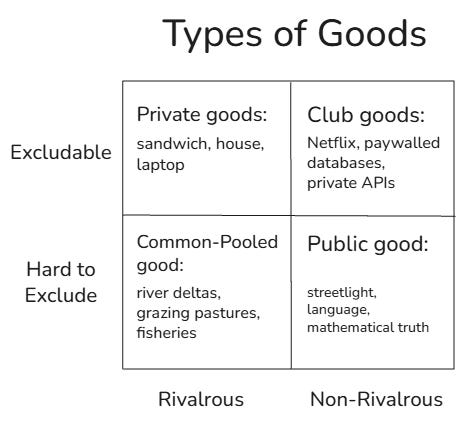
Private and club goods are typically governed by profit-seeking actors and the legal system in which they operate. Public goods are primarily governed by governments or nobody, and common-pool goods tend to exist in a liminal space where everybody seeks the benefit and nobody wants to own the costs of upkeep.
尼罗河三角洲滋养了埃及五千年。湄公河和恒河地区今天仍在养活数亿人。每一个文明摇篮的形成,全部或部分归功于大河的泛滥平原和三角洲,这绝非巧合。这些地区几乎仅凭其原材料固有的富饶,就支撑了人类度过我们最原始的时代。这片泥土渴望迸发生命,然而地球上最肥沃的农田,几乎无一例外,都是偶然形成的。
互联网也是如此。
我们信息高速公路上无数的数字居民,当初并非为了创造训练语料库而出发。我们为自己和为彼此而书写。我们开玩笑、争论、教导、抱怨、调情、调试代码,一路形成了这个由私人资本现在收获的、相互关联的原材料集合。经济学领域(它也在语料库中)为此提供了词汇。
为了对任何资源进行分类,经济学家会问两个问题:它是否具有排他性?是否具有竞争性?
更直白地说:你能阻止别人使用它吗?一个人使用它是否会减少留给其他人的量?
有一些例外和子类别,但这个简单的测试给了我们一张地图。
如果一个物品具有排他性和竞争性,它就是私人物品。想想一个三明治。如果我吃了它,它就没了,法律保护我免受三明治小偷的侵害。
如果一个物品具有排他性但基本是非竞争性的,它就是俱乐部物品。Netflix订阅就是俱乐部物品。如果我看一部电影,你仍然可以看,但前提是我们都付费获得访问权限。
如果一个物品难以排除人们使用并且具有竞争性,它就是公共池塘资源。牧场是经典例子。许多农民可以进入牧场,虽然一头牛吃草不会毁掉田地,但加上足够多的牛,它们最终会把草啃到露出泥土。这就是臭名昭著的“公地悲剧”问题。
最后,如果一个物品难以排除人们使用并且是非竞争性的,它就是公共物品。路灯是公共物品。一旦街道被照亮,我们所有人都可以在灯光下行走,我的行走并不会让你的路变暗。
私人物品和俱乐部物品通常由追求利润的参与者及其运行的法律体系来治理。公共物品主要由政府或无人治理,而公共池塘资源则倾向于存在于一个界限模糊的空间,每个人都寻求利益,却没人愿意承担维护成本。
The frontier labs generally argue that data on the internet is open for training under fair use copyright regimes. In economic terms, this argument implies the internet is a public good. The mass scraping, ingestion, and use of internet data for training does not destroy that original data. Every blog post, tweet, and flame war is indeed still there and for the most part accessible. Nobody clearly owns it.
Does the platform you post on own your posts? Do you share ownership with the platform? Can this relationship change over time?
You did post it online for free after all.
Except granting access is not the same thing as giving license. A library card gets you access to read a book, not to photocopy the entire library. Buying a national park pass does not confer logging rights. Visiting an open store does not entitle you to steal its inventory. Public access to work on the internet does not automatically confer usage rights.
And there is a second, deeper problem with “you posted it, you accepted this.” Until very recently, the LLM training data use case did not exist and could not have been reasonably foreseen by a party posting online. A blogger from 2008 could not have consented to their work being used to train a language model today, because that wasn’t conceivable back then. Consent can’t be assigned backwards in time, least of all for a sci-fi subplot turned real.
前沿实验室通常辩称,根据合理使用版权制度,互联网上的数据可以开放用于训练。用经济学术语来说,这个论点暗示互联网是一种公共物品。大规模抓取、吸收和使用互联网数据进行训练,并不会破坏原始数据。每篇博客文章、每条推文、每场论战确实仍然存在,并且在大多数情况下可以访问。没有人明确拥有它。
你发帖的平台拥有你的帖子吗?你是否与平台共享所有权?这种关系会随时间改变吗?
毕竟你确实是免费发布在网上的。
但授予访问权限与给予许可是两码事。借书证能让你阅读一本书,但不能让你复印整个图书馆。购买国家公园年票并不授予砍伐权。参观一家营业的商店并不意味着你可以偷窃其库存。公开访问互联网上的作品,并不会自动赋予使用权。
“你发布了,你就接受了这一点”还有第二个更深层次的问题。直到最近,LLM训练数据这个用例并不存在,在线发帖方也无法合理预见。一个2008年的博主不可能同意他们的作品被用来训练今天的语言模型,因为这在当时是无法想象的。同意不能回溯性地赋予,尤其不能用于一个变成现实的科幻副剧情。
The current legal battleground for LLMs is a story of non-resolution.
Notably, despite our moral intuition, access and consent are irrelevant to the frontier labs’ primary legal defense claims of “fair use.” Instead, courts evaluate four criteria as they rule on a fair use defense. They look at the purpose of the use of copyrighted material, the nature of the work, the amount used, and the effect on the market for the original. In practice, these four items generally collapse to two important questions.
Is the new work transformative, and does it harm the market for the original?
In June of 2025, Judge Alsup ruled in Bartz v. Anthropic that training on legally acquired books was “quintessentially transformative,” but building its library from pirated books was “inherently, irredeemably infringing.” With this mixed victory, Anthropic faced a theoretical exposure of up to $70B in copyright damages and quickly settled the case for $1.5B a few months later. This is the largest copyright settlement in U.S. history (so far) and granted no future licenses to Anthropic, nor did it clarify any law going forward.
In a related ruling, Kadrey v. Meta, Judge Chhabria found LLM training similarly transformative and grudgingly ruled the evidence of market harm insufficient. In his ruling he criticized the plaintiffs for putting forth almost no evidence of market dilution and suggested that LLMs’ ability to flood a market with AI work similar to the training data "will often cause plaintiffs to decisively win the fourth factor—and thus win the fair use question overall—in cases like this."
Complicating the discussion further, the U.S. Copyright Office issued a non-binding report in 2025 concluding that public availability does not inherently allow fair use model training. As of this writing there is no settled legal standard for measuring LLM-driven market dilution, but this is primed to be a major confrontation in future legal decisions. Already, dozens of lawsuits and policy fights are testing the frontier labs’ evolving training-data defenses.
当前针对LLM的法律战场是一个悬而未决的故事。
值得注意的是,尽管我们有道德直觉,但访问和同意与前沿实验室的主要法律辩护主张——“合理使用”无关。相反,法院在裁决合理使用抗辩时会评估四个标准:使用受版权保护材料的目的、作品的性质、使用的数量以及对原作品市场的影响。在实践中,这四个要素通常归结为两个重要问题:
新作品是否具有转换性?它是否损害了原作品的市场?
2025年6月,法官Alsup在Bartz诉Anthropic案中裁定,基于合法获取的书籍进行训练是“典型的转换性使用”,但使用盗版书籍构建其图书馆则是“本质上、不可挽回地侵权”。在这种喜忧参半的胜利中,Anthropic面临高达700亿美元的版权损害理论风险敞口,并在几个月后以15亿美元迅速和解了此案。这是美国历史上(迄今为止)最大的版权和解案,既未授予Anthropic任何未来许可,也未澄清任何未来的法律。
在相关裁决Kadrey诉Meta案中,法官Chhabria认为LLM训练同样具有转换性,并勉强裁定市场损害证据不足。他在裁决中批评原告几乎没有提出市场稀释的证据,并暗示LLM用与训练数据相似的AI作品充斥市场的能力,“将经常导致原告在这些案件中决定性地赢得第四个要素——从而整体赢得合理使用问题。”
使讨论更加复杂的是,美国版权局在2025年发布了一份不具约束力的报告,结论是公开可用性本身并不允许合理使用的模型训练。截至本文撰写时,尚无衡量LLM驱动的市场稀释的既定法律标准,但这注定会成为未来法律决策中的一场重大对抗。已有数十起诉讼和政策斗争正在检验前沿实验室不断演变的训练数据辩护。
The labs’ most seductive defense is also the simplest.
“It’s just reading” is a common refrain among technologists defending AI model training, and it is a compelling argument. Every writer alive is built from the books they consumed. Nobody sends Hemingway’s estate a check for being inspired by The Old Man and the Sea. If the model is just another reader, it owes what every reader owes: nothing.
A person who reads ten thousand books in their lifetime becomes one more writer, working at human speed, publishing at human volume, and returns their sediment to the delta one grain at a time. A model that reads everything instead becomes a printing press that prints more printing presses. It spits out work at industrial volume, trains its successors, and competes with the very writers it consumed, at the push of a button. Inspiration never diluted a market, but printing does.
The invention of the Gutenberg press around the year 1440 ultimately led to the passage of the Statute of Anne in 1710. A cartel of powerful book publishers lobbied British Parliament to restore their monopoly rights over the book trade, and Parliament instead vested the right in authors as legal owners. The incumbents asked for protection and the public’s representatives handed ownership to the creators.
This statute established the basis of modern copyright law. Before the printing press, this wasn’t really necessary because mass piracy was practically impossible. The new technological landscape triggered a reproduction cascade that overwhelmed legal systems designed for a previous era's problems, but that reckoning took over two and a half centuries to play out.
The printing press that prints more printing presses will not let us wait that long.
实验室最具诱惑力的辩护也是最简单的。
“它只是在阅读”——这是技术人员为AI模型训练辩护时常用的口头禅,也是一个很有说服力的论点。每一位活着的作家都是由他们读过的书塑造的。没有人因为受到《老人与海》的启发而给海明威的遗产寄支票。如果模型只是另一个读者,它欠下的就是每个读者都欠下的:什么也不欠。
一个一生读了一万本书的人,会变成又一个作家,以人类的速度工作,以人类的量级出版,并将他们的沉积物一次一粒地返回三角洲。一个阅读一切的模型,却变成了一台能打印更多打印机的印刷机。它按键即出,以工业规模产出作品,训练它的后继者,并与它消费过的作家们竞争。灵感从未稀释过一个市场,但印刷会。
大约1440年古腾堡印刷机的发明,最终导致了1710年《安妮法令》的通过。一个由强大书商组成的卡特尔游说英国议会,以恢复他们对图书贸易的垄断权,而议会却将权利赋予作者作为法定所有者。在位者要求保护,而公众代表却将所有权交给了创作者。
这项法令奠定了现代版权法的基础。在印刷机出现之前,这并非必要,因为大规模盗版几乎不可能。新的技术格局引发了一场复制级联,压垮了为前一个时代问题设计的法律体系,但那次清算花了两个半世纪才完成。
打印更多打印机的印刷机不会让我们等那么久。
On its face, the rich river delta that holds the deposits of humanity’s collective knowledge does appear to be a public good. Frontier labs scraping and ingesting the massive sedimental body of the internet does not destroy the original materials in a literal sense. The courts have already started ruling in that direction, but, like many legal rulings, this is narrowly correct, and completely misses the point.
A flat understanding of the training corpus question misunderstands how the internet’s functional layers and its participants actually interact. So far we’ve analyzed just the text layer. The webpages, articles, posts, comments, and everything else that the frontier labs scraped into a training corpus are one obvious piece, but there are many other layers of the internet, and they set the conditions for the text layer to exist at all.
Besides the obvious technical layers like the protocol or access layer, we must also consider the discovery layer, the attention layer, the contribution layer, and the integrity layer of the internet along with the flow of behavior between them. The continued utility of the internet depends on people finding, engaging with, contributing to, and ultimately believing in the value of the things they access online.
When framed as a static corpus, it is not obvious that the internet is damaged by AI training runs. Certainly it’s not damaged in the same way too many cows can damage the grass in a pasture.
Instead, what’s actually damaged is the complex system that evolved to enrich that corpus in the first place. The internet is a stack of interconnected public, club, and common-pool goods. Different layers react to and reinforce each other to make the whole valuable yet also vulnerable to the specific harms introduced by LLMs.
No human maker can compete with the raw volume of generative output working to overwhelm our algorithms and attention spans. The layers of the internet behave less like a pasture here and more like a road or an email inbox. They’re non-rivalrous up to a threshold, then catastrophically rival.
Consequently, the incentive to earnestly participate in the web diminishes with every AI variation of a derivative of a tweet of a derivative. Why make and share things online if you won’t get seen, can’t compete with the 10,000 variations of AI dogs dancing to upbeat electronica, and when you finally make something genuinely impressive the top comments just accuse you of being AI? The ability of generative AI tools to flood any corner of the web with media, slop or no, at effectively zero marginal cost might just be the final pedal stuck to the floor of the Spam-Everyone-Forever-Bus that left the station way back in the 90s.
表面上看,那个承载着人类集体知识沉积物的丰饶河流三角洲,确实像是一种公共物品。前沿实验室抓取和吸收互联网庞大的沉积体,在字面意义上并不会破坏原始材料。法院已经开始朝这个方向裁决,但就像许多法律裁决一样,这在狭义上是正确的,却完全忽视了重点。
对训练语料库问题的扁平化理解,误解了互联网的功能层及其参与者实际互动的方式。到目前为止,我们只分析了文本层。网页、文章、帖子、评论,以及前沿实验室抓取到训练语料库中的一切,是一个明显的片段,但互联网还有许多其他层面,它们为文本层的存在设定了条件。
除了协议层或访问层等明显的技术层面,我们还必须考虑互联网的发现层、注意力层、贡献层和完整性层,以及它们之间的行为流动。互联网的持续效用,取决于人们能否找到、参与、贡献,并最终相信他们在线上访问到的事物的价值。
当被框定为静态语料库时,互联网是否因AI训练运行而受损并不明显。它当然不会像太多牛会破坏牧场上的草那样受损。
相反,真正受损的是最初演化出来丰富该语料库的复杂系统。互联网是一个相互连接的公共物品、俱乐部物品和公共池塘资源的堆栈。不同的层相互反应并加强彼此,使整体有价值,同时也容易受到LLM引入的特定危害的影响。
没有人类创作者能够与旨在压垮我们的算法和注意力的生成式输出的原始量级竞争。这里的互联网层次更像是道路或电子邮件收件箱,而不是牧场。它们在达到某个阈值之前是非竞争性的,然后就会变得灾难性地具有竞争性。
因此,真诚参与网络的动机,随着每一个AI变体、推文衍生物的衍生物而减少。如果你不会被看到,无法与10,000个随 upbeat 电子音乐跳舞的AI狗变体竞争,并且当你最终做出真正令人印象深刻的东西时,热门评论却指责你是AI,那你为什么还要在线制作和分享东西?生成式AI工具以几乎为零的边际成本用媒体(无论质量好坏)淹没网络任何角落的能力,可能只是自上世纪90年代就已发车的“永远向所有人发送垃圾邮件”巴士上的最后一脚地板油。
This is an important moment. The naïve harvesting of the fertile corpus layer is a broadside against the very people who made it possible. Some parts of the web have likely already broken. If we play this wrong, the entire internet may irreparably break. Yet we’re not without tools to help us here.
We already know how to protect a commons. Elinor Ostrom won a Nobel Prize in 2009 for documenting how Swiss alpine pastures, Japanese forests, and Spanish irrigation networks sustainably shared their commons for centuries. She identified eight conditions for enduring commons: clear boundaries on who may draw from it, rules matched to local conditions, the people affected having a say in those rules, monitoring by parties accountable to users, graduated penalties for overuse, accessible ways to resolve disputes, recognition of the community’s right to organize, and governance nested across scales.
Run the internet through this checklist and almost none of the eight conditions hold. Its boundaries are hazy, fueled by everyone and fenced by no one. The people who fill it have no say in how it is governed. Its rules are unclear and only sporadically litigated, and then only by a handful of well-capitalized parties. Oversight is thin where it exists at all, always retroactive and never proactive. There is no monitoring, no graduated penalty, no shared venue to resolve disputes. It is, in Ostrom's precise sense, not a governed commons at all. It is a common-pool good with the plug pulled.
That’s why we’re in this mess. Much like in the era of the oozing Cuyahoga and the slurry-drowned Buffalo Creek, we’re staring down a cyberindustrial runoff disaster poised to spoil the entire delta.
The river still flows for now. Fresh sediment continues to settle in the delta, the corpus layer continues to grow, and the labs continue to scrape.
这是一个重要的时刻。对肥沃语料库层的天真收获,是对使其成为可能的人们的一记重拳。网络的某些部分可能已经崩溃。如果我们处理不当,整个互联网可能无可挽回地崩溃。然而,我们并非没有工具来帮助我们。
我们已经知道如何保护公地。埃莉诺·奥斯特罗姆在2009年因记录瑞士高山牧场、日本森林和西班牙灌溉网络如何可持续地共享其公地数百年而获得诺贝尔奖。她确定了持久公地的八个条件:关于谁可以从中获取的明确界限;与当地条件相匹配的规则;受影响的人们在这些规则中有发言权;由对用户负责的各方进行监督;对过度使用采取分级惩罚;解决争端的便捷方式;承认社区组织起来的权利;以及跨规模的嵌套治理。
用这份清单来检查互联网,八个条件几乎没有一个成立。它的界限模糊,由所有人推动,却被无人围栏。填充它的人们对其治理方式没有发言权。其规则不明确,只是零星地被诉讼,而且仅由少数资金雄厚的当事方进行。监督即使存在也很薄弱,总是事后追溯,从未主动预防。没有监控,没有分级惩罚,没有解决争端的共享场所。在奥斯特罗姆的精确意义上,它根本不是治理下的公地。它是一个拔掉了插头的公共池塘资源。
这就是我们陷入困境的原因。很像渗出油污的凯霍加河和淤泥淹没的水牛溪时代,我们正面临一场可能毁掉整个三角洲的网络工业径流灾难。
河流目前仍在流动。新鲜沉积物继续在三角洲沉降,语料库层持续增长,实验室也在继续抓取。
And as they scrape, they continue to compress the colossal delta of the internet into fixed sets of weights, but this ongoing ritual manifests another problem. This time a problem of value, not quality.
Specifically, the problem of who gets paid for what value.
According to the frontier labs, all of these billions of scraped data points are somehow individually worthless, yet collectively worth trillions.
By worthless, they mean that no individually scraped work is needed in the training set. Remove any one piece and the model barely notices. Therefore no single work really matters. Therefore no single work is owed payment.
But if we can unslack our hanging jaw long enough to chew what they’re feeding us, we can see the individual data points are clearly not worthless.
This is a rhetorical trick. It’s doublespeak from a self-appointed detective declaring “since we can’t figure out exactly how much jewelry was stolen, no charges can be filed.” Except they’re also the thief. And just opened up a jewelry store.
This “aw shucks” is, of course, preposterous. Poor accounting practices do not erase the clear transfer of value, especially when the accounting is impossible.
In principle, the accounting is impossible from a legal standpoint because copyright law was built to police discrete copying. Court precedents assume infringers copying enumerable works from legible parties. Large language model training is the statistical absorption of billions of works at once. It’s a different shape with the same moral essence, but since the extracting act is a new mechanism, the legal instrument cannot quite grip it (yet).
But even more concerning is that attempts at quantitative accounting may just be mathematically incoherent.
The leading formal method to value a training input is the Shapley value, which averages an input's marginal contribution across every ordering in which it could appear. But that number isn’t a property of the work itself. It’s a function of the work’s relationship with every other work in the training set. The same document in a different training set will have a different Shapley value. Train the same model twice and, because training is stochastic, the Shapley value might change from run to run. Researchers do not even agree that Shapley is the right contribution metric, and calculating true Shapley values for frontier-scale models is computationally infeasible. These models can take weeks to train once; exact Shapley accounting would require retraining across impossible combinations of inputs. So as of today, there is no objective valuation scheme for calculating any work's specific share that would not be litigated into oblivion the moment it was implemented.
Individual attribution for LLM training at frontier scale will not work for the foreseeable future. You cannot pay people in proportion to their contribution because no administrable, specific share exists. This is the root of the misdirect. The labs interpret this fact to mean “if we can’t attribute then we owe nothing.”
I argue that it means you can’t pay proportionally, but the payment is still owed.
随着他们持续抓取,他们不断将互联网庞大的三角洲压缩成固定的权重集,但这种持续的仪式暴露了另一个问题。这次是价值问题,而非质量问题。
具体来说,就是谁为哪种价值获得报酬的问题。
根据前沿实验室的说法,这数十亿被抓取的数据点,不知何故每个都毫无价值,但合起来却价值数万亿。
所谓毫无价值,他们的意思是训练集中不需要任何单个被抓取的作品。移除任何一件,模型几乎注意不到。因此,没有单一作品真正重要。因此,没有单一作品欠付报酬。
但如果我们能够收起惊掉的下巴,足够久地咀嚼他们喂给我们的东西,我们就能看到单个数据点显然并非毫无价值。
这是一种修辞诡计。这是来自一个自封的侦探的双重话,他宣称“既然我们无法确切知道有多少珠宝被盗,就不能提出指控”。只不过他们也是小偷,并且刚刚开了一家珠宝店。
这种“哎呀,真没办法”的说法,显然是荒谬的。糟糕的会计实践并不能抹去明确的价值转移,尤其是在核算不可能的情况下。
原则上,从法律角度来看,核算是不可行的,因为版权法是为了监管离散的复制而建立的。法院判例假设侵权者从可识别的当事方复制可枚举的作品。大语言模型训练是一次性统计吸收数十亿作品。这是不同形态但具有相同道德本质的行为,但由于提取行为是一种新机制,法律工具尚未能完全抓住它。
但更令人担忧的是,量化核算的尝试可能根本就是数学上不连贯的。
评估训练输入价值的主要形式方法是沙普利值,它平均计算输入在其可能出现的每一种顺序中的边际贡献。但这个数字并不是作品本身的属性。它是作品与训练集中所有其他作品关系的函数。同一份文档在不同的训练集中会有不同的沙普利值。两次训练同一个模型,由于训练是随机的,沙普利值可能随运行而改变。研究人员甚至不同意沙普利是合适的贡献度量标准,并且为前沿规模模型计算真实的沙普利值在计算上不可行。这些模型训练一次可能需要数周;精确的沙普利核算将需要跨不可能的组合重新训练输入。所以至今,没有任何客观的估值方案可以计算出任何作品的具体份额,而不会在实施时立即被诉讼淹没。
在可预见的未来,为前沿规模的LLM训练进行个体归因是行不通的。你无法按贡献比例支付给人们,因为不存在可管理的、具体的份额。这是误导的根源。实验室将此事实解释为“如果我们无法归因,我们就什么都不欠”。
我的论点是,这意味着你不能按比例支付,但欠款仍然存在。
Here is the true shape of the problem. Individuals create singular work, but never in isolation. The internet is communal by nature. Both collaboration and conflict feed the whole.
Branches grow stronger when pruned. The richest soil is built from rot. Vines climb by contact. Friendly minds cross-pollinate ideas while predators and prey run each other faster. This teeming mass of garbage and brilliance is valuable precisely because of the varied relationships each piece has with the others. In the living distance between them, human cognition buds, blooms, and bears fruit. Despite the romance of solitary genius, the internet is a team effort.
And if you cannot identify the most valuable player, you pay the team.
That payment is a royalty. It is a dollars-and-cents accounting of the public genius LLMs extract from the best and worst of us.
Call it the Corpus Royalty.
The frontier labs pay a fixed share of gross revenue into a public fund. The fund pays every eligible American the same amount each year. Any mechanism cleverer than this reimports the measurement problem, and it dies ten thousand quibbling deaths in the courtroom.
I propose an American mechanism because international regimes are built through national commitments. The United States is not the only public with a claim, but in practice it has the regulatory gravity to establish the first durable policy. Smaller markets may be unable to impose parallel royalties without driving frontier labs out of their jurisdictions, which makes a flagship American regime the likely anchor for a later global remedy.
As LLMs fuse themselves into the internet and reshape the incentives for human expression, a royalty becomes the only coherent answer to the question of compensating collective, unattributable contribution. Frontier labs cannot continue their harvest of the internet unfettered. They must replenish the upstream sources that feed the fertile delta their models depend on, or the internet will become unrecognizable within the decade.
这是问题的真正形态。个人创作独特的作品,但从未孤立完成。互联网本质上是公共的。合作与冲突共同滋养着整体。
枝条因修剪而更强壮。最肥沃的土壤由腐烂物构建。藤蔓通过接触攀爬。友善的思想交叉授粉,而捕食者与猎物则互相驱动跑得更快。这一大堆垃圾与才华之所以有价值,正是因为每件作品与其他作品之间存在各种关系。在它们之间活生生的距离中,人类认知萌芽、绽放并结出果实。尽管有孤独天才的浪漫叙事,互联网是团队努力的结果。
如果你无法识别最有价值的球员,那就支付整个团队。
这笔支付是一种版税。它是对LLMs从我们最好和最坏的一面中提取的公共天才进行的真金白银核算。
称之为语料库版税。
前沿实验室将其总收入的一个固定份额支付到一个公共基金。该基金每年向每位符合条件的美国人支付相同的金额。任何比这更巧妙的机制都会重新引入衡量问题,并在法庭上死于无数吹毛求疵的争论。
我提议一个美国机制,因为国际制度是通过国家承诺建立的。美国并非唯一有主张权的公众,但实际上它具有监管引力来建立第一个持久的政策。较小的市场可能无法在不将前沿实验室赶出其管辖范围的情况下实施类似的版税,这使得一个旗舰性的美国制度可能成为后来全球补救措施的锚点。
随着LLMs融入互联网并重塑人类表达的动机,版税成为补偿集体、不可归因贡献问题的唯一连贯答案。前沿实验室不能继续不受约束地收获互联网。他们必须补充滋养其模型所依赖的肥沃三角洲的上游来源,否则互联网将在十年内变得面目全非。
We’ve built smaller versions of this machinery before.
When private entities profit from shared resources, we recognize the public is owed a claim on the proceeds. The Alaska Permanent Fund follows this intuition. Every eligible resident receives a share of resource wealth no one resident can individually claim. Since we cannot reliably measure what any single person’s words are worth to a model, the distribution should reflect the failure of attribution rather than pretend to solve it.
When individual claims are too numerous to price one by one, we do not pretend they have no value, and when private entities damage public spaces, we declare they are culpable for that destruction. After a century of burning rivers, Congress built Superfund in 1980 and handed the cleanup bill to the polluters, for dumping that was legal when it happened. Nobody had to trace which barrel poisoned which well. The industries that profited from the toxic waste paid to restore the ground.
Some will say the Bell precedent argues for opening the weights, not cutting checks, but remedies follow wounds. In Bell’s case, competitors were wounded by intellectual lockout, so the remedy was access. Today, contributors are wounded by the extraction of intellectual value. It follows that payment is the remedy that makes the wounded whole.
我们之前建造过更小规模的这类机制。
当私人实体从共享资源中获利时,我们承认公众对收益拥有索取权。阿拉斯加永久基金遵循这一直觉。每位符合条件的居民都获得一份任何居民个人都无法单独主张的资源财富份额。既然我们无法可靠地衡量任何一个人的文字对一个模型的价值,分配就应该反映归因的失败,而不是假装解决了它。
当个人索赔太多而无法逐一定价时,我们不会假装它们没有价值。当私人实体损害公共空间时,我们宣布他们对这种破坏负有责任。在河流燃烧了一个世纪之后,国会在1980年建立了超级基金,并将清理账单交给了污染者,即使他们的倾倒行为在当时是合法的。没人需要追踪哪个桶污染了哪口井。从有毒废物中获利的行业支付了修复土地的费用。
有些人会说,贝尔的先例支持开放权重,而不是开支票,但补救措施跟随伤害而来。在贝尔的案例中,竞争对手因知识产权封锁而受伤,因此补救措施是访问权。今天,贡献者因智力价值的提取而受伤。因此,支付是使受伤者恢复完整的补救措施。
The Corpus Royalty may be small at first. Perhaps just enough for an extra case of beer per year, but the amount matters less than the standing it confers. It shows the public they are more than just raw material exploited to train increasingly large language models. If the labs are right about what they are building, beer money becomes grocery money becomes rent money that grows with the labs and their revenues. If the labs are wrong, it won’t be because a royalty killed the business model. Normal people’s lives, arguments, questions, jokes, corrections, and creations help sustain the corpus those models consume, and this brings them along proactively instead of parasitically. The corpus is either essential or it isn’t. If it is, it has a price, and industries pay for essential inputs every day. The labs have already conceded as much in their licensing deals with Reddit, News Corp, and the Associated Press.
This is not welfare, because welfare assumes the companies are subsidizing the public, when the subsidy runs the other way. This is not charity, because charity implies nothing was received in return. This is not a tax, because a tax treats the surplus as company property subject to public claim.
This is restitution.
The legal word for this shape of problem is unjust enrichment, but the common law version is too small for the thing now in front of us. In ordinary law, unjust enrichment asks whether one party has benefited at another’s expense under circumstances that make keeping the whole benefit inequitable.
The frontier labs have received such a benefit by converting an uncompensated, massively aggregated, publicly generated corpus into private infrastructure-level value while threatening the conditions under which that corpus is renewed. They have done this at a scale and level of diffusion that individual litigation cannot sensibly price. The size of the problem tells us the remedy must be collective.
A royalty paid on value rooted in the public corpus is a return. What flows back to the internet is owed, not gifted. This is a royalty on public genius.
语料库版税一开始可能很小。也许只够每年多买一箱啤酒,但金额的重要性不及它所赋予的地位。它向公众表明,他们不仅仅是用于训练越来越大的语言模型的原材料。如果实验室对其正在建造的东西的判断是正确的,啤酒钱会变成食品杂货钱,再变成房租钱,并随着实验室及其收入的增长而增长。如果实验室错了,那不会是因为版税扼杀了商业模式。普通人的生活、争论、问题、笑话、纠正和创造,帮助维持了那些模型消耗的语料库,而这会积极主动地、而非寄生式地将他们带上前来。语料库要么是必需的,要么不是。如果是必需的,它就有价格,而行业每天都在为必需的投入付费。实验室在与Reddit、新闻集团和美联社的许可协议中已经承认了这一点。
这不是福利,因为福利假设公司在补贴公众,而补贴是反向流动的。这不是慈善,因为慈善意味着没有收到任何回报。这不是税收,因为税收将盈余视为公司财产,受公共主张约束。
这是赔偿。
这种问题的法律术语是不当得利,但普通法版本对我们面前的这个事物来说太小了。在普通法中,不当得利询问一方是否在另一方付出代价的情况下获益,且情况使得保留全部利益不公平。
前沿实验室已经获得了这样的利益,他们将一个未获补偿、大规模聚合、由公众生成的语料库转化为私有的基础设施级价值,同时威胁到了该语料库更新的条件。他们这样做的规模和扩散程度,使得个体诉讼无法合理定价。问题的大小告诉我们,补救措施必须是集体性的。
对植根于公共语料库的价值支付的版税是一种回报。流回互联网的东西是欠债,不是礼物。这是对公共天才征收的版税。
A royalty is only part of the solution. It’s one piece of a larger system of contribution and sustainment. It does not replace copyright claims or private licensing contracts. Those can and should still happen where ownership is legible. The royalty solves for the unattributable long tail of creativity that cannot organize, negotiate, or litigate its way into the licensing market.
What the labs are doing is not new in kind, only in scale. This is the private capture of public genius at civilizational scale. This should not surprise us. Corporate entities built atop public support often try to privatize the upside while socializing the conditions that made it possible. Special organizations have abused their special status this way before. The difference is that this time the affected class is everyone at once.
Perhaps we have been building toward this since we first scratched marks into clay more than 5,000 years ago. We’ve recorded, collected, and categorized our way into fragility. Once every externalized thought, every written word, every diagram, flourish, and turn of phrase can be rolled into a mechanical genie, who could resist the temptation to sell it back to the people who supplied it?
This is why the public needs a claim. The frontier labs increasingly seek the privilege and power of a utility without accepting the public obligations that come along with it. A Corpus Royalty restores some of the balance in that bargain by letting the public collect a share of the wealth it made possible. The public already bears the downside of the world these models are creating and deserves part of the upside.
The Corpus Royalty ensures humankind’s scattered sparks of brilliance have skin in the game they helped create.
版税只是解决方案的一部分。它是一个更大的贡献与维持体系的一个环节。它不会取代版权主张或私人许可合同。在所有权清晰的地方,这些仍然可以并且应该发生。版税解决的是无法组织、谈判或诉讼进入许可市场的、不可归因的创造力长尾问题。
实验室正在做的事情,在种类上并非新鲜,只在规模上。这是文明规模的公共天才私人捕获。我们不应感到惊讶。建立在公共支持之上的公司实体,常常试图将收益私有化,而将使其成为可能的条件社会化。特殊组织以前就这样滥用过它们的特殊地位。不同之处在于,这一次受影响的阶层是所有人,同时地。
也许自从5000多年前我们第一次在黏土上刻下标记以来,我们就一直在朝着这个目标前进。我们通过记录、收集和分类,走向了脆弱。一旦每一个外化的思想、每一个书写的文字、每一张图表、每一笔花体和每一个措辞转折,都能被卷入一个机械精灵,谁能抗拒将其卖回给提供它的人们的诱惑呢?
这就是为什么公众需要一个主张权。前沿实验室越来越追求公用事业的特权和权力,却不接受随之而来的公共义务。语料库版税通过让公众收集一份他们使之成为可能的财富份额,恢复了该交易中的一些平衡。公众已经在承受这些模型正在创造的世界的不利之处,并理应获得部分有利之处。
语料库版税确保人类散落的才华火花,在他们帮助创造的游戏中有自己的利益。