OpenAI企业AI报告:256%增长背后的采用现状与组织差距
OpenAI官方报告,基于其超100万企业客户和覆盖近100家企业的9000人调查,总结2025年企业AI采用现状。核心论点包括:采用正从试点转向规模化——ChatGPT企业消息量同比增8倍,API推理token消耗增320倍;收益与使用深度强相关——75%用户报告日省40-60分钟,数据/工程岗达60-80分钟;行业与个体差距在扩大——前沿工作者消息量为中位数6倍,编码任务差距达17倍;组织准备度(数据接入、工作流标准化、管理层支持)成为主要瓶颈,约四分之一企业仍未启用数据连接器。报告还提供Intercom、Lowe's、BBVA、Moderna等案例佐证。适用关注企业AI落地与战略的工程管理者,但需注意其数据来自厂商自身。
Foreword
At OpenAI, our mission is to ensure that artificial intelligence benefits all of humanity, and helping enterprises solve problems is central to this mission.
The majority of economically valuable activity takes place inside organizations, where innovation translates directly into improved outcomes for workers, customers, and other stakeholders. Enterprise problems also present the hardest technical challenges for frontier intelligence, requiring reliability, safety, and security at scale. The revenue generated from solving these problems can help fund broad, free access to powerful AI for hundreds of millions of people worldwide.
For much of the past three years, the visible impact of AI has been most apparent among consumers. However, the history of general purpose technologies—from steam engines to semiconductors—shows that significant economic value is created after firms translate underlying capabilities into scaled use cases. Enterprise AI now appears to be entering this phase, as many of the world’s largest and most complex organizations are starting to use AI as core infrastructure.
More than 1 million business customers now use OpenAI’s tools. This report brings together evidence from de-identified and aggregated enterprise usage data and a variety of other sources to provide a grounded view of how AI is being deployed inside organizations today.

前言
在 OpenAI,我们的使命是确保人工智能惠及全人类,而帮助企业解决问题正是这一使命的核心。
大多数具有经济价值的活动发生在组织内部,创新在此直接转化为员工、客户和其他利益相关者获得更好的成果。企业问题也为前沿智能带来了最艰难的技术挑战,要求在规模化运营中具备可靠性、安全性和保障性。解决这些问题所产生的收入,可以帮助为全球数亿人提供广泛、免费使用强大 AI 的机会。
在过去三年的大部分时间里,AI 的显著影响主要体现在消费者端。然而,从蒸汽机到半导体等通用技术的发展史表明,只有在企业将底层能力转化为规模化用例之后,重大经济价值才会被创造出来。企业 AI 如今似乎正进入这一阶段,许多全球最大、最复杂的组织开始将 AI 作为核心基础设施来使用。
目前有超过 100 万企业客户在使用 OpenAI 的工具。本报告汇集了去标识化、聚合的企业使用数据以及其他多种来源的证据,为我们了解 AI 当下在组织内部的部署方式提供了一个有据可依的视角。
Four key findings stand out
-
Enterprise usage is scaling, with deeper workflow integration. ChatGPT message volume grew 8x and API reasoning token consumption per organization increased 320x year-over-year, demonstrating that more enterprises are using AI and their intensity of usage has increased.
-
Enterprises that leverage AI are experiencing measurable productivity and business impact. Enterprise users report saving 40–60 minutes per day and being able to complete new technical tasks such as data analysis and coding. Case studies indicate AI is contributing to important outcomes such as revenue growth, improved customer experience, and shorter product-development cycles.
-
Enterprise growth is global and rapidly accelerating across industries. Over the past six months, international adoption has surged as organizations worldwide deepen their use of AI, complementing continued strong momentum in the U.S. In the past 12 months, the median sector grew by more than 6x, with the technology sector leading the pack at 11x.
-
A widening gap is emerging between leaders and laggards. Frontier workers are sending 6x more messages and frontier firms are sending 2x as many messages per seat than the median enterprise. There’s a substantive gap in the likelihood to utilize the most capable AI tools today, despite broad availability of these tools. Models are capable of far more than most organizations have embedded into workflows, and this presents an opportunity for firms.
“Looking ahead, the next phase of enterprise AI will be shaped by stronger performance on economically valuable tasks, better understanding of organizational context, and a shift from asking models for outputs to delegating complex, multi-step workflows. As these capabilities mature, we expect organizations to not only improve efficiency, but discover new ways to serve customers and deliver value.
The findings in this report represent early signs of how AI is beginning to reshape the modern enterprise. As enterprise AI evolves, OpenAI will continue to share real-world evidence on how AI is influencing firms, workers, and the broader economy.”
—Ronnie Chatterji, Chief Economist OpenAI
四大关键发现
-
企业使用规模在扩大,工作流集成更深。 ChatGPT 消息量增长了 8 倍,每家企业 API 推理 token 消耗量同比增加了 320 倍,这说明更多企业在使用 AI,且使用强度在提高。
-
利用 AI 的企业正获得可衡量的生产力与商业影响。 企业用户报告每天节省 40–60 分钟,并能完成数据分析、编程等新的技术任务。案例研究表明,AI 正在推动收入增长、改善客户体验、缩短产品开发周期等重要成果。
-
企业增长是全球性的,并在各行业快速加速。 过去六个月,随着全球组织深化 AI 应用,国际采用率激增,美国也继续保持强劲势头。过去 12 个月,行业中位数增长超过 6 倍,科技行业以 11 倍领跑。
-
领先者与落后者之间的差距正在拉大。 前沿工作者发送的消息数是中位企业的 6 倍,前沿企业每席位发送的消息数是中位企业的 2 倍。尽管这些工具已广泛可用,但如今使用最强大 AI 工具的可能性存在实质性差距。模型的能力远超大多数组织已嵌入工作流的程度,这对企业而言是机遇。
“展望未来,企业 AI 的下一个阶段将由以下因素塑造:在经济价值高的任务上表现更强、对组织语境的理解更好,以及从向模型提问转向委托复杂、多步骤工作流。随着这些能力成熟,我们预期组织不仅能提升效率,还能发现服务客户和创造价值的新方式。
本报告的发现代表了 AI 开始重塑现代企业的早期迹象。随着企业 AI 的发展,OpenAI 将继续分享 AI 如何影响企业、员工和更广泛经济的真实证据。”
——Ronnie Chatterji,OpenAI 首席经济学家
Introduction
Over the past three years, enterprises have integrated AI systems across a wide range of use cases and operational workflows.
These deployments provide insights on how AI is shaping work, particularly in environments where accuracy standards are high, workflows are complex, and improvements in productivity or decision quality have direct economic outcomes. Because much of the world’s economically valuable activity occurs inside firms, enterprise adoption patterns provide a clear signal of where AI is delivering value today and where it will likely do so in the future.
The scale and diversity of OpenAI’s more than 1 million business customers provides a distinctive view into this shift. This report summarizes key findings from across OpenAI’s enterprise customer base, and what those patterns suggest about the current state and trajectory of enterprise AI. By examining how adoption varies across industries and functions, the analysis also highlights where AI is becoming deeply embedded in firms, and where gaps are emerging.
Findings are based on two primary data sources
-
Real-world usage data from enterprise customers of OpenAI.
-
An OpenAI survey of 9,000 workers across almost 100 enterprises documenting patterns of AI adoption.
All analyses in this report are based on de-identified, aggregated enterprise usage data. Message content was classified using automated systems, and no OpenAI employee reviewed individual enterprise, business, or API customer data as part of this analysis.
引言
过去三年,企业已在广泛的用例和运营工作流中集成 AI 系统。
这些部署让我们深入了解 AI 如何塑造工作,尤其是在准确度标准高、工作流复杂、生产力或决策质量的改进会直接带来经济回报的环境中。由于世界上大部分具有经济价值的活动都发生在企业内部,企业采用模式清晰地表明了 AI 当前在哪里创造价值,以及未来可能在哪里创造价值。
OpenAI 超过 100 万企业客户的规模和多样性,为这一转变提供了独特视角。本报告总结了 OpenAI 企业客户群的关键发现,以及这些模式所反映的企业 AI 现状与趋势。通过分析不同行业和职能的采用差异,报告还指出了 AI 在哪些企业正深度嵌入,以及哪些地方仍存在差距。
发现基于两个主要数据来源
-
OpenAI 企业客户的真实使用数据。
-
OpenAI 对近 100 家企业中 9,000 名员工的调查,记录 AI 采用模式。
本报告中的所有分析均基于去标识化、聚合的企业使用数据。消息内容通过自动化系统分类,没有任何 OpenAI 员工在本分析中审查过单个企业、业务或 API 客户数据。
Enterprise AI usage is accelerating and deepening
Over the past year, enterprise AI adoption has increased substantially as organizations incorporate AI into repeatable, multi-step workflows across functions and business units. OpenAI now serves more than 7 million ChatGPT workplace seats, and ChatGPT Enterprise seats have increased approximately 9x year-over-year.
Since November 2024, weekly Enterprise messages have grown approximately 8x in aggregate, with the average worker sending 30% more messages. This growth reflects both more frequent use of ChatGPT and a deepening in the intensity of use.
Two shifts underscore the deepening integration of AI into core enterprise workflows.
企业 AI 使用正在加速并深化
过去一年,随着组织将 AI 融入跨职能、跨业务部门可重复的多步骤工作流,企业 AI 采用率大幅上升。OpenAI 目前服务超过 700 万个 ChatGPT 工作席位,ChatGPT Enterprise 席位同比增长约 9 倍。
自 2024 年 11 月以来,每周 Enterprise 消息总量增长约 8 倍,平均每位员工发送的消息量增加了 30%。这一增长既反映了 ChatGPT 使用频率的提升,也反映了使用强度的加深。
有两个变化凸显了 AI 正更深地融入企业核心工作流。
Custom GPTs and Projects are enabling deeper workflow integration
GPTs and Projects are configurable interfaces built on ChatGPT that can be tailored with instructions, knowledge, and custom actions, enabling workers to execute repeatable, multi-step tasks.
Weekly users of Custom GPTs and Projects have increased by approximately 19x year-to-date. In recent months, approximately 20% of all Enterprise messages were processed via a Custom GPT or Project. The most widely deployed GPTs either codify institutional knowledge into reusable assistants or automate workflows through integrations with internal systems. Some organizations have built a culture of developing and sharing Custom GPTs at scale. For example, BBVA regularly uses more than 4,000 GPTs, indicating that AI-driven workflows are increasingly implemented as persistent tools embedded in daily operations.
19x
Year-to-date increase in weekly users of Custom GPTs and Projects
20%
of all Enterprise messages were processed via a Custom GPT or Project
Custom GPT 和 Projects 正在实现更深的工作流集成
GPTs 和 Projects 是构建在 ChatGPT 之上的可配置界面,可通过指令、知识和自定义操作进行定制,让员工能够执行可重复、多步骤的任务。
今年以来,Custom GPT 和 Projects 的周活跃用户数量增加了约 19 倍。最近几个月,约 20% 的 Enterprise 消息通过 Custom GPT 或 Project 处理。部署最广的 GPT 要么将机构知识固化成可复用的助手,要么通过与内部系统的集成实现工作流自动化。一些组织已经形成了大规模开发、共享 Custom GPT 的文化。例如,BBVA 经常使用超过 4,000 个 GPT,这表明 AI 驱动的工作流正越来越多地以持久工具的形式嵌入日常运营。
19 倍
Custom GPT 和 Projects 周活跃用户今年以来的增长
20%
的 Enterprise 消息通过 Custom GPT 或 Project 处理
Developer and API workflows are rapidly scaling
Companies build on the API to integrate models directly into their products and systems with a high degree of control and customization. As firms transition from experimentation to production deployments, API consumption has rapidly increased. More than 9,000 organizations have now processed over 10 billion tokens, and nearly 200 have exceeded 1 trillion tokens.
Average reasoning token consumption per organization has increased by approximately 320x in the past 12 months, suggesting that more intelligent models are being systematically integrated into expanding products and services. Codex, while still early in its enterprise lifecycle, is gaining rapid traction as teams adopt it for end-to-end software tasks: code generation, refactoring, testing, and debugging.
In the past six weeks, Codex engagement indicates growing penetration of AI-assisted development inside enterprises.
2x
Increase in weekly active users
50%
Approximate increase in weekly messages
开发者与 API 工作流快速扩张
企业基于 API 构建,以高度的控制和定制化方式将模型直接集成到自己的产品和系统中。随着企业从试验转向生产部署,API 消耗量迅速增长。目前已有超过 9,000 家组织处理了超过 100 亿 token,另有近 200 家超过了 1 万亿 token。
过去 12 个月,每家企业平均的推理 token 消耗量增加了约 320 倍,这表明更智能的模型正被系统地集成到不断扩展的产品和服务中。Codex 虽然仍处于企业应用早期,但正迅速获得增长,团队用它完成端到端的软件任务:代码生成、重构、测试和调试。
过去六周,Codex 的参与度表明 AI 辅助开发在企业内的渗透正在加深。
2 倍
周活跃用户增长
50%
周消息量约增长
Workers report measurable value from using AI
In most settings, AI enables workers to produce higher quality work faster. However, productivity alone does not fully reflect how AI is reshaping work. Survey data from almost 100 enterprises highlights key operational gains across functions, and shifts in who performs specialized and technical work.
Enterprise workers report time saved and improved outcomes across functions
Seventy-five percent of surveyed workers report that using AI at work has improved either the speed or quality of their output. On average, ChatGPT Enterprise users attribute 40–60 minutes of time saved per active day to their use of AI, with data science, engineering, and communications workers saving more than average (60–80 minutes per day). Time saved per message varies by function: accounting and finance users report the largest benefits followed by analytics, communications, and engineering.
These gains translate into broad operational improvements across functions
-
87% of IT workers report faster IT issue resolution
-
85% of marketing and product users report faster campaign execution
-
75% of HR professionals report improved employee engagement
-
73% of engineers report faster code delivery
These results indicate that productivity benefits are already materializing across core enterprise functions, not only in early-adopting technical roles.
员工反映从 AI 使用中获得可衡量的价值
在大多数情况下,AI 能让员工更快地产出更高质量的工作。然而,仅用生产力并不能完全反映 AI 如何重塑工作。来自近 100 家企业的调查数据,突出了各职能的关键运营增益,以及由谁执行专业和技术工作的变化。
企业员工反映节省了时间,并改善了各职能的成果
75% 的受访员工表示,在工作中使用 AI 提高了产出的速度或质量。平均而言,ChatGPT Enterprise 用户将每个活跃日节省 40–60 分钟归功于 AI,其中数据科学、工程和沟通类员工节省的时间超过平均水平(每天 60–80 分钟)。每条消息节省的时间因职能而异:会计和金融用户报告收益最大,其次是分析、沟通和工程。
这些增益转化为各职能更广泛的运营改进
-
87% 的 IT 员工报告 IT 问题解决更快
-
85% 的市场和产品用户报告营销活动执行更快
-
75% 的 HR 专业人士报告员工参与度提升
-
73% 的工程师报告代码交付更快
这些结果表明,生产力收益已在企业核心职能中显现,而不仅仅出现在早期采用的技术岗位上。
Technical work expands beyond traditional role boundaries
AI is not only accelerating existing work; it is also expanding the tasks and skills workers can perform. Several studies find that AI has an equalizing effect, disproportionately aiding lower performing workers.1 Consistent with these findings, 75% of workers report being able to complete tasks they previously could not perform, including programming support and code review, spreadsheet analysis and automation, technical tool development and troubleshooting, and custom GPT or agent design.
The broadening of individual capabilities is particularly apparent in technical settings, where non-technical teams are increasingly engaging in coding and data-analysis work that was previously confined to specialized roles. Among ChatGPT Enterprise users, coding-related messages have increased across all functions, and outside of engineering, IT, and research, coding-related messages have grown by an average of 36% over the past six months.
75%
of users report being able to complete new tasks
36%
Average increase in coding-related messages outside of engineering, IT, and research
技术工作突破传统职能边界
AI 不仅加速了现有工作,还扩展了员工能执行的任务和技能。几项研究发现,AI 具有均等化效应,对绩效较低的员工的帮助尤为明显。1 与这些发现一致,75% 的员工表示能够完成以前无法完成的任务,包括编程支持和代码审查、电子表格分析与自动化、技术工具开发和故障排除,以及自定义 GPT 或 Agent 设计。
个人能力的扩展在技术环境中尤为明显,非技术团队越来越多地参与此前仅限于专业角色的编程和数据分析工作。在 ChatGPT Enterprise 用户中,各职能的编程相关消息都在增加;在工程、IT 和研究之外,编程相关消息在过去六个月平均增长了 36%。
75%
的用户表示能够完成新任务
36%
工程、IT 和研究之外编程相关消息的平均增长
Workers report greater productivity from more intensive AI use
At the individual worker level, impact increases as workers deepen their use of AI. Across a large sample of workers, time saved is correlated with the use of more advanced ChatGPT features, including Deep Research, GPT‑5 Thinking, and Image Generation. Workers consuming the most intelligence (as measured by credits used2) report higher time savings. Workers who save more than 10 hours per week are not just using more intelligence, they are also using multiple models, engaging with more tools, and using AI across a wider range of tasks.
Productivity gains increase with intensity of AI use

更高强度的 AI 使用带来更高生产力
在个体员工层面,随着员工加深 AI 的使用,影响会增大。在大量员工样本中,节省时间与使用更高级 ChatGPT 功能(包括 Deep Research、GPT‑5 Thinking 和 Image Generation)相关。消耗最多智能(以使用的 credits 衡量2)的员工报告节省时间更多。每周节省超过 10 小时的员工,不仅使用更多智能,还会使用多个模型、接触更多工具,并在更广泛的任务中使用 AI。
生产力增益随 AI 使用强度增加
Pace of acceleration varies based on industry and geography
Over the last year we’ve seen overall rapid adoption as companies move from AI pilots to full deployments, and there are notable differences based on industry and geography.
Growth is rapid across most industries
OpenAI customer growth is broad-based across industries, with the median sector expanding more than 6x year-over-year and even the slowest-growing sector exceeding 2x.
AI adoption by industry: enterprise scale vs. year-over-year growth
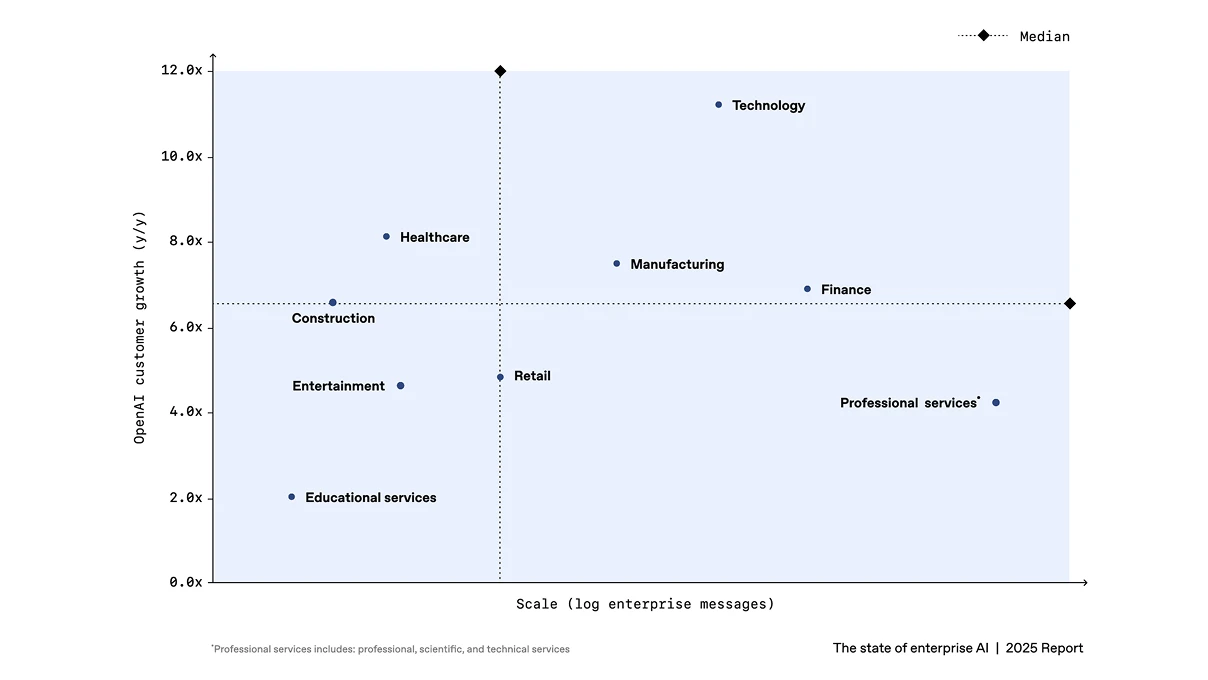
Technology, healthcare, and manufacturing show the fastest growth, while finance and professional services operate at the largest scale.
In absolute terms, ChatGPT Enterprise customers are most concentrated today in professional services, finance, and technology, sectors that were early adopters and continue to lead in their scale of AI usage. Healthcare and manufacturing started from a much smaller base but are now among the fastest-growing sectors, rapidly closing the gap.
| Fastest-growing sectors | Year-over-year customer growth |
|---|---|
| Technology | 11x |
| Healthcare | 8x |
| Manufacturing | 7x |
加速节奏因行业和地域而异
过去一年,随着企业从 AI 试点转向全面部署,整体采用速度很快,但行业和地域之间存在显著差异。
大多数行业的增长都很迅速
OpenAI 客户增长在各行业是广泛的,行业中位数同比增长超过 6 倍,即使增长最慢的行业也超过了 2 倍。
各行业 AI 采用:企业规模 vs. 同比增长
科技、医疗和制造业增长最快,而金融和专业服务运营规模最大。
从绝对数量看,ChatGPT Enterprise 客户目前最集中在专业服务、金融和科技行业,这些行业是早期采用者,并继续在 AI 使用规模上领先。医疗和制造业从较小的基数起步,但现在已是增长最快的行业,正在迅速缩小差距。
| 增长最快的行业 | 客户同比增长 |
|---|---|
| 科技 | 11 倍 |
| 医疗 | 8 倍 |
| 制造业 | 7 倍 |
The API is most commonly used to build and scale customer-facing applications (e.g., in-product assistants, search, and automation), particularly by technology companies. But usage is diversifying: customer service and content generation now represent approximately 20% of API activity, and non-technology firm API use has grown 5x year-over-year. Taken together, this pattern suggests adoption is expanding beyond technology-led product embedding toward a broader set of operational and workflow deployments across industries.
Technology companies
are using the API at a rate 5x higher year-over-year as they scale external, customer-facing applications. They also lead in coding workflows, where frontier models such as Codex are accelerating software development.
-
In-app Assistant & Search
-
Agentic Workflow Automation
-
Coding & Developer Tools
-
Customer Support
-
Data Analysis, Summarization & Extraction
Professional services
concentrate API spend in coding and developer tools to build custom tooling that accelerates delivery, improves the customer experience (often via personalization), and enables assistant applications.
-
Coding & Developer Tools
-
Content & Creative Generation
-
In-app Assistant & Search
-
Customer Support
-
Agentic Workflow Automation
Finance organizations
often start with customer-support because support is a large, scalable cost center with proven ROI. Coding and developer tools rank second as firms invest in system migration and custom applications for trading, risk, and compliance.
-
Customer Support
-
Coding & Developer Tools
-
Agentic Workflow Automation
-
In-app Assistant & Search
-
Data Analysis, Summarization & Extraction
API 最常用于构建和扩展面向客户的应用(如产品内助手、搜索和自动化),尤其是科技公司。但使用正在多样化:客户服务和内容生成现在约占 API 活动的 20%,非科技公司的 API 使用同比增长了 5 倍。综合来看,这表明采用正从以科技为主导的产品嵌入,扩展到各行业更广泛的运营和工作流部署。
科技公司
它们扩展外部面向客户的应用时,API 使用率同比高出 5 倍。它们在编码工作流中也处于领先地位,Codex 等前沿模型正在加速软件开发。
-
应用内助手与搜索
-
Agentic 工作流自动化
-
编码与开发者工具
-
客户支持
-
数据分析、摘要与提取
专业服务
将 API 支出集中在编码和开发者工具上,构建加速交付的定制工具,改善客户体验(通常通过个性化),并支持助手应用。
-
编码与开发者工具
-
内容与创意生成
-
应用内助手与搜索
-
客户支持
-
Agentic 工作流自动化
金融组织
通常从客户支持开始,因为支持是一个大规模、可扩展且 ROI 已被验证的成本中心。编码和开发者工具排在第二位,因为企业在交易、风险和合规方面投资于系统迁移和定制应用。
-
客户支持
-
编码与开发者工具
-
Agentic 工作流自动化
-
应用内助手与搜索
-
数据分析、摘要与提取
Enterprise growth is global and accelerating
While early AI adoption was primarily U.S.-based, international growth is now accelerating rapidly:
-
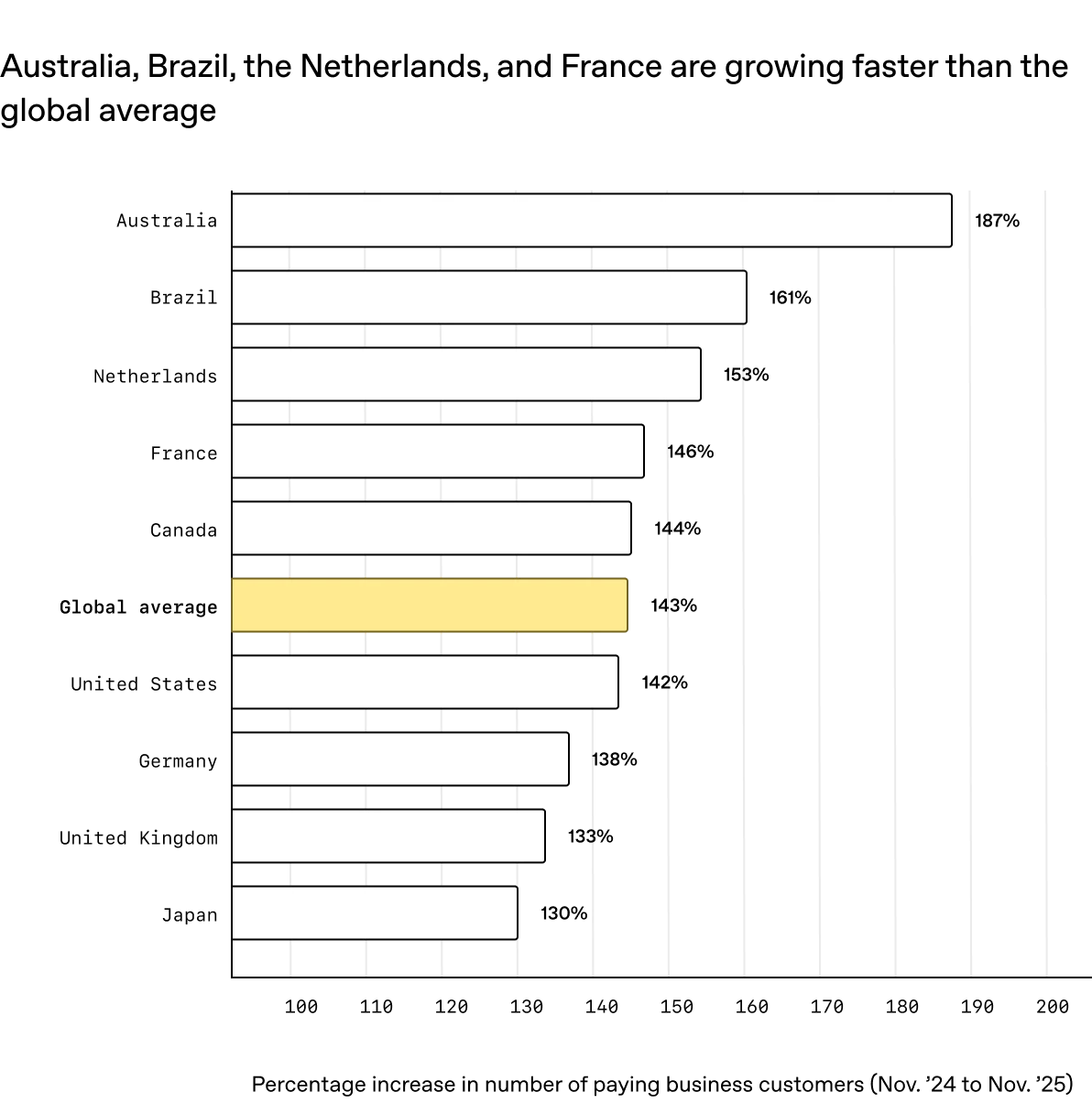
Among the largest markets, Australia, Brazil, the Netherlands, and France show the fastest growth in business customers, increasing more than 143% year-over-year.
-
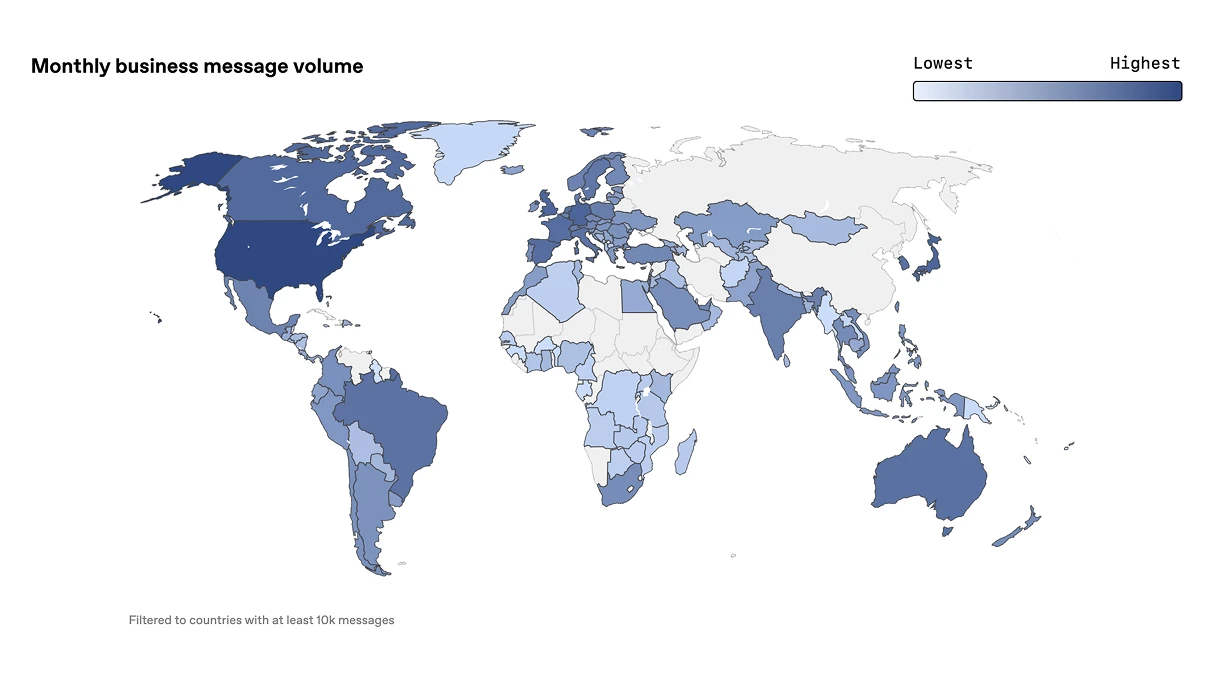
ChatGPT usage among business customers continues to scale globally, with the United States, Germany, and Japan among the most active markets by message volume.
-
The United Kingdom and Germany now rank among the largest ChatGPT Enterprise markets outside the U.S. by number of customers.
-
International API customer growth has exceeded 70% over the last 6 months, with Japan having the largest number of corporate API customers outside of the U.S.
企业增长是全球性的,并在加速
虽然早期 AI 采用主要在美国,但国际增长现在正在快速加速:
-
在最大市场中,澳大利亚、巴西、荷兰和法国的商业客户增长最快,同比增长超过 143%。
-
商业客户的 ChatGPT 使用继续在全球扩展,美国、德国和日本按消息量位列最活跃市场。
-
英国和德国现按客户数量位列美国以外最大的 ChatGPT Enterprise 市场。
-
过去 6 个月,国际 API 客户增长超过 70%,日本拥有美国以外最多的企业 API 客户。
The growing divide in AI adoption
There are clear differences emerging in how AI is used across industries and among individuals within firms. Whether this gap widens or contracts will depend on how organizations approach change management and their ability to build the systems, skills, and operating models required to successfully deploy AI.
To understand this growing divide more deeply, it is useful to compare frontier workers (defined as those in the 95th percentile of adoption intensity) to the median worker. Frontier workers generate 6x more messages than the median worker. Even among those who work in data analytics, frontier workers use the data-analysis tool 16x more than the median.
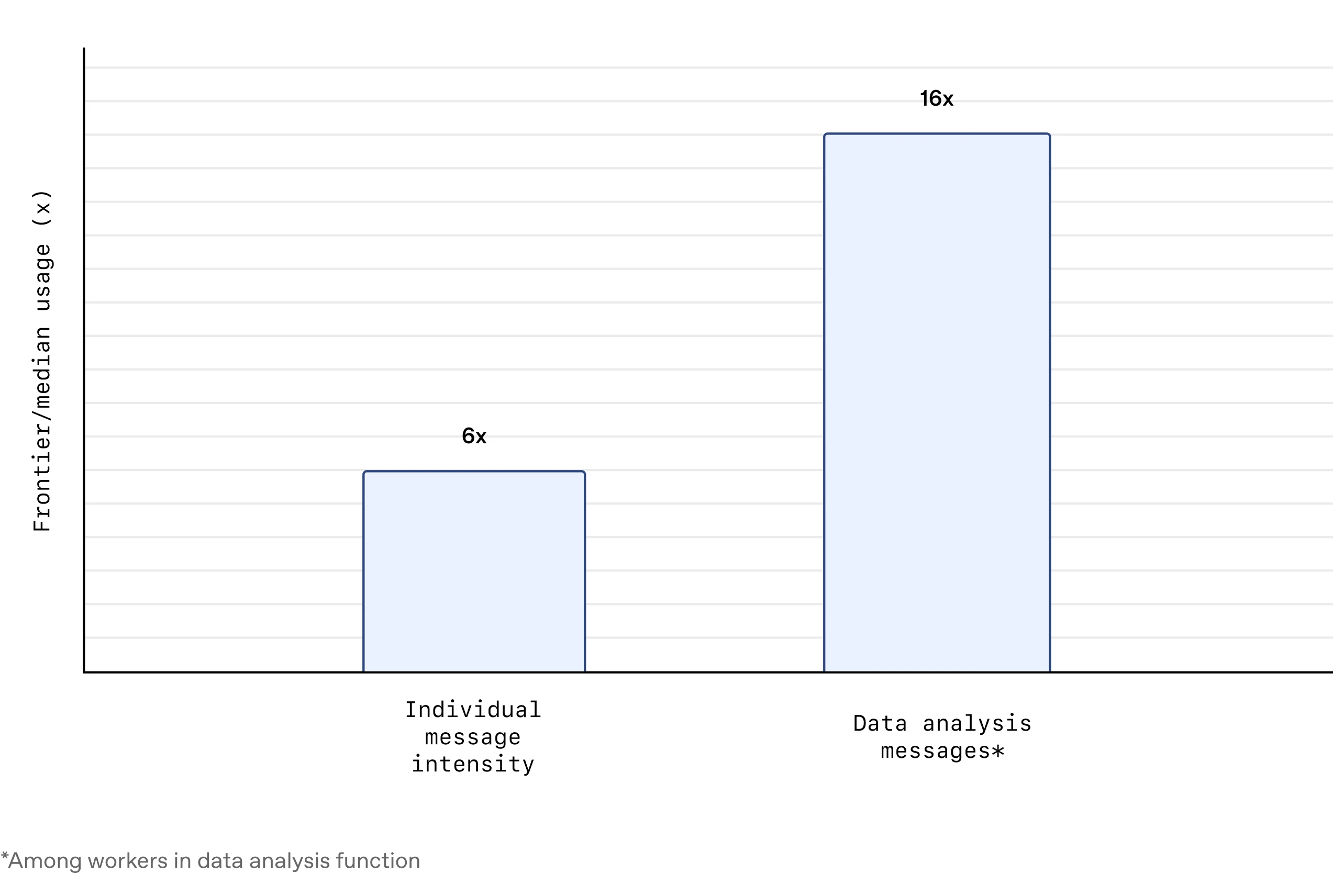
The gaps are widest between frontier and median workers for writing, coding, and analysis. Coding exhibits the largest relative gap in message volume, with frontier workers sending 17x as many messages as the median.

Comparison of 95th percentile-to-median
These differences matter. Usage data matched to survey results show that users who engage across roughly seven task types report five times more time saved than those who use only about four. In other words, the benefits users realize from AI scale directly with depth of use.
AI 采用中的差距不断扩大
在行业内部和企业内部不同个体之间,AI 的使用方式正出现明显差异。这一差距是扩大还是缩小,将取决于组织如何进行变革管理,以及它们是否有能力建立成功部署 AI 所需的系统、技能和运营模式。
为了更深入地理解这一不断扩大的差距,有必要将前沿工作者(定义为采用强度第 95 百分位的员工)与中位员工进行比较。前沿工作者产生的消息量是中位员工的 6 倍。即使在数据分析岗位上,前沿工作者使用数据分析工具的次数也是中位员工的 16 倍。
前沿与中位员工在写作、编码和分析方面的差距最大。编码的消息量相对差距最大,前沿工作者发送的消息数是中位员工的 17 倍。
第 95 百分位对中位数的比较
这些差异很重要。与调查结果匹配的使用数据显示,参与约七种任务类型的用户,比仅使用约四种的用户多节省五倍的时间。换句话说,用户从 AI 中获得的收益与使用的深度直接成正比。
Time savings increase as users engage across more distinct tasks
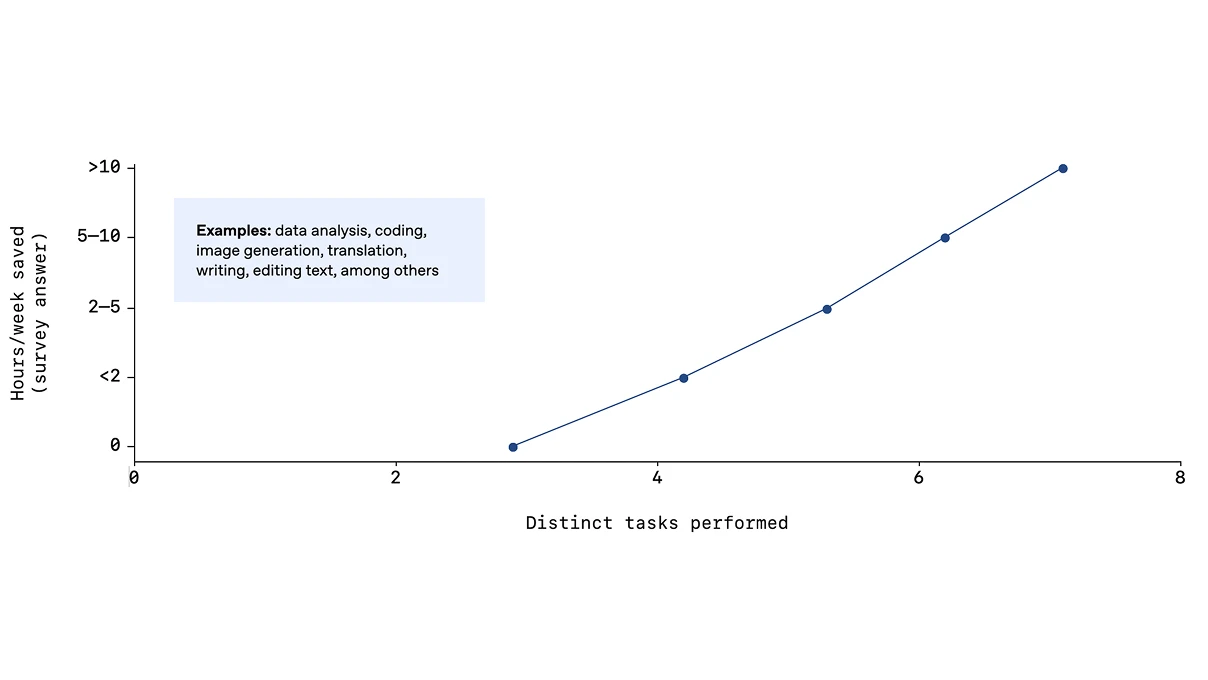
随着用户参与更多不同任务,时间节省增加
Even among active ChatGPT Enterprise users, many have not tried some of the most capable tools. Of monthly active users, 19% have never used data analysis, 14% have never used reasoning, and 12% have never used search. Among daily active users, those shares drop to 3%, 1%, and 1%, respectively.
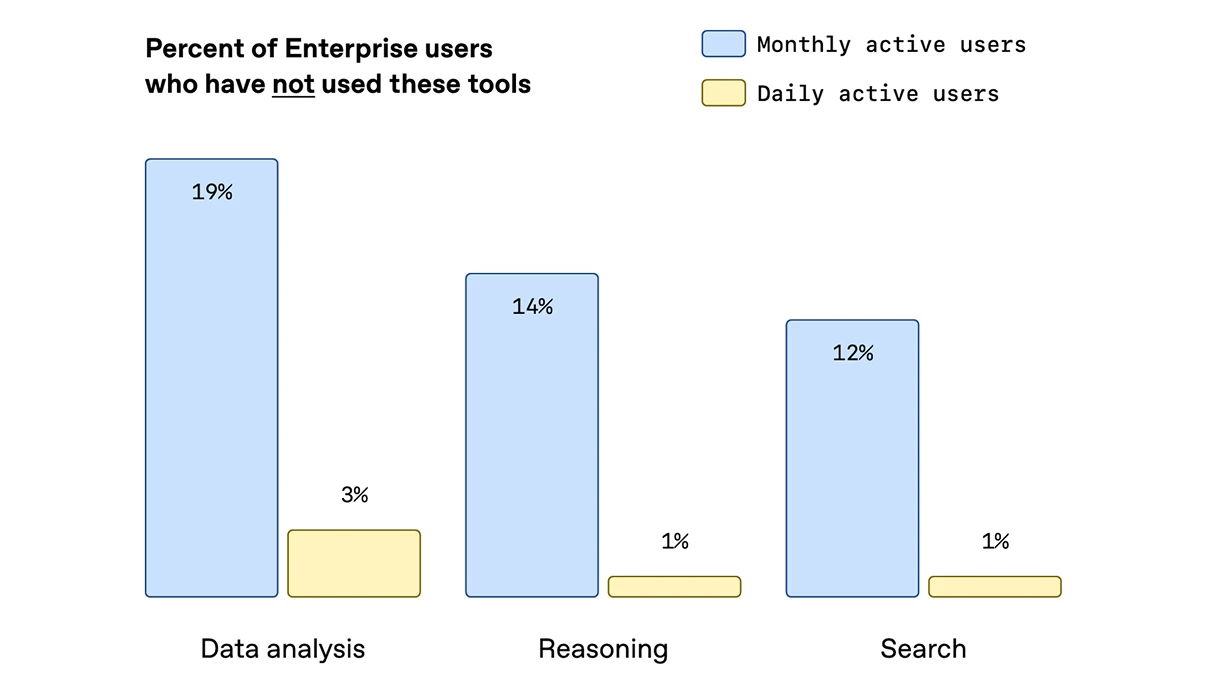
即使在活跃的 ChatGPT Enterprise 用户中,也有许多人没有尝试过一些最强大的工具。在月活跃用户中,19% 从未使用过数据分析,14% 从未使用过推理,12% 从未使用过搜索。在日活跃用户中,这些比例分别下降到 3%、1% 和 1%。
There’s significant headroom for firms to increase their AI maturity
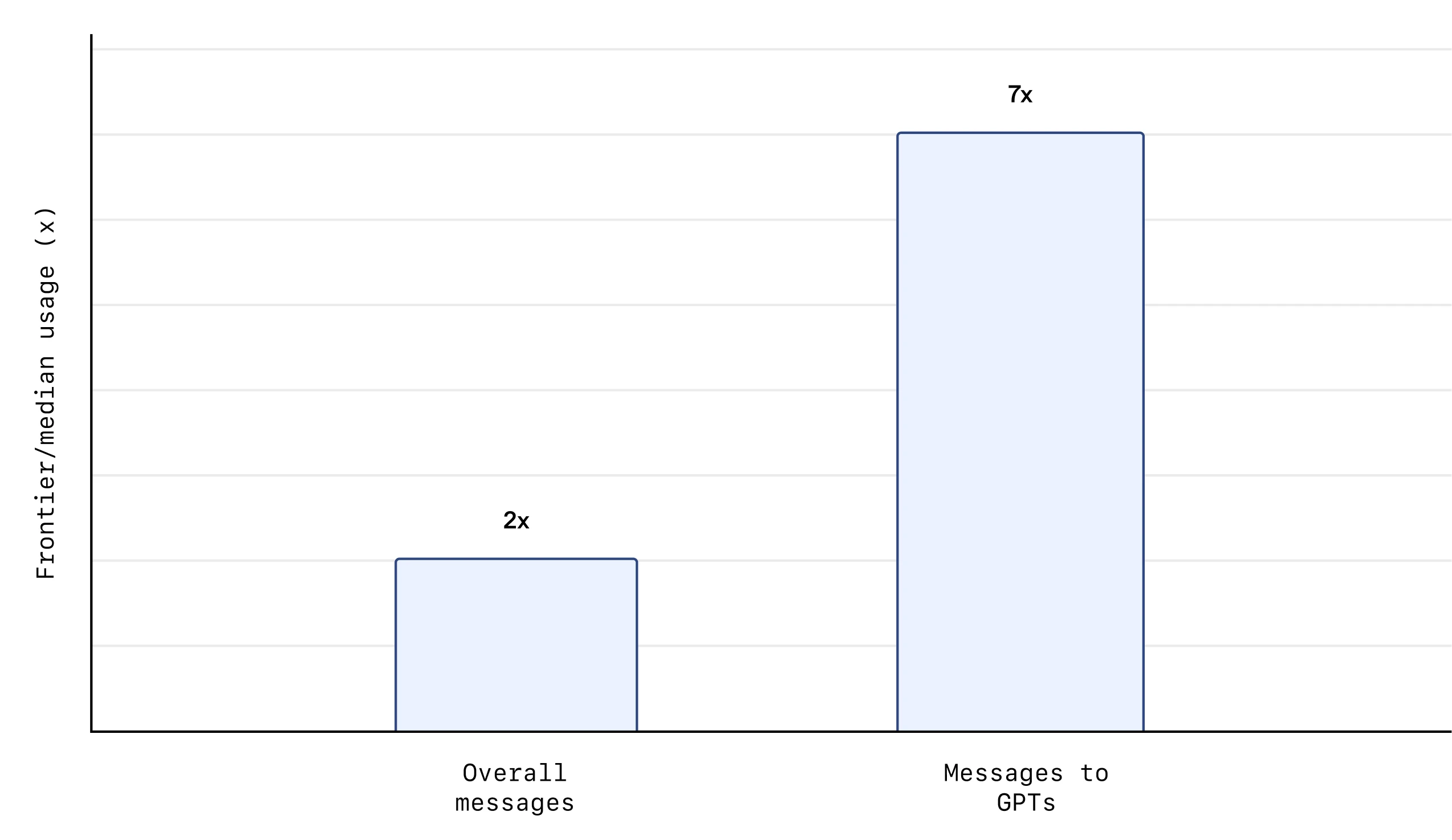
At the firm level, gaps in adoption intensity mirror those observed at the individual level. Frontier firms (95th percentile) generate approximately 2x more messages per seat than the median enterprise and 7x more messages to GPTs, indicating markedly deeper organizational integration and workflow standardization. These firms invest systematically in the infrastructure and operating models required to embed AI as core organizational capability rather than a peripheral productivity tool.
企业提升 AI 成熟度的空间巨大
在企业层面,采用强度的差距与个体层面观察到的差距相似。前沿企业(第 95 百分位)每座位产生的消息量约为中位企业的 2 倍,向 GPT 发送的消息量是 7 倍,这表明它们的组织集成和工作流标准化明显更深。这些企业系统性地投资于将 AI 嵌入为核心组织能力所需的基础设施和运营模式,而不是将 AI 视为外围生产力工具。
AI adoption and business impact: case evidence
The following case studies illustrate how AI is generating measurable business outcomes across a range of organizational contexts. Rather than a one-size-fits-all solution, their impact reflect the application of AI to specific operational and strategic challenges. Across these examples, AI is associated with revenue growth, improvements in customer experience, automation of manual processes, and accelerated product development.
These effects are not confined to a small set of firms, and external research shows that AI adoption is beginning to influence core financial performance indicators.
A 2025 Boston Consulting Group (BCG) study found that over the past three years, AI leaders achieved 1.7x revenue growth, 3.6x greater total shareholder return, and 1.6x EBIT margin. They also outperformed on nonfinancial measures such as patent output and employee satisfaction, linking AI maturity to both financial and organizational strength. While this evidence is still early, it suggests that AI adoption is correlated with improved financial performance and organizational outcomes.
Case studies
AI 采用与商业影响:案例证据
以下案例研究展示了 AI 如何在各种组织环境中产生可衡量的商业结果。它们的影响并非一刀切,而是将 AI 应用于具体的运营和战略挑战。在这些例子中,AI 与收入增长、客户体验改善、手动流程自动化以及产品开发加速相关。
这些影响并不局限于少数企业,外部研究显示 AI 采用已开始影响核心财务绩效指标。
波士顿咨询集团(BCG)2025 年的一项研究发现,在过去三年中,AI 领先者实现了 1.7 倍收入增长、3.6 倍更高的股东总回报和 1.6 倍的 EBIT 利润率。它们在专利产出和员工满意度等非财务指标上也表现更好,将 AI 成熟度与财务和组织实力联系起来。虽然这一证据仍处于早期,但它表明 AI 采用与财务绩效和组织成果的改善相关。
案例研究
Intercom
Intercom used OpenAI’s Realtime API for Fin Voice, delivering a low-latency, enterprise-ready voice AI Agent
Challenge
Fin, Intercom’s AI agent for customer service, delivers industry-leading resolution rates across chat, email, and social channels, resolving millions of customer queries each month. But extending Fin to a new channel — the phone — introduced a new, critical challenge: latency. In phone support, where issues are often urgent, even brief pauses can destroy the customer experience, and lead callers to abandon the interaction or escalate to a human.
Solution
Intercom built Fin Voice on OpenAI’s Realtime API to dramatically reduce latency and enable natural, interruption-friendly phone conversations. The Realtime API’s low time-to-first-token, strong instruction-following, and dependable tool-calling capabilities allow Fin Voice to navigate complex, multi-step requests with high quality and reliability.
Impact
Latency has decreased by 48% since March through Fin Voice’s use of the Realtime API for answer generation.
With faster responses enabled by the Realtime API, customers are seeing Fin Voice resolve 53% of calls end-to-end on average — a significant result given that phone calls are typically far more complex than chat.
Customers report that calls that ultimately require human agents are resolved 40% faster once Fin Voice completes the initial steps, improving efficiency on higher-touch calls.
Given that human-handled support conversations typically cost upwards of $5–$20 (depending on region and industry), Fin is already saving customers hundreds of millions of dollars annually.
Intercom
Intercom 将 OpenAI Realtime API 用于 Fin Voice,提供低延迟、企业级就绪的语音 AI Agent
挑战
Fin 是 Intercom 面向客户服务的 AI Agent,在聊天、电子邮件和社交渠道上提供行业领先的解决率,每月解决数百万客户查询。但将 Fin 扩展到新渠道——电话——引入了一个新的关键挑战:延迟。在电话支持中,问题往往很紧急,即使短暂的停顿也可能破坏客户体验,导致来电者放弃互动或转接给人工。
解决方案
Intercom 基于 OpenAI 的 Realtime API 构建了 Fin Voice,大幅降低延迟,并实现自然、可打断的电话对话。Realtime API 的低首 token 延迟、强大的指令遵循能力和可靠的工具调用能力,使 Fin Voice 能够高质量、可靠地处理复杂、多步骤的请求。
影响
自 3 月以来,通过 Fin Voice 使用 Realtime API 生成答案,延迟降低了 48%。
借助 Realtime API 带来的更快响应,客户看到 Fin Voice 平均端到端解决 53% 的电话——考虑到电话通常比聊天复杂得多,这是一个显著成果。
客户报告,一旦 Fin Voice 完成初始步骤,最终需要人工处理的电话解决速度快了 40%,提高了高触达电话的效率。
鉴于人工处理的客服对话通常花费 5–20 美元(视地区和行业而定),Fin 每年已为客户节省数亿美元。
Lowe's
Lowe’s deployed Mylow and Mylow Companion to scale expert home-improvement guidance to every online visitor and in-store associate
Challenge
Lowe’s needed to scale expert home improvement guidance to online shoppers and help store associates, especially new hires, answer complex questions consistently across more than 1,700 stores.
Solution
Lowe’s deployed Mylow on Lowes.com to provide customer project and product advice, and Mylow Companion for store associates in every store.
Impact
Impact
Mylow and Mylow Companion answer nearly 1 million questions per month about everything from product specs to project know-how to the status of a customer order since launching in March of this year.
Mylow is available on Lowes.com and in the award-winning Lowe’s mobile app. When customers engage with Mylow during their online visits, the conversion rate more than doubles.
Mylow Companion is deployed in 100% of stores and answers hundreds of thousands of associate questions each week. Lowe’s is seeing customer satisfaction scores increase 200 basis points when associates use Mylow Companion to help customers shopping in the aisle.
Lowe's
Lowe’s 部署 Mylow 和 Mylow Companion,将专家级家装指导扩展到每位在线访客和店内员工
挑战
Lowe’s 需要将专家级家装指导扩展到在线购物者,并帮助门店员工(尤其是新员工)在超过 1,700 家门店中一致地回答复杂问题。
解决方案
Lowe’s 在 Lowes.com 上部署 Mylow,提供客户项目和产品建议,并在每家门店部署 Mylow Companion 供员工使用。
影响
影响
自今年 3 月推出以来,Mylow 和 Mylow Companion 每月回答近 100 万个问题,涵盖产品规格、项目知识、客户订单状态等。
Mylow 可在 Lowes.com 和屡获殊荣的 Lowe’s 移动应用中使用。当客户在在线访问期间与 Mylow 互动时,转化率提高一倍以上。
Mylow Companion 已部署在 100% 的门店,每周回答数十万个员工问题。当员工使用 Mylow Companion 帮助在店内购物的客户时,Lowe’s 看到客户满意度得分提高了 200 个基点。
Indeed
Indeed uses GPT‑powered job matching and career coaching to improve hiring outcomes for job seekers and employers
Challenge
Indeed’s mission is to help people get jobs. Job seekers can face friction when searching, evaluating fit, and applying for roles, while employers want more qualified applicants for their open roles. Both sides benefit from deeper personalization and clearer context about what makes a strong match.
Solution
To address this friction, Indeed launched a suite of AI-powered products, using its proprietary AI to match job seekers and employers coupled with GPT‑powered explanations that help explain why they’re a good fit. Indeed Invite to Apply uses AI to generate and send contextual, personalized job invitations at scale, helping candidates understand why a role is a strong match and improving employer reach. Indeed Career Scout acts as an AI career coach, accelerating job discovery and streamlining the application process for job seekers.
Impact
In experiments, Invite to Apply with LLM-generated explanations increased started applications by 20% and improved downstream success (interviews and hires) by 13% versus traditional matching.
Early results show job seekers using Career Scout find and apply to relevant jobs 7x faster and are 38% more likely to be hired, with 84% rating it valuable.
Indeed
Indeed 使用 GPT 驱动的职位匹配和职业辅导,改善求职者和雇主的招聘结果
挑战
Indeed 的使命是帮助人们找到工作。求职者在搜索、评估匹配度和申请职位时可能遇到障碍,而雇主希望为开放职位获得更合格的申请人。双方都能从更深层次的个性化和更清晰的强匹配背景中受益。
解决方案
为解决这一摩擦,Indeed 推出了一套 AI 驱动的产品,使用其专有 AI 匹配求职者和雇主,并辅以 GPT 驱动的解释,帮助说明为什么匹配良好。Indeed Invite to Apply 使用 AI 大规模生成并发送情境化、个性化的职位邀请,帮助候选人理解为什么某个职位是强匹配,并提高雇主的触达范围。Indeed Career Scout 充当 AI 职业教练,加速职位发现并简化求职者的申请流程。
影响
在实验中,使用 LLM 生成解释的 Invite to Apply 与传统匹配相比,开始申请增加了 20%,后续成功(面试和录用)提高了 13%。
早期结果显示,使用 Career Scout 的求职者找到并申请相关工作职位快 7 倍,被录用的可能性高 38%,84% 的人认为它有价值。
BBVA
BBVA deployed a legal AI chatbot to instantly validate corporate signatory authority and unblock branch commercial operations
Challenge
In Mexico, BBVA must perform a legal check (also known as bastanteo) to confirm that a company representative has the authority to sign and act on behalf of the company before key transactions can proceed (e.g., opening accounts, signing contracts, issuing credit). Historically, this process relied on a specialist legal team responding to repetitive branch queries, creating delays, bottlenecks, and high demand for scarce legal capacity.
Solution
BBVA built a generative AI chatbot that provides instant access to standardized, pre-validated legal FAQs and documentation guidance for common signatory-authority questions. The content was developed and reviewed by BBVA’s Legal Services team, reducing manual handling of daily inquiries and making approved legal guidance consistently available.
Impact
The solution built with ChatGPT Enterprise automates more than 9,000 queries annually and has enabled BBVA to redeploy the equivalent of 3 FTE’s toward producing over 11,000 bastanteos per year, delivering 26% of the Legal Services division’s annual savings KPI.
BBVA
BBVA 部署法律 AI 聊天机器人,即时验证公司签署权,打通分支机构的商业运营
挑战
在墨西哥,BBVA 必须进行法律检查(也称为 bastanteo),以确认公司代表有权代表公司签署和行动后,关键交易才能继续(例如开户、签合同、发放信贷)。历史上,这一流程依赖专家法律团队回应重复的分行查询,造成延误、瓶颈,以及对稀缺法律能力的高需求。
解决方案
BBVA 构建了一个生成式 AI 聊天机器人,针对常见的签署权问题,即时提供标准化、经过预验证的法律 FAQ 和文档指导。内容由 BBVA 法律服务团队开发和审查,减少了日常查询的人工处理,并使经批准的法律指导始终可用。
影响
该解决方案由 ChatGPT Enterprise 构建,每年自动化处理超过 9,000 个查询,使 BBVA 能够将相当于 3 个全职员工的工作量重新部署,每年产出超过 11,000 份 bastanteo,贡献了法律服务部门年度节省 KPI 的 26%。
Oscar Health
Oscar Health deployed member-facing chatbots to answer benefits, cost, and general health questions in real time and help members navigate the complexities of the healthcare system
Challenge
For many people, the healthcare system can be challenging to understand and navigate. Understanding benefits, finding the right doctor, estimating care costs, and getting clear answers to questions are often challenging and time consuming. This is partially because the data needed to make the right decisions often lives in different places, including portals, benefits documents, and doctors’ notes from past visits. Oscar wanted to create a single, trustworthy entry point that helped members better understand and navigate the healthcare system.
Solution
Oscar developed a pair of member-facing chatbots to answer member benefits, costs and general health questions, on-demand and in realtime. Unlike general-purpose AI chatbots, these are integrated with Oscar systems and data, allowing them to draw from medical records, claims, and customer service interactions to personalize responses. Their chatbots can also assist with common tasks, including finding in-network doctors and refilling prescriptions.
Impact
The result is a platform that can address a wide array of questions and tasks, including understanding benefits, supporting symptom-related questions, preparing for visits, and explaining follow-up instructions, while also escalating members to providers or care guides as needed. Their platform answers 58% of benefits questions instantly and is able to handle 39% of benefits messages without any human escalation. Today, they now have the foundation for future capabilities, including appointment booking, voice interactions, and condition-specific management.
Oscar Health
Oscar Health 部署面向会员的聊天机器人,实时解答福利、费用和一般健康问题,帮助会员驾驭医疗系统的复杂性
挑战
对许多人来说,医疗系统可能难以理解和驾驭。理解福利、寻找合适的医生、估算护理费用,以及获得清晰答案,往往既困难又耗时。部分原因是做出正确决定所需的数据分散在不同地方,包括门户网站、福利文件和过去就诊的医生记录。Oscar 希望创建一个单一、值得信赖的入口,帮助会员更好地理解和驾驭医疗系统。
解决方案
Oscar 开发了一对面向会员的聊天机器人,按需、实时回答会员的福利、费用和一般健康问题。与通用 AI 聊天机器人不同,这些机器人集成了 Oscar 的系统和数据,可以从病历、理赔和客户服务交互中提取信息,以个性化回复。它们的聊天机器人还可以协助常见任务,包括查找网络内医生和续配处方。
影响
结果是构建了一个能够处理各种问题和任务的平台,包括理解福利、支持症状相关问题、准备就诊、解释后续指示,并在需要时将会员升级给提供者或护理指导。该平台能即时回答 58% 的福利问题,并能处理 39% 的福利消息而无需任何人工升级。如今,它们已为未来能力奠定了基础,包括预约、语音交互和特定病症管理。
Moderna
Moderna used AI to significantly compress Target Product Profile development time
Challenge
Writing a Target Product Profile (TPP) is typically a multi-week, cross-functional effort involving teams across clinical, product, and marketing roles. Teams must review and process large evidence packs, sometimes up to 300 pages of information, to create these blueprints for product development.
Solution
Using ChatGPT Enterprise, Moderna has streamlined substantial parts of the TPP drafting and analysis workflow. The system helps extract key facts and assumptions from large data packages, generate structured draft sections, and flag important details or potential errors to the teams providing human oversight.
Impact
Delays or errors in TPPs can affect downstream activities such as research planning, cross-functional alignment, and product launch preparation. By reducing the time required to review, cross-reference, and integrate large evidence packages, teams can spend more time pressure-testing trade-offs and making higher-quality decisions earlier in the TPP creation process. Moderna reports that a core analytical step in this process has been reduced from weeks to hours in some cases, and believes that each day gained in early TPP planning can help the company deliver for patients more quickly.
Moderna
Moderna 使用 AI 大幅压缩目标产品档案(TPP)开发时间
挑战
编写目标产品档案(TPP)通常需要跨职能、多周的协作,涉及临床、产品和营销团队。团队必须审查和处理大量证据包,有时多达 300 页信息,才能为产品开发创建这些蓝图。
解决方案
Moderna 使用 ChatGPT Enterprise 精简了 TPP 起草和分析工作流的绝大部分。该系统帮助从大型数据包中提取关键事实和假设,生成结构化的草稿章节,并标记重要细节或潜在错误,供人工监督团队审查。
影响
TPP 的延迟或错误会影响后续活动,如研究规划、跨职能对齐和产品上市准备。通过减少审查、交叉引用和整合大型证据包所需的时间,团队可以在 TPP 创建过程中更早地花时间压力测试权衡并做出更高质量的决策。Moderna 报告称,该过程中的一个核心分析步骤在某些情况下已从数周缩短到数小时,并相信在早期 TPP 规划中赢得的每一天都能帮助公司更快为患者提供产品。
In practice, leading firms consistently do several things
| Practice | Description |
|---|---|
| Deep system integration through enabling context | They turn on connectors to give AI secure access to company data inside core tools, enabling context-aware responses and automated actions. Roughly one in four enterprises still has not taken this step. |
| Workflow standardization and reuse | They actively promote the creation, sharing, and discovery of repeatable solutions for common tasks. GPTs often power this work, while the most sophisticated organizations embed API-powered assistants directly into core internal systems. |
| Executive leadership and sponsorship | They set clear mandates, secure resources, and align teams, and create space for experimentation, all of which enable deployment at scale. |
| Data readiness and evaluations | They codify institutional knowledge into machine-readable routines, build APIs for key data pipelines, and run continuous evaluations to track model performance on real-world outcomes. |
| Deliberate change management | They build structures that speed organizational learning, combining centralized governance and training with distributed enablement through embedded AI champions. |
The AI landscape is evolving rapidly; OpenAI releases a new feature or capability roughly every three days. The primary constraints for organizations are no longer model performance or tooling, but rather organizational readiness.
在实践中,领先企业始终会做几件事
| 实践 | 描述 |
|---|---|
| 通过启用上下文实现深度系统集成 | 他们开启连接器,让 AI 安全访问核心工具中的公司数据,实现上下文感知的响应和自动化操作。大约四分之一的企业仍未迈出这一步。 |
| 工作流标准化与复用 | 他们积极推动常见任务可重复解决方案的创建、共享和发现。GPTs 通常支持这项工作,而最先进的组织会将 API 驱动的助手直接嵌入核心内部系统。 |
| 高管领导与支持 | 他们设定明确任务、争取资源、协调团队,并为实验创造空间,这些都为规模化部署提供支持。 |
| 数据就绪与评估 | 他们将机构知识编码为机器可读的例程,为关键数据管道构建 API,并持续运行评估,以追踪模型在真实世界结果上的表现。 |
| 刻意的变革管理 | 他们建立加速组织学习的结构,将集中治理和培训与通过嵌入式 AI 倡导者进行分布式赋能相结合。 |
AI 领域正在快速演变;OpenAI 大约每三天就发布一项新功能或能力。组织面临的主要约束已不再是模型性能或工具,而是组织就绪度。
Conclusion
Across OpenAI’s more than 1 million business customers, AI is being embedded into an expanding range of workflows, products, and internal systems. Adoption is broad-based and accelerating across industries and regions, though depth of integration varies widely by organization.
The data suggest that depth of use matters. Workers and firms that make more consistent use of advanced tools, such as reasoning models, data analysis, Custom GPTs, Projects, and APIs, report larger productivity gains and broader task coverage than those whose use remains limited.
AI is also beginning to change who performs certain types of technical work. Coding and analytical tasks are increasingly showing up outside of traditional specialist roles, expanding what some non-technical teams are able to do. At the same time, industry patterns remain distinct, reflecting different operational needs across technology, professional services, finance, healthcare, manufacturing, and more.
Despite a growing divide in AI adoption, enterprise AI is still in the early innings. Firms have an opportunity to catch up by adopting the patterns of frontier workers and organizations. As enterprise AI matures, firms will increasingly translate AI capabilities into products and services that deliver new sources of value through faster iteration, deeper personalization, and new experiences. Organizations that succeed in bringing these capabilities into market-facing workflows will use AI not merely as a productivity tool, but as a durable engine of revenue growth and competitive advantage.
结论
在 OpenAI 超过 100 万的企业客户中,AI 正被嵌入到越来越多的工作流、产品和内部系统中。采用是广泛且在各行业各区域加速的,尽管集成的深度因组织而异。
数据表明,使用深度很重要。更持续使用推理模型、数据分析、Custom GPT、Projects 和 API 等高级工具的员工和企业,比那些使用有限的企业报告了更大的生产力收益和更广的任务覆盖。
AI 也开始改变某些技术工作的执行者。编码和分析任务越来越出现在传统专业角色之外,扩展了一些非技术团队的能力。与此同时,行业模式仍然各不相同,反映了科技、专业服务、金融、医疗、制造等行业的差异化运营需求。
尽管 AI 采用差距在扩大,企业 AI 仍处于早期阶段。企业有机会通过采纳前沿工作者和组织的行为模式来迎头赶上。随着企业 AI 的成熟,企业将越来越多地将 AI 能力转化为产品和服务,通过更快的迭代、更深的个性化和新体验创造新价值来源。那些成功将这些能力带入面向市场工作流的组织,将不仅仅将 AI 用作生产力工具,而是将其作为收入增长和竞争优势的持久引擎。