Cursor 踏入 AI 编程第三纪元:云端 Agent 独立作业,内部 35% PR 来自机器
Cursor 团队回顾 AI 辅助编程的三个时代:从 Tab 自动补全,到同步式 Agent 交互,再到云端 Agent 独立完成数小时级任务的新阶段。内部已有 35% 的合并 PR 由云上 Agent 自主生成,Agent 用户数首次反超 Tab 用户。开发者角色正从逐行指导代码转变为定义问题、设置评审标准并同时调度多个 Agent。Agent 返回的不再是 diff,而是日志、录屏和实时预览等可直接评估的成品。
When we started building Cursor a few years ago, most code was written one keystroke at a time. Tab autocomplete changed that and opened the first era of AI-assisted coding. Then agents arrived, and developers shifted to directing agents through synchronous prompt-and-response loops. That was the second era. Now a third era is arriving. It is defined by agents that can tackle larger tasks independently, over longer timescales, with less human direction. As a result, Cursor is no longer primarily about writing code. It is about helping developers build the factory that creates their software. This factory is made up of fleets of agents that they interact with as teammates: providing initial direction, equipping them with the tools to work independently, and reviewing their work.
几年前我们开始构建 Cursor 时,大部分代码还是一次一个按键敲出来的。Tab 自动补全改变了这一点,开启了 AI 辅助编程的第一时代。随后智能体(agent)到来,开发者转向通过同步的提示-响应循环来指挥智能体,这是第二时代。现在,第三时代正在到来。它的特征是智能体能够独立处理更大规模的任务,时间跨度更长,只需要较少的人工指导。因此,Cursor 的主要目的不再是编写代码,而是帮助开发者构建创造软件的工厂。这个工厂由成群的智能体组成,开发者像对待队友一样与它们交互:提供初始方向、配备独立工作的工具,并审查它们的工作。
Many of us at Cursor are already working this way. More than one-third of the PRs we merge are now created by agents that run on their own computers in the cloud. A year from now, we think the vast majority of development work will be done by these kinds of agents.
我们 Cursor 的许多同事已经在这样工作。目前我们合并的 PR 中,超过三分之一是由运行在云端独立计算机上的智能体创建的。我们认为一年后,绝大多数开发工作将由这类智能体完成。
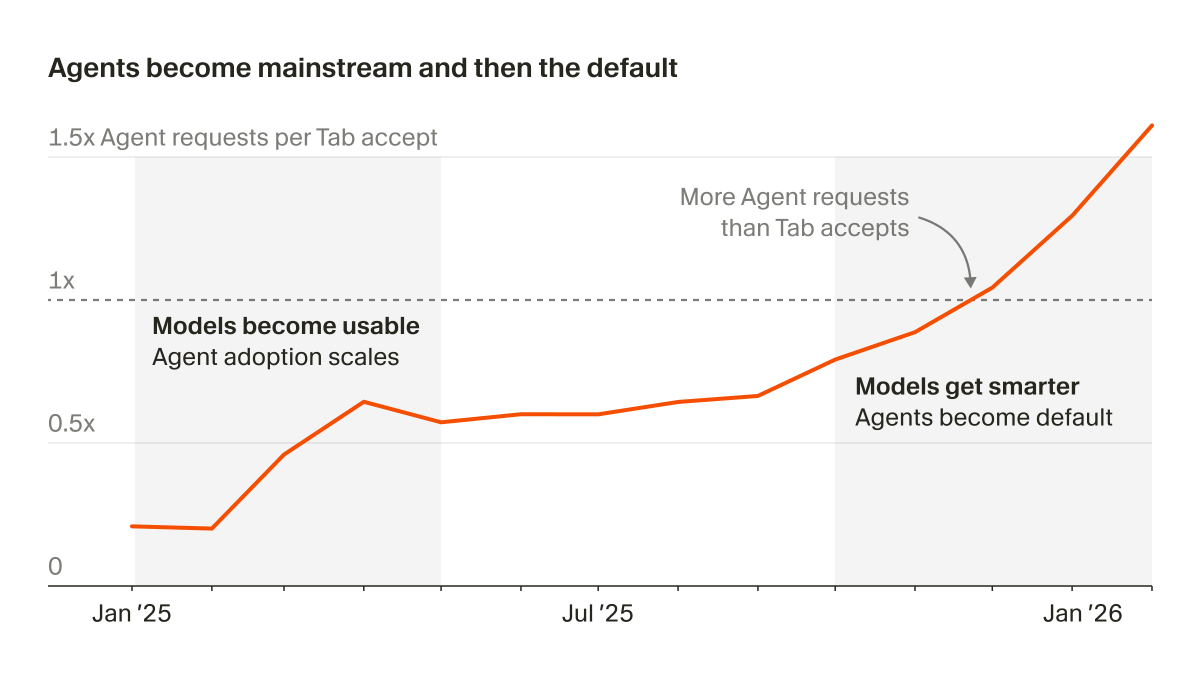
Tab excelled at identifying where low-entropy, repetitive work could be automated. For nearly two years, it produced significant leverage. Then the models improved. Agents could hold more context, use more tools, and execute longer sequences of actions. Developer habits began to shift, slowly through the summer, then rapidly over the last few months. The transformation has been so complete that today, many Cursor users never touch the tab key. In March 2025, we had roughly 2.5x as many Tab users as agent users. Now, that is flipped: we now have 2x as many agent users as Tab users and agent usage in Cursor has surged.
But already this shift is giving way to something bigger. The Tab era lasted nearly two years. The second era, in which most work is done with synchronous agents, may not last one.
Tab 擅长识别哪些低熵、重复性的工作可以自动化。近两年来,它带来了显著的效率提升。随后模型改进了:智能体能够处理更多上下文、使用更多工具、执行更长的操作序列。开发者的习惯开始转变,夏天时还比较缓慢,过去几个月则急剧加速。这种转变如此彻底,以至于如今许多 Cursor 用户从未碰过 Tab 键。2025 年 3 月,我们的 Tab 用户大约是智能体用户的 2.5 倍。现在情况完全颠倒:智能体用户是 Tab 用户的两倍,且 Cursor 中的智能体使用量激增。
但这个转变正在让位于更重大的变化。Tab 时代持续了近两年。第二个时代——大部分工作由同步智能体完成——可能持续不到一年。
Compared to Tab, synchronous agents work further up the stack. They handle tasks that require context and judgment, but still keep the developer in the loop at every step. But this form of real-time interaction, combined with the fact that synchronous agents compete for resources on the local machine, means it is only practical to work with a few at a time.
Cloud agents remove both constraints. Each runs on its own virtual machine, allowing a developer to hand off a task and move on to something else. The agent works through it over hours, iterating and testing until it is confident in the output, and returns with something quickly reviewable: logs, video recordings, and live previews rather than diffs.
This makes running agents in parallel practical, because artifacts and previews give you enough context to evaluate output without reconstructing each session from scratch. The human role shifts from guiding each line of code to defining the problem and setting review criteria.
与 Tab 相比,同步智能体在更高的抽象层工作。它们处理需要上下文和判断的任务,但仍然让开发者参与每个步骤。但这种实时交互形式,加上同步智能体在本地机器上竞争资源,意味着一次只能实际处理少数几个。
云智能体消除了这两项限制。每个云智能体运行在独立的虚拟机上,允许开发者移交任务后转而处理其他事情。智能体在数小时内逐步完成工作,迭代和测试直到对输出有信心,然后返回可快速审查的结果:日志、视频录制和实时预览,而不是差异对比。
这使得并行运行智能体变得可行,因为制品和预览提供了足够的上下文来评估输出,无需从头重建每个会话。人类的角色从指导每一行代码转变为定义问题和设置审查标准。
Thirty-five percent of the PRs we merge internally at Cursor are now created by agents operating autonomously in cloud VMs. We see the developers adopting this new way of working as characterized by three traits:
- Agents write almost 100% of their code.
- They spend their time breaking down problems, reviewing artifacts / code, and giving feedback.
- They spin up multiple agents simultaneously instead of handholding one to completion.
There is a lot of work left before this approach becomes standard in software development. At industrial scale, a flaky test or broken environment that a single developer can work around turns into a failure that interrupts every agent run. More broadly, we still need to make sure agents can operate as effectively as possible, with full access to tools and context they need.
We think yesterday's launch is an initial but important step in that direction.
在 Cursor 内部,我们合并的 PR 中有 35% 现在是由在云端虚拟机中自主运行的智能体创建的。我们看到采用这种新工作方式的开发者表现出三个特征:
- 智能体编写了几乎 100% 的代码。
- 他们将时间花在分解问题、审查制品/代码以及提供反馈上。
- 他们同时启动多个智能体,而不是手把手地指导一个智能体直到完成。
要让这种方法成为软件开发的标准,还有很多工作要做。在工业规模上,一个单个开发者可以绕过的脆弱测试或中断的环境,就会变成打断每个智能体运行的故障。更广泛地说,我们还需要确保智能体能够尽可能高效地运行,完全访问所需的工具和上下文。
我们认为昨天发布的产品是朝这个方向迈出的初步但重要的一步。