人机协作工作流:从审批疲劳到计划级干预的设计
本文基于Anthropic对40万次Claude Code会话的分析,揭示当前“Human-in-the-Loop”实践中的核心问题:用户93%的审批率导致“审批疲劳”,人类名义上在场但实际失去判断力。作者提出应将工作流重新设计为三个层:输入层(任务描述、约束、示例)、引导层(计划级审批而非逐步骤批准)、输出审查层(定义质量标准并自我评估)。实验显示,仅添加输出审查检查点即可将生成质量提升8-10%。文章给出具体操作步骤,并指出真正的差距不是模型能力,而是工作流架构设计。适合AI工程、Agent开发及所有使用AI辅助工作的一线工程师。

Stop approving every action your AI takes. Start designing where you sit in the loop.
Approving every action gets you consent fatigue and a rubber-stamp reflex. Designing your checkpoints gets you output quality that improves with every session.
Anthropic published internal telemetry from Claude Code showing that users approve 93% of permission prompts. Their own engineers named the problem consent fatigue. The human is nominally in the loop but functionally checked out.
Their fix wasn't to remove humans from the process. It was to restructure where humans participate, moving from per-action approval to plan-level review, monitoring, and targeted intervention.
停止批准 AI 采取的每一个行动。开始设计你在循环中的位置。
批准每一个行动会让你陷入同意疲劳和橡皮图章式的反射。设计你的检查点,能让每次会话的输出质量都得到提升。
Anthropic 发布了 Claude Code 的内部遥测数据,显示用户批准了 93% 的权限提示。他们自己的工程师将这个问题称为“同意疲劳”。用户名义上在循环中,但实际上已经心不在焉。
他们的修复方案并非将人类从流程中移除,而是重新组织人类的参与方式,从逐个行动批准转变为计划级审查、监控和定向干预。

Chip Huyen said the same thing from a different direction. In AI Engineering, the most-read technical book on O'Reilly since its release, her advice is to start with a human in the loop and gradually increase automation as confidence in the AI grows. Microsoft built an entire adoption framework around the same principle and called it Crawl-Walk-Run.
Human in the loop is a workflow architecture. You define where human judgment enters the process, the AI iterates against those checkpoints, and what comes out improves until neither side could match the result alone.
Chip Huyen 从另一个角度阐述了相同的观点。在 O'Reilly 上最受关注的技术书籍《AI Engineering》中,她建议从人类在循环中开始,随着对 AI 信心的增长,逐步增加自动化。微软围绕同样的原则构建了一整套采用框架,称之为 Crawl-Walk-Run。
人机协同是一种工作流架构。你定义人类判断进入流程的位置,AI 针对这些检查点进行迭代,输出的结果不断改进,直到任何一方都无法单独达到这样的效果。
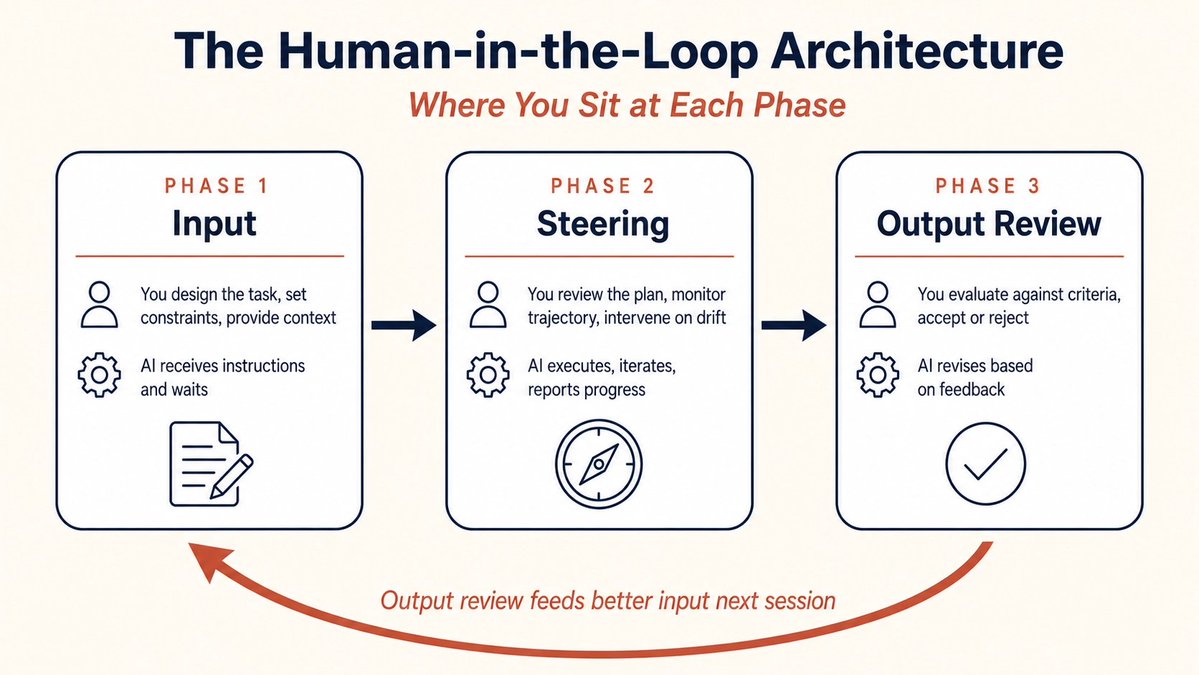
Anthropic analyzed roughly 400,000 Claude Code sessions between October 2025 and April 2026. One pattern held across nearly all of them. People make the planning decisions. The AI makes the execution decisions.
The more domain expertise a person brings to a session, the more work the AI completes per instruction and the higher the success rate. That's not a safety concept. That's a workflow architecture, and it breaks into three phases.
Input covers what happens before the AI starts working. Your task description, your constraints, your context, the examples you provide. People almost always underinvest here and then spend twice the time correcting outputs that went sideways from the first prompt.
Steering is what happens while the AI is working. Monitoring its direction, intervening when something drifts, reviewing the plan rather than approving each individual action.
Anthropic's data showed that experienced users auto-approve individual actions at twice the rate of new users but interrupt the agent mid-execution far more often. They watch the trajectory, not steps.
Output review is the final gate. What you accept, what you reject, and the criteria you judge against. This sounds obvious, but nearly everyone skips it and ships the first output they receive.
Every working human-in-the-loop workflow is some combination of these three.
Anthropic 分析了 2025 年 10 月至 2026 年 4 月期间大约 40 万次 Claude Code 会话。其中有一个模式几乎贯穿始终:人类做规划决策,AI 做执行决策。
一个人带入会话的领域专业知识越多,AI 每次指令完成的工作就越多,成功率也越高。这并非安全概念,而是一种工作流架构,它分为三个阶段。
输入阶段涵盖 AI 开始工作之前的部分:你的任务描述、约束条件、上下文、所提供的示例。人们几乎总是在这里投入不足,然后花两倍的时间来纠正从第一条提示就开始偏离方向的输出。
引导阶段发生在 AI 工作时:监控其走向,在出现偏差时进行干预,审查计划而不是批准每个单独的行动。
Anthropic 的数据显示,经验丰富的用户自动批准个别行动的比例是新用户的两倍,但他们在执行过程中中断 agent 的频率要高得多。他们关注的是轨迹,而不是步骤。
输出审查是最后的关卡:你接受什么、拒绝什么,以及你判断的标准。这听起来显而易见,但几乎所有人都跳过了它,直接交付收到的第一个输出。
每个有效的人机协同工作流都是这三者的某种组合。
start with output review
This is the simplest entry point and the one that pays off fastest.
At their Code with Claude event, Anthropic shipped a feature called Outcomes. It adds a grading loop where you define what "good enough" looks like, and the system evaluates its own output against those criteria before delivering. Nothing about the model changed. The same AI ran the same prompts with one addition, a grading checkpoint.
The result was a 10.1% quality improvement on slide generation and 8.4% on document generation.
That number matters because it proves a meaningful portion of bad AI output isn't a model problem. It's an evaluation problem. Nobody was checking whether the output was actually good before it shipped.
You don't need a platform feature to do this yourself. The practice is simpler than the tooling. Before you start any AI task, write down what a good result looks like in concrete terms.
Then compare the output against your own criteria before you use it. One pass of intentional review against a defined standard catches the majority of the errors that make AI output feel unreliable.
Don't overhaul your entire workflow on day one. Pick one recurring AI task you already run, whether that's emails, first drafts, summaries, or code, and add a single review checkpoint. That alone is already more human-in-the-loop than nearly anyone practices.
从输出审查开始
这是最简单的切入点,也是见效最快的。
在 Code with Claude 活动中,Anthropic 发布了一项名为“Outcomes”的功能。它增加了一个评分循环,你可以定义“足够好”的标准,系统在交付前会据此评估自己的输出。模型本身没有变化,同一个 AI 运行相同的提示,只是多了一个评分检查点。
结果是幻灯片生成质量提高了 10.1%,文档生成质量提高了 8.4%。
这个数字之所以重要,是因为它证明相当一部分糟糕的 AI 输出并非模型问题,而是评估问题。在输出交付之前,根本没人检查它是否真的合格。
你不需要平台功能来做这件事。实践比工具更简单。在开始任何 AI 任务之前,用具体术语写下好的结果是什么样的。
然后在你使用输出之前,将其与自己的标准进行对比。一次有针对性的审查,对照既定标准,就能捕获大部分让 AI 输出感觉不可靠的错误。
不要第一天就彻底改造整个工作流。选择一个你已经经常运行的 AI 任务——无论是电子邮件、初稿、摘要还是代码——并增加一个审查检查点。单凭这一点,就已经比几乎所有人的实践更接近人机协同了。
add the steering layer
Output review catches problems after they happen. Steering prevents them from happening in the first place.
The old model of steering was per-action approval. The AI proposes something, you approve or reject, the AI proposes the next step. Anthropic's 93% approval rate proved this approach is broken at scale.
At hundreds of actions per session, people stop reading what they're approving. Ilya Kabanov's analysis of Anthropic's own research described the reality plainly. What's actually happening is incident response, not oversight.
Anthropic's alternative is a pattern they call Plan Mode. Instead of approving each action individually, the AI presents its intended sequence of actions upfront. You review, edit, and approve the plan as a whole before anything executes.
You can still intervene during execution, but the cognitive load moves from "evaluate 200 micro-decisions" to "review one plan and watch for drift."
This pattern translates directly to any AI workflow regardless of the tool. Give the AI a structured task. Ask it to outline its approach before executing. Review the outline, then let it run and check back at natural breakpoints rather than hovering over every step.
The practical implementation for daily work is a steering document. A CLAUDE.md file, a custom instruction set, or a system prompt that encodes your standards, constraints, and recurring preferences. One well-maintained steering document replaces hundreds of mid-session corrections because the AI already knows your rules before you start typing.
添加引导层
输出审查是在问题发生后进行捕捉,而引导层则能从一开始就防止问题发生。
旧的引导模式是按行动批准:AI 提出某个行动,你批准或拒绝,AI 再提出下一步。Anthropic 的 93% 批准率证明这种方法在大规模下是行不通的。
当每次会话包含数百个行动时,人们不再阅读他们批准的是什么。Ilya Kabanov 对 Anthropic 自身研究的分析清晰地描述了现实:实际发生的根本不是监督,而是事故响应。
Anthropic 的替代方案是一种他们称之为“Plan Mode”的模式。AI 不逐个批准行动,而是在执行之前,将预期的行动序列整体呈现出来。你审查、编辑并批准整个计划。
你仍然可以在执行过程中进行干预,但认知负载从“评估 200 个微决策”转变为“审查一个计划并留意偏移”。
这种模式可以直接应用到任何 AI 工作流中,无论使用什么工具。给 AI 一个结构化的任务,要求它在执行之前概述方法。审查大纲,然后让它运行,并在自然的断点处回检,而不是在每个步骤上徘徊。
在日常工作中,实用的实现是使用一个引导文档。一个 CLAUDE.md 文件、一套自定义指令或一个系统提示,编码了你的标准、约束和反复出现的偏好。一份维护良好的引导文档可以取代数百次会话中的纠正,因为 AI 在开始输入之前就已经知道了你的规则。
build the input layer
This is the phase that separates people who get reliable results from people who keep fighting their AI tools.
People almost always start a session by typing a vague instruction and then spend 80% of their time correcting the output. That's the loop running backward. The human effort lands at the end, in re-prompting and output correction, when it should land at the beginning.
Anthropic's session data showed this pattern directly. The greater the domain expertise a person brings, the more work the AI completes per instruction.
Expertise here doesn't mean technical skill. It means knowing what you want and being able to describe it precisely. A senior engineer who writes a clear task description with constraints and context gets more done per prompt than someone who writes "fix the bug" and waits.
Expertise here doesn't mean technical skill. It means knowing what you want and being able to describe it precisely.
构建输入层
这个阶段将那些能获得可靠结果的人与那些不断与 AI 工具斗争的人区分开来。
人们几乎总是通过键入一条模糊的指令开始会话,然后花 80% 的时间纠正输出。这是循环在反向运行。人类的努力落在了最后——重复提示和输出修正上,而它本应落在开头。
Anthropic 的会话数据直接显示了这一模式。一个人带来的领域专业知识越多,AI 每次指令完成的工作就越多。
这里的专业能力并非指技术技能,而是指你清楚自己想要什么,并能精确地描述它。一位资深工程师写出包含约束和上下文的清晰任务描述,比一个只写“修复这个 bug”然后等待的人,每次提示能完成更多工作。
这里的专业能力并非指技术技能,而是指你清楚自己想要什么,并能精确地描述它。

The input layer is where you encode that precision. Your task descriptions, your context files, your reference examples, your boundaries. What the AI needs to understand is not just what to do but how you want it done and where the limits are.
A reliable structure is three parts. First, state the goal in one sentence. Second, define the constraints, meaning what the output must include and must not include.
Third, provide an example of what good looks like. That triad gives the AI enough structure to produce something usable on the first pass, which means your output review catches refinements instead of fundamental rewrites.
Building this feels like extra work upfront, and it is. But it saves multiples of that time on every session that follows. The people who invest in their input layer once start improving immediately. The people who never build one keep resetting to zero every time they open a new chat.
输入层就是你编码这种精确性的地方。你的任务描述、上下文文件、参考示例、边界条件。AI 需要理解的不仅仅是要做什么,还有你希望它怎么做,以及界限在哪里。
一个可靠的结构包含三部分:首先,用一句话陈述目标。其次,定义约束条件,即输出必须包含什么、不得包含什么。
第三,提供一个好结果的示例。这个三元组为 AI 提供了足够的结构,使其能在第一次尝试就产生可用的结果,这意味着你的输出审查只需要捕捉改进点,而不是进行彻底重写。
构建这个看起来像是额外的前期工作,确实如此。但它会在后续的每次会话中节省数倍的时间。那些在输入层上投入一次的人,会立即开始改进。那些从未构建输入层的人,每次打开新聊天时都只能归零重来。
run the full loop
Here's what all three phases look like working together in a single task.
A developer needs to refactor a payment processing module. Without human-in-the-loop design, this starts with a prompt like "refactor the payment module" and ends with a 500-line diff that changed the public API, broke two tests, and used a different naming convention than the rest of the codebase. The developer spends an hour manually fixing the output. Net time saved approaches zero.
With the three phases in place, the same task runs differently.
The input is structured before the AI touches anything. "Refactor the payment processing module. Don't change the public API. Keep backward compatibility with v2 endpoints. Match the naming conventions in /src/auth. Here's the current test suite as context." That takes about five minutes to write and eliminates 80% of the corrections that would have happened later.
The steering happens when the AI outlines its refactoring plan before executing. It proposes extracting three helper functions, consolidating error handling, and restructuring the retry logic. The developer spots that the AI planned to merge two functions that need to stay separate for rate-limiting reasons. One redirect, ten seconds. The AI revises its plan and executes.
The output review takes about ten minutes. The developer checks the diff against their original constraints. Public API unchanged. Tests pass. Naming conventions match. They accept.
The first approach (no loop) took 90 minutes. The second (with the loop) took about 25. The difference isn't that the AI got smarter between the two attempts. It's that the human invested their time at the front of the process instead of the back.
That's the pattern for any AI-assisted task, not just code. Writing, research, analysis, design. Front-load your input, steer the plan, review the output against defined criteria. The loop is the same regardless of the domain.
运行完整循环
以下是三个阶段在单个任务中协同工作的示例。
一位开发者需要重构支付处理模块。没有设计人机协同的情况下,任务从“重构支付模块”这样的提示开始,最终得到一个 500 行的 diff,它修改了公共 API、破坏了两个测试、使用了与代码库其他部分不同的命名约定。开发者花了一个小时手动修复输出。净节省时间几乎为零。
在三个阶段到位的情况下,同一个任务的运行方式截然不同。
在 AI 接触任何内容之前,输入已结构化:“重构支付处理模块。不要更改公共 API。保持与 v2 端点的向后兼容。匹配 /src/auth 中的命名约定。以下是当前测试套件作为上下文。”这大约需要五分钟来编写,却消除了 80% 本应在后期出现的纠正。
引导发生在 AI 在执行前概述重构计划时。AI 提议提取三个辅助函数、合并错误处理、重构重试逻辑。开发者发现 AI 计划合并两个因速率限制需要保持独立的函数。一次重定向,十秒钟。AI 修改计划并执行。
输出审查大约需要十分钟。开发者对照原始约束检查 diff:公共 API 未变、测试通过、命名约定匹配。接受。
第一种方法(无循环)花了 90 分钟。第二种(有循环)大约用了 25 分钟。差异并非 AI 在两次尝试之间变得更聪明,而是人类将时间投入到了流程的前端而非后端。
这是任何 AI 辅助任务的模式,不只是代码。写作、研究、分析、设计。前置输入、引导计划、对照标准审查输出。无论领域如何,循环是一样的。
watch what your work becomes
When all three phases click into place, your daily interaction with AI changes shape entirely.
You stop typing vague requests and correcting outputs for an hour. You start writing structured inputs that take five minutes and produce usable results on the first or second pass. Your steering documents accumulate knowledge between sessions, so the AI improves at your specific work over time without any model upgrade needed.
Your task list stops being a list of things to produce and becomes a list of things to review. The center of your day moves from production to direction. You're not writing the first draft anymore. You're defining what a good draft looks like, reviewing what comes back, and refining the standard for next time.
This doesn't mean you stop thinking. It means your thinking moves to a different altitude. Instead of choosing words, you're choosing direction. Instead of debugging code line by line, you're reviewing architecture and catching mistakes before they cascade.
The parts that genuinely need a human, things like judgment, taste, domain knowledge, and strategic decisions, get more of your attention because the parts that don't are handled.
The people who build this workflow once will keep building on it for years. The people who keep typing one-off prompts and hoping for the best will keep resetting to zero every session.
The old version of human in the loop asked you to approve every action. That was never going to scale, and the data proves it.
The new version asks you to invest in three things. Your input, your steering, and your review criteria. Build those once, and the AI handles more with each session while you handle less. Not because you're being replaced, but because you're finally operating at the altitude where a human actually makes a difference.
观察你的工作将变成什么样
当三个阶段全部就位时,你与 AI 的日常互动将完全改变形态。
你不再输入模糊的请求然后花一个小时纠正输出。你开始编写结构化的输入——只需五分钟,就能在第一次或第二次尝试时产生可用的结果。你的引导文档在会话之间积累知识,因此随着时间的推移,AI 在你特定工作上的表现会越来越好,完全不需要升级模型。
你的任务列表不再是一串需要产出的东西,而是一串需要审查的事项。你一天的核心从生产转变为指导。你不再写初稿,你定义什么是一份好的初稿,审查返回的内容,并为下一次完善标准。
这并不意味着你停止思考。而是你的思考上升到不同的高度。你不再挑选词语,而是选择方向。不再逐行调试代码,而是审查架构并在错误级联之前将其捕获。
那些真正需要人类的部分——判断力、品味、领域知识、战略决策——会获得你更多的关注,因为不需要的部分已经被处理了。
那些构建过这个工作流一次的人,会在此基础上持续构建多年。而那些不断输入一次性提示并希望得到最佳结果的人,每次会话都会归零。
旧版的人机协同要求你批准每一个行动。这永远无法规模化,数据已经证明了这一点。
新版要求你投资三件事:你的输入、你的引导和你的审查标准。一次构建好这些,AI 每次会话就能处理更多,而你处理得更少。不是因为你被取代,而是因为你终于在人类真正能发挥作用的高度上运作了。