管理是新的 AI 超能力:写清目标,剩下交给 Agent
作者在宾大 EMBA 课堂上做了一个实验:让几乎不会写代码的高管学生用 Claude Code 和 Google Antigravity,在四天内从零做出可演示的创业原型,并借助 ChatGPT、Claude、Gemini 完成市场分析、商业计划与财务模型。作者判断,这批学生的成果比 AI 出现前完整一学期的平均进度领先约一个数量级。他认为关键不在提示词技巧,而是“告诉 AI 你想要什么”的委托能力,并提出一个可计算的决策模型:比较人工基准耗时、AI 单次成功率与 AI 流程耗时(提问、等待、评估)。引用 OpenAI GDPval 的数据:专家平均 7 小时的任务,GPT-5.2 在 72% 的评审中打平或胜过人类;按“让 AI 先做、人工检查一小时、不行再自己做”的策略,平均能省约 3 小时。文中还建议把 PRD、五段式命令等既有管理文档直接改造成 agent 指令。适合想用 Agent 提效的团队负责人与领域专家阅读。
I just taught an experimental class at the University of Pennsylvania where I challenged students to create a startup from scratch in four days. Most of the people in the class were in the executive MBA program, so they were taking classes while also working as doctors, managers, or leaders in a variety of large and small companies. Few had ever coded. I introduced them to Claude Code and Google Antigravity, which they needed to use to build a working prototype. But a prototype alone is not a startup, so they used ChatGPT, Claude, and Gemini to accelerate the idea generation, market research, competitive positioning, pitching, and financial modelling processes. I was curious how far they could get in such a short time. It turns out they got very far.
I’ve been teaching entrepreneurship for a decade and a half, and I've seen thousands of startup ideas (some of which turned into large companies) so I have a good sense of the expectations for what a class of smart MBA students can accomplish. I would estimate that what I saw in a couple of days was an order of magnitude further along the path to a real startup than I had seen out of students working over a full semester before AI. Most of the prototypes were not just sample screens but actually had a core feature working. Ideas were far more diverse and interesting than usual. Market and customer analyses were insightful. It was really impressive. These were not yet working startups nor were they fully operational products (with a couple exceptions) — but they had shaved months and huge amounts of money and effort from the traditional process. And there was something else: most early startups need to pivot, changing direction as they learn more about what the market wants and what is technically possible. By lowering the costs of pivoting, it was much easier to explore the possibilities without being locked in or even explore multiple startups at once: you just tell the AI what you want.
我刚刚在宾夕法尼亚大学上了一堂实验课,要求学生用四天时间从零打造一家创业公司。班上多数人就读于 EMBA 项目,也就是一边上课,一边以医生、经理或领导者的身份在各类大小公司工作。几乎没有一个人写过代码。我给他们介绍了 Claude Code 和 Google Antigravity,并让他们用这些工具构建一个能跑起来的原型。但原型本身不等于创业公司,所以他们又用 ChatGPT、Claude 和 Gemini 加速想法生成、市场调研、竞争定位、路演与财务建模。我很好奇,他们在这么短的时间内能走多远。结果是:走得非常远。
我教创业教育已有十五年,看过数千个创业想法(其中一些长成了大公司),因此很清楚一群聪明的 MBA 学生能达到什么水平。据我估计,他们用几天时间在通往真正创业公司的道路上所前进的距离,比 AI 出现前一个完整学期的学生还要领先一个数量级。多数原型不是几屏演示,而是真的有一个核心功能在跑;想法也比平时更多样、更有趣;市场和客户分析颇有见地。实在令人印象深刻。这些还称不上可运营的创业公司,也算不上完整的商业产品(有两三个例外),但它们已经从传统流程中省下了几个月时间,以及大量的金钱和精力。还有一点:多数早期创业公司都需要 pivot,随着对市场需求和技术可能性的了解加深而不断调整方向。当 pivot 的成本被压低,探索各种可能就变得容易得多,人不会被锁死,甚至可以同时探索多个方向:你只需告诉 AI 你想要什么。
I wish I could say this impressive output was the result of my brilliant teaching, but we don’t really have a great framework yet for how to use all these tools, the students largely figured it out on their own. It helped that they had some management and subject matter expertise because it turns out that the key to success was actually the last bit of the previous paragraph: telling the AI what you want. As AIs are increasingly capable of tasks that would take a human hours to do, and as evaluating those results becomes increasingly time consuming, the value of being good at delegation increases. But when should you delegate to AI?
我多希望这么出色的成果归功于我的精彩教学,但说真的,我们还没有一套使用这些工具的成熟框架,学生们很大程度上是自己摸索出来的。他们有一定的管理和领域经验,这确实有帮助;事实证明,成功的关键正是上一段最后那句话:告诉 AI 你想要什么。当 AI 越来越能完成原本需要人类花数小时处理的任务,而评估这些结果又越来越耗时,“善于委派”的价值也随之上升。那么,什么时候才该把事情交给 AI 呢?
We actually have an answer, but it is a bit complicated. Consider three factors: First, because of the Jagged Frontier of AI ability, you don’t reliably know what the AI will be good or bad at on complex tasks. Second, whether the AI is good or bad, it is definitely fast. It produces work in minutes that would take many hours for a human to do. Third, it is cheap (relative to professional wages), and it doesn’t mind if you generate multiple versions and throw most of them away.
答案是有的,只是有点复杂。先看三个因素:第一,由于 AI 能力分布呈 Jagged Frontier(锯齿状前沿),在复杂任务上它到底擅长什么、不擅长什么,你并不总能可靠预判。第二,无论擅长与否,AI 都绝对够快:几分钟就能完成人工需要几小时的工作。第三,它很便宜(相对于专业人员薪酬而言),而且你生成多个版本、扔掉大部分,它也毫无怨言。
These three factors mean that deciding to delegate to AI depends on three variables:
Human Baseline Time: how long the task would take you to do yourself
Probability of Success: how likely the AI is to produce an output that meets your bar on a given attempt
AI Process Time: how long it takes you to request, wait for, and evaluate an AI output
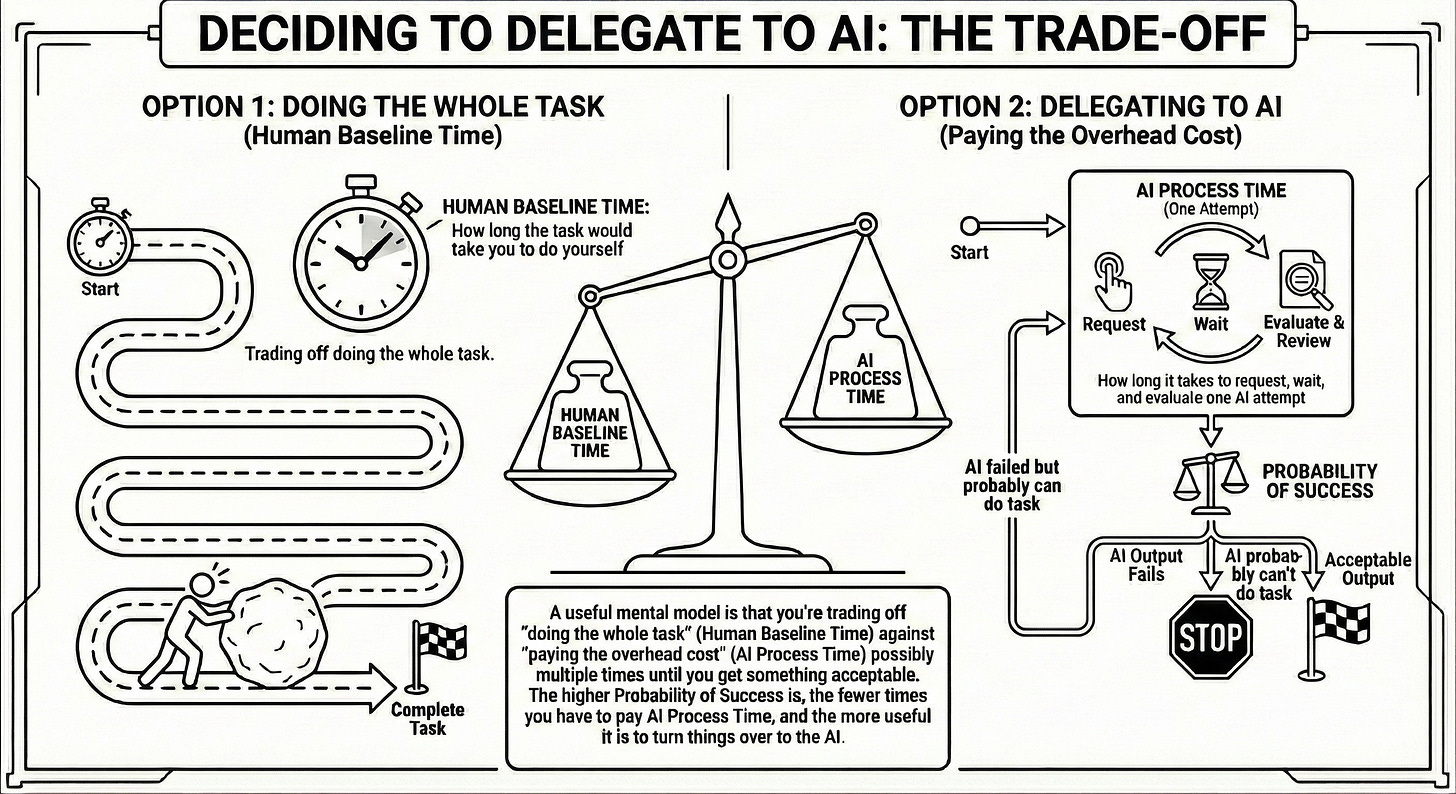
A useful mental model is that you’re trading off “doing the whole task” (Human Baseline Time) against “paying the overhead cost” (AI Process Time), possibly multiple times until you get something acceptable. The higher Probability of Success is, the fewer times you have to pay AI Process Time, and the more useful it is to turn things over to the AI. For example, consider a task that takes you an hour to do, but the AI can do it in minutes, though checking the answer takes thirty minutes. In that case, you should only give the work to the AI if Probability of Success is very high, otherwise you’ll spend more time generating and checking drafts than just doing it yourself. If the Human Baseline Time is 10 hours, though, it could be worth several hours of working with the AI, assuming that the AI can be made to do a competent job.
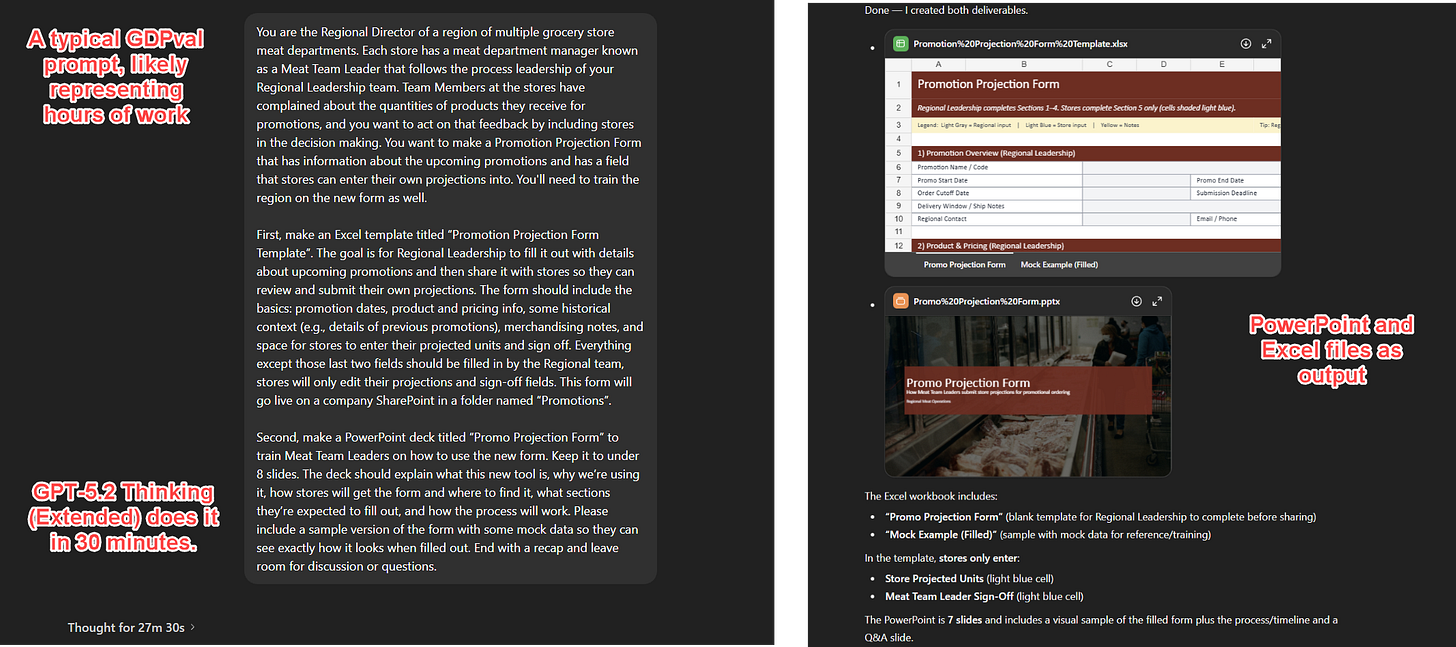
An example of a many hour Human Baseline Time prompt, with an initial AI Process Time of 30 minutes (when you can be doing something else) plus the time to check and write the prompt. If you have to make a lot of corrections, though, it isn’t worth it.
这三个因素意味着,决定是否把任务交给 AI 要看三个变量:
人工基准时间(Human Baseline Time):你自己做这件事需要多长时间 成功率(Probability of Success):AI 在单次尝试中产出达到你标准的答案的可能性 AI 过程时间(AI Process Time):从发起请求、等待结果到评估 AI 输出,总共要花多长时间
一个有用的思维模型是:你是在拿“把整件事做完”(人工基准时间)和“支付管理开销”(AI 过程时间)做交换,而且可能要交换多次,直到得到可接受的结果。成功率越高,需要支付 AI 过程时间的次数就越少,把任务交给 AI 就越划算。举例来说,假设一件事你自己做要一小时,AI 几分钟就能完成,但检查答案要花三十分钟。这种情况下,只有当成功率非常高时,才适合把它交给 AI;否则你花在生成和检查草稿上的时间,会超过自己动手做完。但如果人工基准时间是十小时,那花上几小时和 AI 协作也是值得的,前提是能让它交出合格的工作。
这是一个“人工基准时间长达数小时”的提示词示例:初始 AI 过程时间约 30 分钟(期间你可以去做别的事),还要加上检查和撰写提示词的时间。不过,如果需要反复大改,那就不划算了。
We know this equation works because this past summer, OpenAI released one of the more important papers on AI and real work, GDPval. I have discussed it before, but the key was that it pitted experienced human experts in diverse fields from finance to medicine to government against the latest AIs, with another set of experts working as judges. It took experts seven hours on average to do the work, so, in this case, that is the Human Baseline Time. The AI Process Time was interesting: the AI took only minutes for tasks, but it required an hour for experts to actually check the work, and, of course, prompts take time to write as well. As for Probability of Success, when GDPval first came out, judges gave human work the win the majority of the time, but, with the release of GPT-5.2, the balance shifted. GPT-5.2 Thinking and Pro models tied or beat human experts an average of 72% of the time.
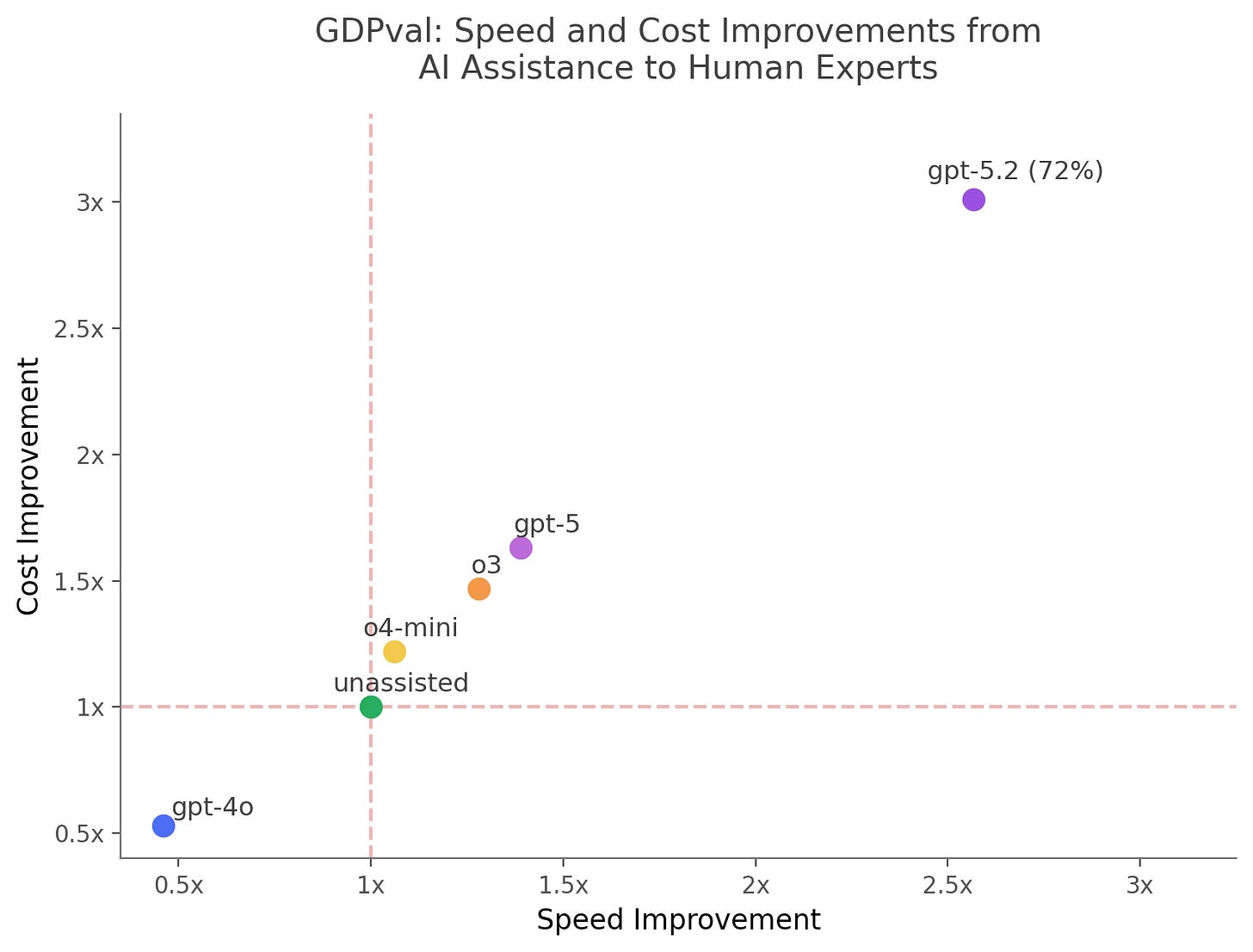
Speed and cost improvements from AI-assisted work on GDPval tasks under a “draft → review → retry if needed” workflow (relative to unaided experts at 1×, 1×). The GPT‑5.2 point is a projection using its ~72% win-or-tie rate on GDPval; other model points are from the GDPval paper. Real‑world outcomes will vary sharply by task: some tasks are “easy wins,” some are clear failures, and the hardest cases are plausible‑looking failures.
我们知道这个等式成立,是因为今年夏天 OpenAI 发布了一份关于 AI 与真实工作的重要论文:GDPval。我之前聊过它,关键设计是让来自金融、医疗、政府等多个领域的资深人类专家与最新 AI 对战,再由另一组专家担任裁判。专家平均要花七小时完成这些工作——所以在这里,Human Baseline Time 就是七小时。AI 过程时间则很有趣:AI 执行任务只花几分钟,但专家真正检查结果需要一个钟头,写提示词当然也要时间。至于成功率:GDPval 刚发布时,裁判多数时候判定人类胜出;而随着 GPT-5.2 发布,天平发生了变化。GPT-5.2 Thinking 和 Pro 模型平均有 72% 的概率与人类专家打平或胜出。
在“草稿→检查→必要时重试”的工作流下,AI 辅助执行 GDPval 任务带来的速度与成本改善(相对于不借助 AI 的专家为 1×、1×)。GPT-5.2 的点是基于它在 GDPval 上约 72% 的胜/平率所作的预测;其他模型点来自 GDPval 论文。现实结果会因任务而大不相同:有些任务是“轻松得分”,有些是明显失败,最难的案例则是看起来貌似合理的失败。
We can now calculate how many hours you would save on a seven-hour task, assuming that 72% probability of success and an hour of evaluation. If you tried every task by taking the time to prompt the AI, evaluating the answer for an hour, and then doing it yourself if the AI answer was bad, you would save 3 hours on average. Tasks the AI failed on would take longer (you wasted time prompting and reviewing!) but tasks the AI succeeded on would be much faster. But we can change the equation even more in our favor using techniques from management!
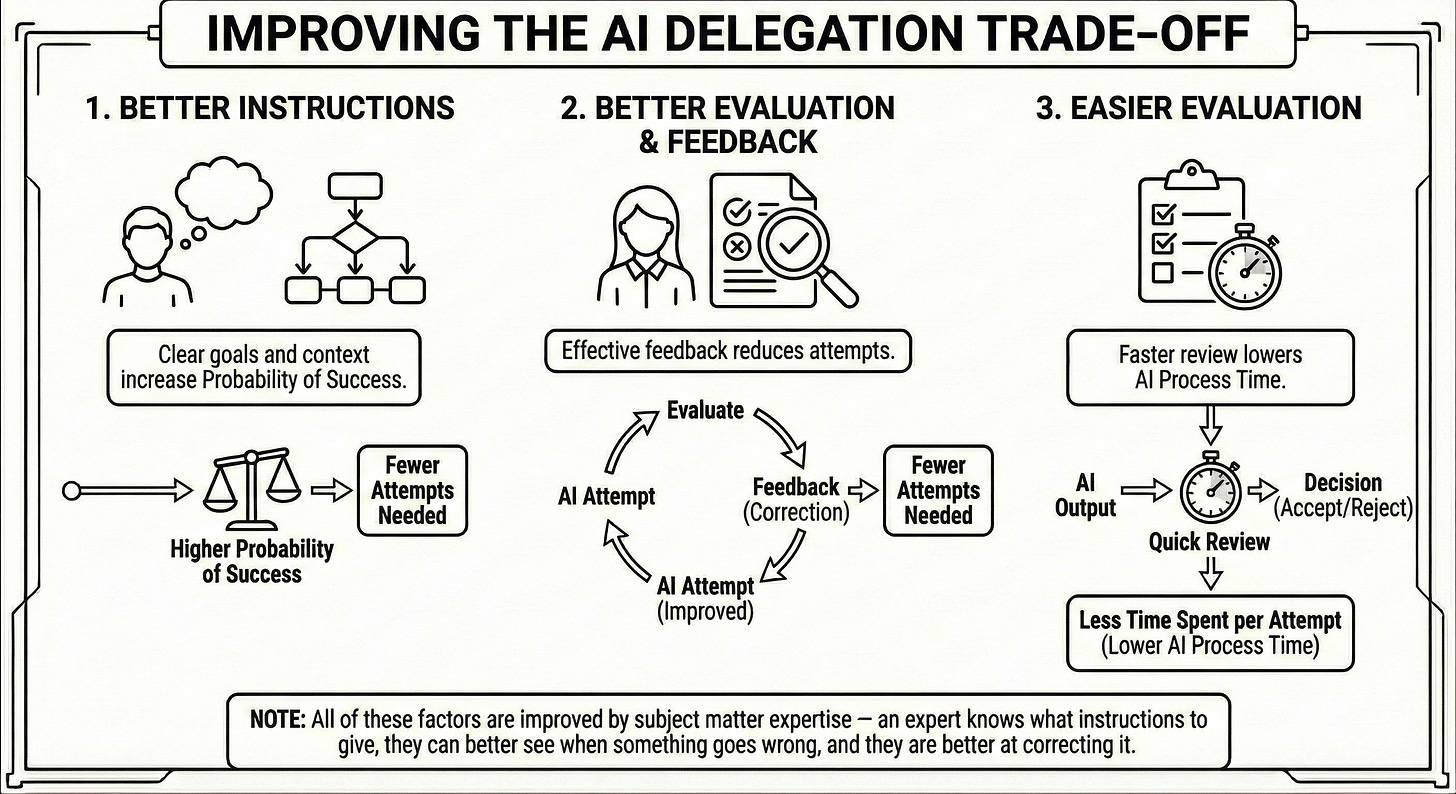
There are three things we can do to make delegating to AI more worthwhile by increasing the Probability of Success and lowering AI Process Time. We can give better instructions, setting clear goals that the AI can execute on with a higher chance of succeeding. We can get better at evaluation and feedback, so we need to make fewer attempts to get the AI to do the right thing. And we can make it easier to evaluate whether the AI is good or bad at a task without spending as much time. All of these factors are improved by subject matter expertise — an expert knows what instructions to give, they can better see when something goes wrong, and they are better at correcting it.
现在我们可以算算:在 72% 成功率、一小时评估时间的假设下,完成一个七小时任务能省多少时间。如果每个任务都先花时间给 AI 写提示词、花一小时评估答案,AI 不行再自己重做,平均每个任务能省三小时。AI 没做对的任务会花更长时间(提示词和审查的时间都浪费了),但 AI 做对的任务会快得多。不过,我们还可以利用管理技巧,让等式进一步朝有利方向倾斜。
有三件事能让“委派给 AI”更划算:提高成功率,同时降低 AI 过程时间。一是给更好的指示,设定清晰的目标,让 AI 执行时有更高概率成功;二是提高自己的评估和反馈能力,这样不用反复尝试就能让 AI 走对方向;三是让“判断 AI 是否胜任某项任务”这件事本身不要耗费那么多时间。所有这些都会因领域专长而增强——专家知道该给什么指示、更容易看出哪里出了问题,也更擅长修正。
If you don’t need something specific, AI models have become incredibly capable of figuring out how to solve problems themselves. For example, I found Claude Code was able to generate an entire 1980s style adventure game with one prompt to "create an entirely original old-school Sierra style adventure game with EGA-like graphics. You should use your image agent to generate images and give me a parser. Make all puzzles interesting and solvable. Finish the game (it should take 10-15 minutes to play), don’t ask any questions. make it amazing and delightful." That’s it, the AI made everything, including the art. With two final prompts it tested the game and deployed it. You can play it yourself: enchanted-lighthouse-game.netlify.app
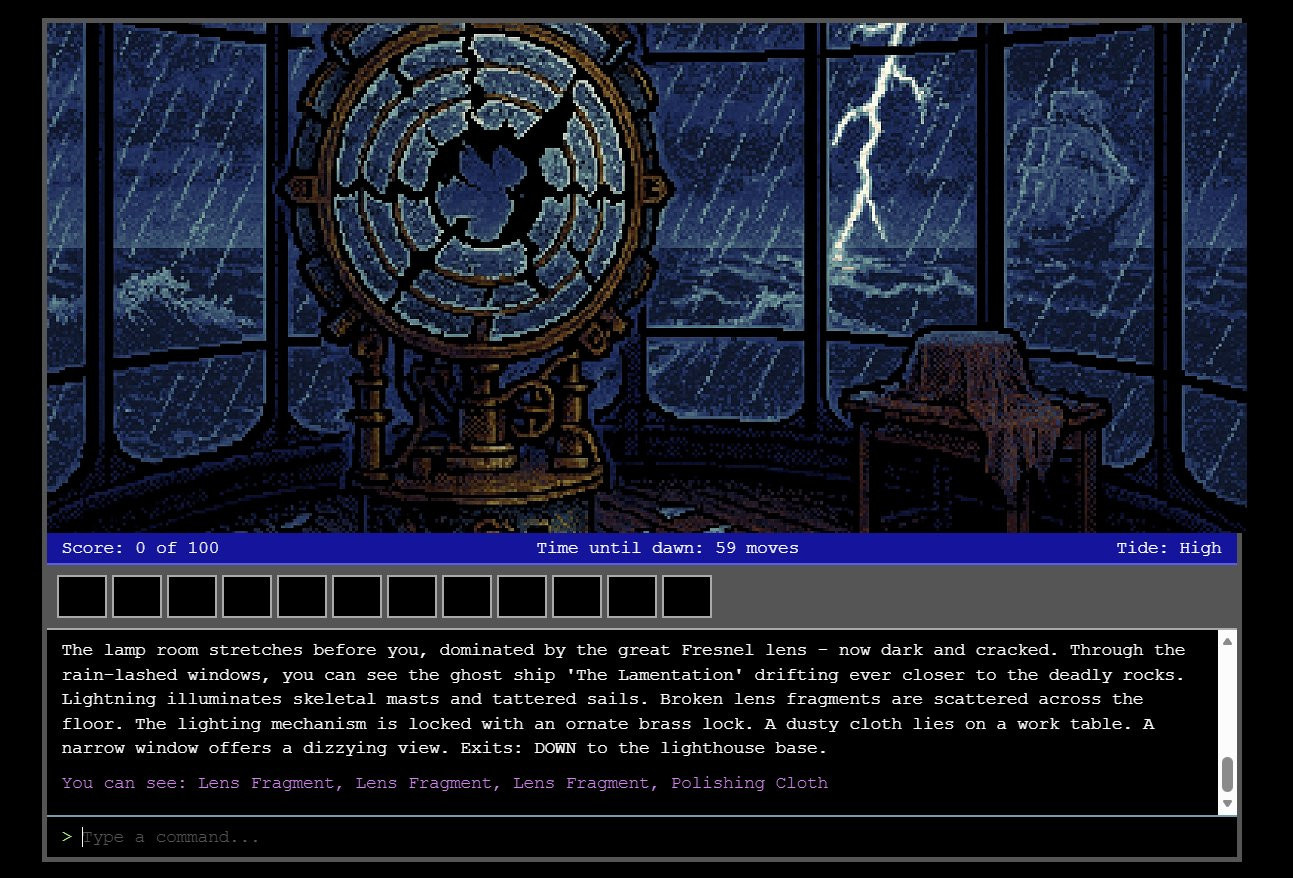
This is genuinely amazing, but that amazement is amplified because I didn’t need anything specific, just an adventure game that the AI was free to improvise. But real work, and real delegation, means that you have a specific output in mind, and that is where things can get tricky. How do you communicate your intention to the AI to execute on what you want, so it can use “judgement” to solve problems while still giving you the output you desire?
如果你并不需要某个特定成果,AI 模型已经非常擅长自行判断并解决问题。例如,我发现 Claude Code 可以凭一句提示就生成一整套 1980 年代风格的冒险游戏。这句提示是:“创作一款全新的老派 Sierra 风格冒险游戏,采用 EGA 风格画面;用你的图像代理生成图片,并给我一个解析器;让所有谜题都有趣且可解;把游戏做完(游戏时长应为 10–15 分钟);不要问任何问题;让它惊艳而讨喜。”就这样,AI 完成了所有东西,包括美术。之后我只用了两条最终提示,它就自己测试并部署了游戏。你可以亲自试玩:enchanted-lighthouse-game.netlify.app
这确实令人惊叹,但这种惊叹感之所以被放大,是因为我并没有要任何特定内容,只是一款可以让 AI 自由发挥的冒险游戏。真实的工作和真实委派则意味着,你心里有一个明确的产出,而这正是容易卡住的地方:你如何把自己的意图转达给 AI,让它带着“判断力”去解决问题,同时仍交出你想要的成果?
This problem existed long before AI and is so universal that every field has invented their own paperwork to solve it. Software developers write Product Requirements Documents. Film directors hand off shot lists. Architects create design intent documents. The Marines use Five Paragraph Orders (situation, mission, execution, administration, command). Consultants scope engagements with detailed deliverable specs. All of these documents work remarkably well as AI prompts for this new world of agentic work (and the AI can handle many pages of instructions at a time). The reason you can use so many formats to instruct AI is that all of these are really the same thing: attempts to get what’s in one person’s head into someone else’s actions.
这个问题早在 AI 出现之前就存在,而且普遍到每个行业都发明了自己的文书来解决。软件开发者写产品需求文档(PRD);电影导演交分镜表;建筑师创建设计意向文件;美国海军陆战队使用五段式命令(态势、任务、执行、后勤、指挥);咨询公司用详细的交付物规格界定项目范围。这些文档用作新时代智能体工作的 AI 提示词效果出奇地好(AI 一次能处理很多页指示)。你之所以能用这么多格式给 AI 下指令,是因为它们本质上都是同一件事:把一个人脑子里的想法,变成另一个人的行动。
When you look at what actually goes into good delegation documentation, it’s remarkably consistent: What are we trying to accomplish, and why? Where are the limits of the delegated authority? What does “done” look like? What specific outputs do I need? What interim outputs do I need to follow your progress? And what should you check before telling me you’re finished? If these are well-specified, the AI, like humans, is far more likely to do a good job.
仔细看一份好的委派文档,内容其实惊人地一致:我们要完成什么,为什么?被委派的权限边界在哪里?“做完”长什么样?我需要哪些具体产出?需要哪些阶段性产出以便我跟进进度?在你告诉我“完成”之前,应该检查哪些事项?如果这些都定义清楚,AI 和人类一样,更有可能把工作做好。
And in figuring out how to give these instructions to the AI, it turns out you are basically reinventing management.
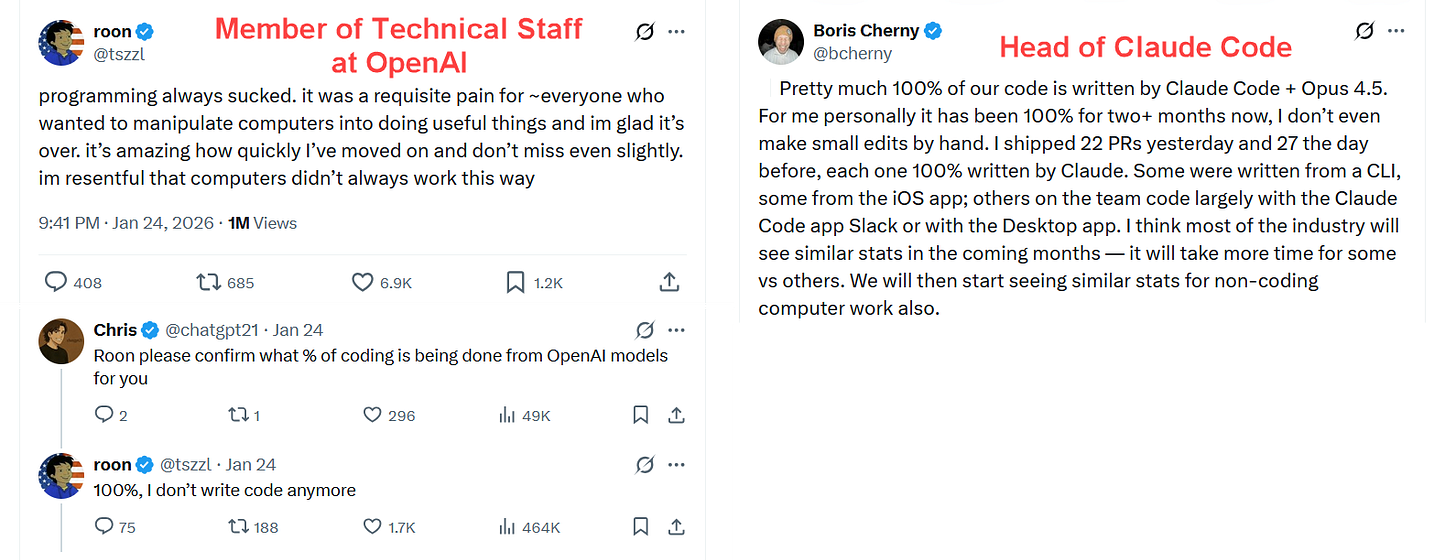
I find it interesting to watch as some of the most well-known software developers at the major AI labs note how their jobs are changing from mostly programming to mostly management of AI agents. Coding has always had a very organized structure, with clearly verifiable outputs (the code either works or it doesn’t) so it has been one of the first areas where AI tools have matured, and thus the first profession to feel this change. It isn’t the last.
而且,在琢磨如何给 AI 下达这些指示的过程中,你其实是在重新发明管理。
我饶有兴趣地看到,一些大型 AI 实验室最有名的软件开发者都表示,他们的工作正在从以编程为主转向以管理 AI 智能体为主。编程一直是一种结构非常清晰的工作,产出可以明确验证(代码要么能跑,要么不能跑),所以它成为 AI 工具最早成熟的领域之一,也因此成为最先感受到这种变化的职业。但它不会是最后一个。
As a business school professor, I think many people have the skills they need, or can learn them, in order to work with AI agents - they are management 101 skills. If you can explain what you need, give effective feedback, and design ways of evaluating work, you are going to be able to work with agents. In many ways, at least in your area of expertise, it is much easier than trying to design clever prompts to help you get work done, as it is more like working with people. At the same time, management has always assumed scarcity: you delegate because you can’t do everything yourself, and because talent is limited and expensive. AI changes the equation. Now the “talent” is abundant and cheap. What’s scarce is knowing what to ask for.
This is why my students did so well. They weren’t AI experts. But they’d spent years learning how to scope problems in their fields of expertise, define deliverables, and recognize when a financial model or medical report was off. They had hard-earned frameworks from classes and jobs, and those frameworks became their prompts. The skills that are so often dismissed as “soft” turned out to be the hard ones.
I don’t know exactly what work looks like when everyone is a manager with an army of tireless agents. But I suspect the people who thrive will be the ones who know what good looks like — and can explain it clearly enough that even an AI can deliver it. My students figured this out in four days. Not because they were AI natives, but because they already knew how to manage. All that training, it turns out, was accidentally preparing them for exactly this moment.
作为商学院教授,我认为许多人与 AI 智能体协作所需的技能已经具备,或者可以学会——它们就是管理学 101。只要你能说明自己需要什么、给出有效反馈,并设计出评估工作质量的方法,你就能和智能体协作。在很多方面,至少在你的专业领域内,这比设计精巧的提示词更省力,因为更像是在与人打交道。同时,管理学一直建立在稀缺的假设上:你之所以委派,是因为你无法事必躬亲,也因为人才有限且昂贵。AI 改变了这个等式。如今,“人才”变得充裕又廉价;稀缺的是知道该要什么。
这正是我的学生们表现出色的原因。他们不是 AI 专家,但花了多年时间学习如何在各自领域界定问题、定义交付物,并判断一份财务模型或医疗报告哪里不对。他们从课堂和工作中学来的、来之不易的框架,变成了他们的提示词。那些常被贬为“软技能”的本领,到头来才是最硬的本事。
我不知道,当每个人都成为管理者、麾下有一支不知疲倦的智能体大军时,工作会变成什么样。但我猜想,能活得很好的人,将是那些知道“好”是什么样子,并且能把它讲得足够清楚、连 AI 都能交付的人。我的学生在四天内悟出了这一点。不是因为他们是什么 AI 原住民,而是因为他们早就懂得如何管理。事实证明,他们过往的一切训练,都是在为这一刻悄然做准备。